Koala: the Australian marsupial that sleeps 20 hours a day
Discover the koala (Phascolarctos cinereus), the arboreal marsupial from Australia that feeds on eucalyptus and sleeps up to 20 hours. Facts, habitat and conservation status.
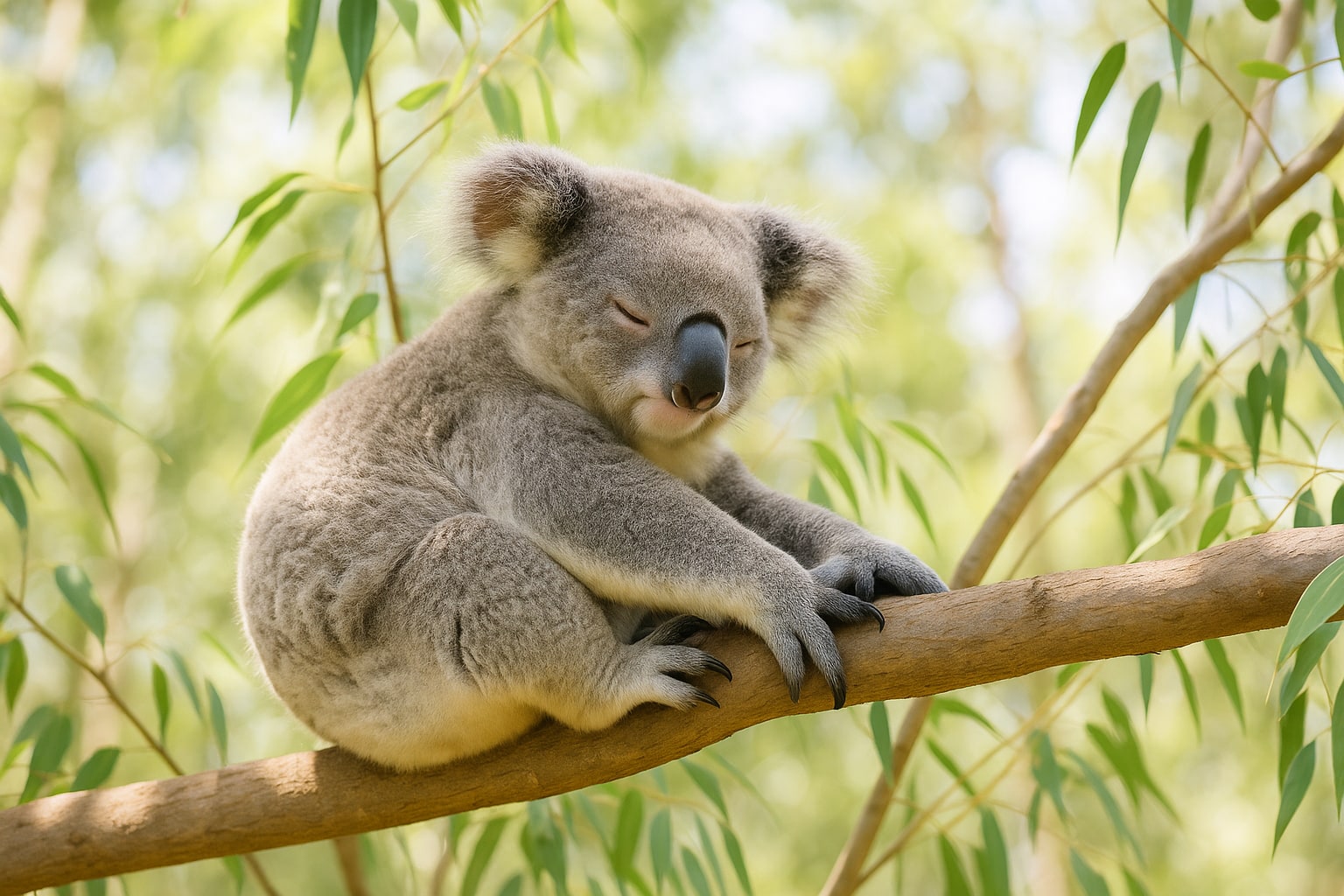
Few animals are as quickly associated with Australia as the koala (Phascolarctos cinereus). You will see it in documentaries hugging a eucalyptus branch, seemingly asleep, and that image is no coincidence: it spends most of the day resting. But behind that peaceful image is a marsupial with a peculiar biology, a demanding diet and a conservation situation that has worsened over the last decade.
In 2022, the Australian Government reclassified the populations in Queensland, New South Wales and the Australian Capital Territory as endangered at the national level. The IUCN lists it as Vulnerable (VU). We are talking about an iconic animal, yes, but also one with serious problems.
Koala quick facts
| Data | Value |
|---|---|
| Scientific name | Phascolarctos cinereus |
| Group | Arboreal marsupial (not a bear) |
| Size | 60-85 cm |
| Weight | 4-15 kg depending on sex and region |
| Lifespan | 10-12 years in the wild; up to 18 in captivity |
| Diet | Eucalyptus leaves (≈ 500-1,000 g/day) |
| Hours of sleep | Up to 18-20 h per day |
| IUCN status | Vulnerable (VU) |
Identification: not a bear, a marsupial
The koala is not a bear, although for years it was called that. It is a marsupial, a distant relative of the wombat, with which it shares a family (Vombatiformes).
It measures between 60 and 85 cm in length and weighs 4 to 15 kg. Southern males are sturdier, with denser and darker fur; northern ones, in Queensland, are smaller and light grey in tone. It has rounded, furry ears, a large black nose, and hands with two opposable thumbs that allow it to grip branches firmly. Curiously, its fingerprints are almost indistinguishable from human ones under a microscope.
It lives between 10 and 12 years in the wild. In captivity it can reach 18.
Habitat and distribution: only in Australia
The koala is endemic to eastern and southeastern Australia. You will find it in Queensland, New South Wales, Victoria and southern South Australia. It inhabits open eucalyptus forests (open eucalypt forests), both in coastal and inland areas.
It is strictly arboreal: it comes down to the ground only to change trees. And even then, those ground-level journeys are the ones that pose the greatest risk from cars and dogs.
Feeding: a diet toxic to almost any other mammal
The koala eats eucalyptus leaves, and little else. There are more than 700 species of Eucalyptus in Australia, but the koala only consumes about 30, and usually prefers between 5 and 10 depending on the region.
Eucalyptus leaves are tough, poor in nutrients and loaded with toxic essential oils for most mammals. The koala digests them thanks to a very developed caecum (it can measure more than 2 metres) where a specialised bacterial flora breaks down those compounds.
- It consumes between 500 g and 1 kg of leaves per day.
- It hardly drinks water: it obtains it from the foliage. In fact, “koala” is said to mean “no drink” in some Aboriginal languages.
- It chews the leaves until they become a fine paste to facilitate fermentation.
Behaviour: why it sleeps so much
This diet explains one of its best-known characteristics: it sleeps between 18 and 20 hours a day. It is not laziness. It is a metabolic strategy.
Eucalyptus leaves provide very little energy, and neutralising their toxins consumes resources. The koala compensates by minimising its activity. It moves, feeds for about 4-5 hours (usually at dusk and at night) and returns to rest wedged in the fork of a branch.
It is solitary and territorial. Males mark trees with a chest gland and emit deep bellows surprisingly powerful for their size, studied by biologist Benjamin Charlton (2013, Current Biology), who found that they produce sounds at frequencies 20 times lower than expected from their anatomy.
The female has a single young every 1-2 years. The newborn, the size of a bean, crawls into the marsupial pouch, where it stays for about 6 months. Afterwards it rides on its mother’s back until about one year of age.
Conservation status: why it is in danger
The IUCN has listed the koala as Vulnerable (VU) since 2016. In 2022, Australia raised the status of the eastern populations to Endangered.
The threats accumulate:
- Habitat loss due to logging, agriculture and urban expansion.
- Wildfires. The 2019-2020 fires (“Black Summer”) affected tens of thousands of koalas, according to estimates from WWF Australia.
- Chlamydia: a very widespread bacterial infection that causes blindness, infertility and death.
- Road deaths and dog attacks from domestic dogs.
- Climate change: heatwaves and droughts reduce the nutritional quality of the leaves.
Organisations such as the Australian Koala Foundation and the state programme NSW Koala Strategy work on reforestation, ecological corridors and experimental vaccines against chlamydia. If you are interested in how other species face similar threats, you can read our profile of the golden eagle.
Verifiable curiosities
- It has fingerprints almost identical to those of humans, confirmed by anatomist Maciej Henneberg (University of Adelaide).
- It cannot be a pet. It is strictly protected by Australian law (Environment Protection and Biodiversity Conservation Act 1999). No private individual may keep one outside authorised centres.
- Its brain is small in proportion to its skull, with space filled by cerebrospinal fluid. It has been interpreted as an adaptation to a diet very poor in energy.
- It is born the size of a gummy sweet, about 2 cm and less than 1 gram.
Frequently asked questions
How many hours does a koala sleep per day?
Between 18 and 20 hours. It is a direct response to its diet: eucalyptus leaves are poor in energy and require long digestion times.
Why does the koala only eat eucalyptus?
Because its digestive system has evolved to process its toxins. Few mammals can do this, which gives it access to a resource with little competition.
Can you keep a koala as a pet?
No. It is illegal in Australia and there is no legal international trade. Only zoos and accredited rescue centres may keep them.
Is it really a bear?
No. It is a marsupial. Its closest relative is the wombat.
How many koalas are left?
Estimates vary greatly depending on the source. The Australian Koala Foundation spoke in 2022 of fewer than 100,000 wild individuals, although other organisations cite higher figures. The population trend, in any case, is downward.