Red fox: the most widespread wild mammal in the world
Discover the red fox (Vulpes vulpes), the wild carnivore with the widest distribution on the planet: habitat, diet, behaviour and conservation status according to the IUCN.
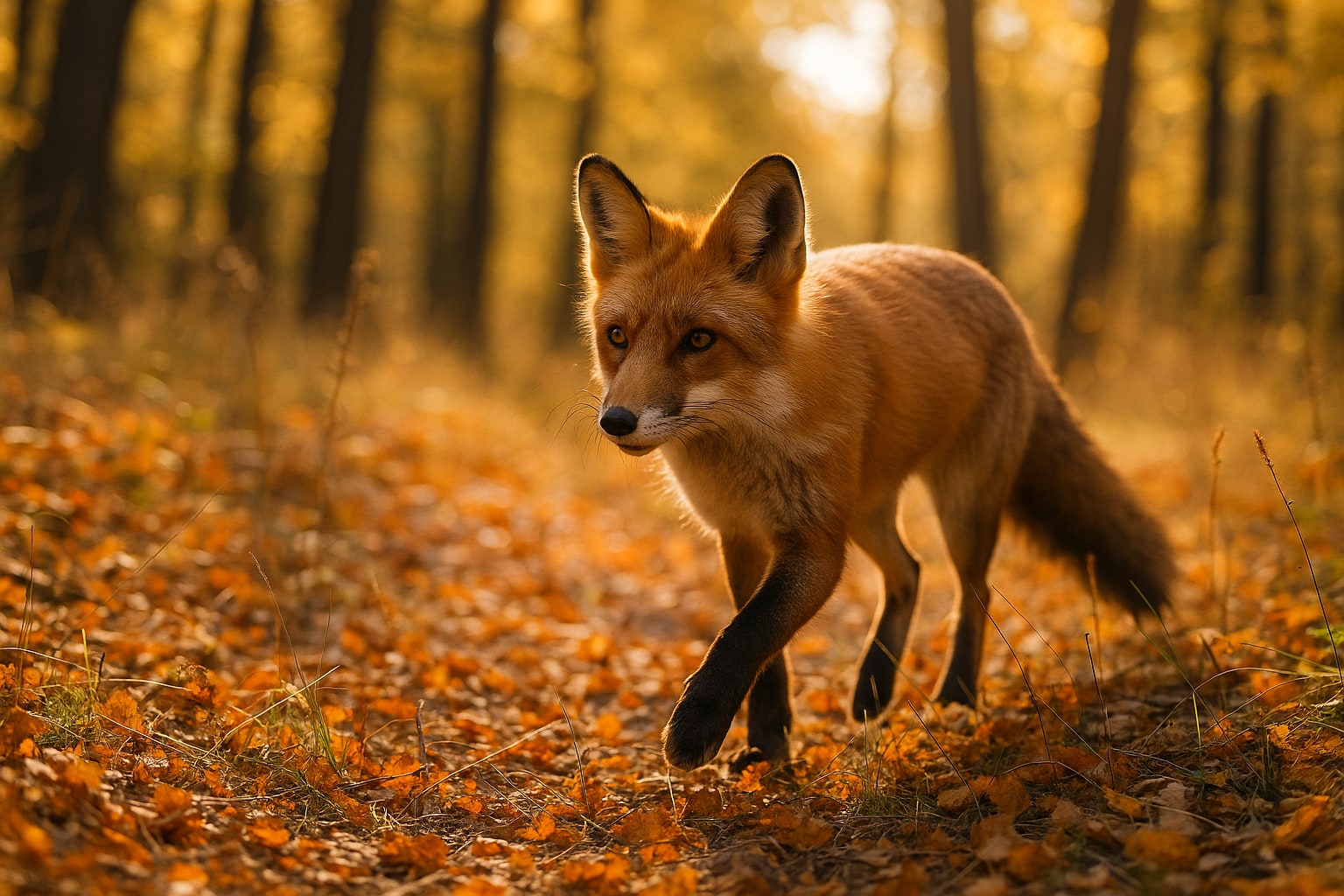
Few species have adapted as well to the human world as the red fox (Vulpes vulpes). You can spot it crossing a Scandinavian forest, rummaging through a bin in London or running across a desert dune in Arabia. Its ability to live in extreme climates and in cities has made it the wild carnivore with the widest geographical distribution on the planet.
And that is no small detail. The International Union for Conservation of Nature (IUCN) classifies it as Least Concern (LC) precisely because it occupies around 70 million km² spread across almost the entire Northern Hemisphere, as well as Australia, where it was introduced in the 19th century.
Red fox quick facts
| Detail | Value |
|---|---|
| Scientific name | Vulpes vulpes |
| Family | Canids (Canidae) |
| Size (body) | 45-90 cm + tail of 30-55 cm |
| Weight | 3-14 kg (depending on subspecies and sex) |
| Lifespan | 2-4 years in the wild; up to 14 in captivity |
| Distribution | Northern Hemisphere + Australia |
| IUCN status | Least Concern (LC) |
| Recognised subspecies | More than 45 |
Identification: how to recognise the red fox
The red fox is a medium-sized canid, more slender than a domestic dog and with an unmistakable silhouette. Its coat is usually reddish-orange on the back, white on the belly and throat, and black on the back of the ears and on the legs. The tail, long and very bushy, almost always ends in a characteristic white tip.
There are colour variants: the silver fox, the cross fox and the common fox. All belong to the same species. Males are usually somewhat larger than females, with weights ranging from 5 to 14 kg in northern subspecies and only 3-5 kg in populations from warm regions.
A curious feature: its pupils are vertical, more like those of a cat than a dog. It is an adaptation to crepuscular hunting.
Habitat and distribution: the record of a carnivore
This is where the red fox truly shines. No other wild carnivore species occupies so many different ecosystems. It is present across all of Europe, much of Asia, North America down to Mexico, the north of Africa, and was introduced to Australia in 1855 for hunting purposes, where it is now considered an invasive species.
It lives in:
- Temperate and boreal forests.
- Arctic tundra (some subspecies reach the Arctic Circle).
- Semi-arid zones and desert edges.
- Agricultural and peri-urban areas.
- Large cities: London, Berlin, Zurich or Madrid have stable populations.
Its individual territory varies enormously. In the countryside it can cover 500-2,000 hectares; in a dense European city, barely 30-50 hectares.
Red fox diet: opportunistic by definition
Its diet largely explains its success. The red fox is an opportunistic carnivore with an omnivorous tendency. It eats whatever is available in each season and each area.
Its usual menu includes:
- Small mammals: mice, voles and field voles (the base of its diet in Europe).
- Rabbits and hares in Mediterranean areas.
- Birds and eggs when it can.
- Insects, earthworms and amphibians.
- Fruit in summer and autumn: blackberries, wild cherries, grapes.
- Carrion and urban waste in populations close to humans.
An adult needs about 500 grams of food per day. It usually stores surplus by burying it, a behaviour that has also been studied in domestic dogs and that we discuss when analysing why dogs bury their toys and bones.
Behaviour and reproduction
The red fox is mainly crepuscular and nocturnal, although in areas without human pressure it may hunt by day. It has an extraordinary sense of hearing: it can detect the squeak of a vole beneath snow more than a metre deep. Hence that characteristic vertical leap, the “mousing jump”, with which it pounces on its prey.
It lives in small family groups. The breeding pair is usually monogamous during the breeding season, normally between December and February. The female gives birth to 4 to 6 cubs after about 52 days of gestation, in a den dug out or reused from another animal. The young leave the den at 4-5 weeks and are independent by around six months.
Its vocal repertoire is wide: short barks, yelps, growls and that sharp, almost human-like scream heard on winter nights.
Conservation status and conflicts with humans
The IUCN classifies it as LC (Least Concern). Its populations are stable or increasing across most of its range. In Spain, it is a game species with a hunting season regulated by each autonomous community.
The main challenges are not of conservation but of management:
- Road deaths on roads (one of the main causes of mortality).
- Sarcoptic mange, which can decimate local populations.
- Its role as a reservoir of rabies in some regions (central Europe eradicated the disease through oral vaccination since the 1990s).
- Conflict with poultry farming and with hunting management.
In Australia, by contrast, it is classified as an invasive species due to its impact on native fauna, and active control programmes are in place.
Verifiable curiosities
- A study published in Biology Letters (Červený et al., 2011) suggests that the red fox orients itself using the Earth’s magnetic field when pouncing on its prey: it succeeds more often when it jumps towards the northeast.
- It can run at 50 km/h over short distances.
- Its vibrissae (whiskers) are also present on its forelegs, something uncommon among terrestrial carnivores.
- The famous silver fox experiment by Dmitri Belyaev, begun in Siberia in 1959, showed how selection for tameness produced physical changes (drooping ears, white patches) within just a few generations.
Frequently asked questions
Is the red fox dangerous to people? Not under normal circumstances. It avoids human contact. Attacks are extremely rare and usually involve sick animals or animals habituated to being fed. You should never give it food.
Can you keep a fox as a pet in Spain? No. The Vulpes vulpes is native wild fauna and keeping it as a companion animal is not permitted. It is also inadvisable, both ethically and biologically: it is a wild animal with needs incompatible with domestic life.
How long does a red fox live? In the wild, the average is 2 to 4 years, strongly affected by road deaths and disease. In captivity it can reach 12-14 years.
Does it attack domestic cats? Very rarely. Camera trap studies in the United Kingdom show that foxes and cats usually ignore each other or keep their distance. A healthy adult cat is not a usual prey.
Why are there so many foxes in cities? Because they find abundant food (waste, rodents), shelter in parks and gardens, and fewer predators. London has an estimated urban population of more than 10,000 individuals according to studies by the Mammal Society.