Common octopus: the most intelligent invertebrate in the ocean
Discover why the common octopus (Octopus vulgaris) fascinates science: three hearts, 500 million neurons, and an intelligence that challenges what we know about invertebrates.
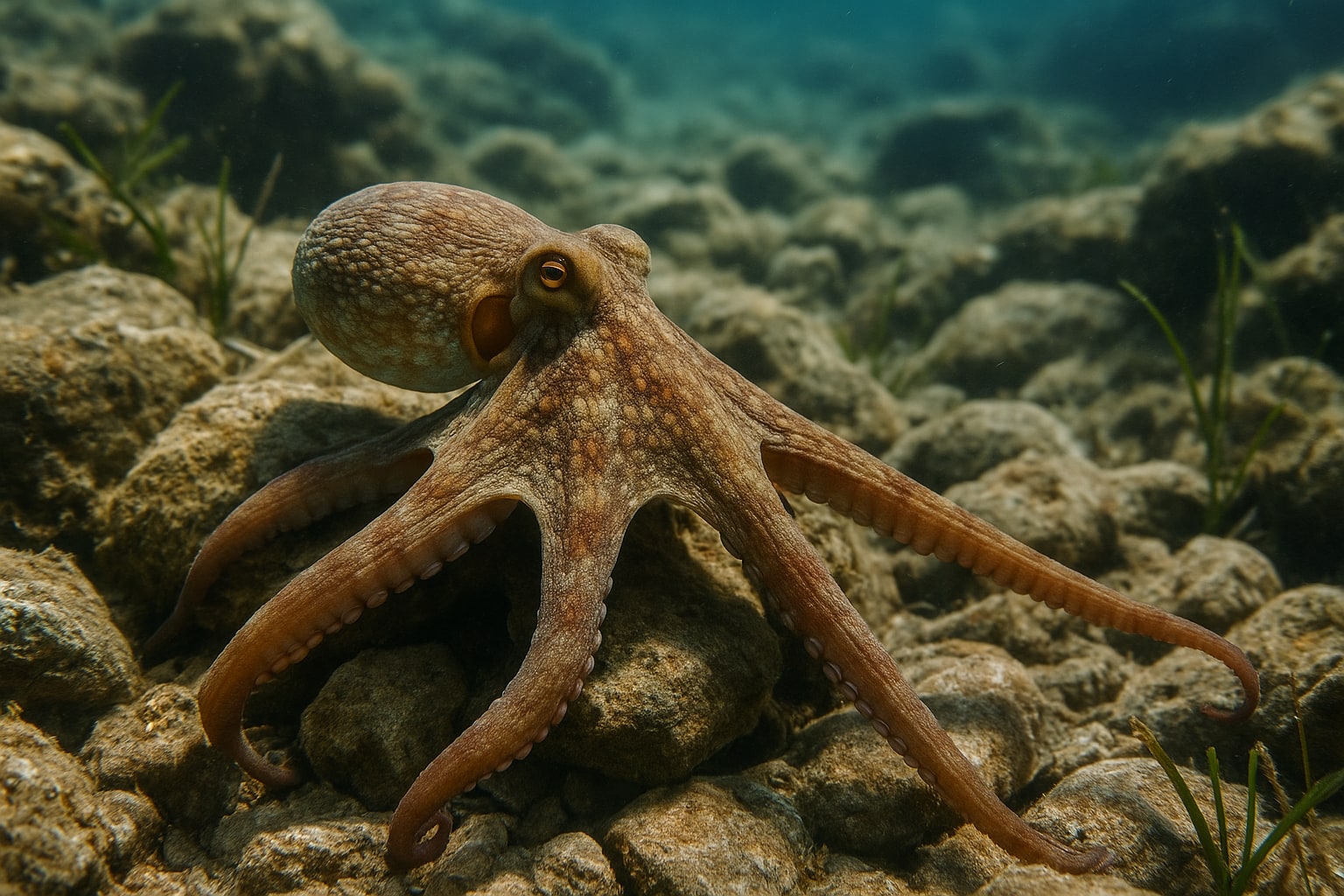
Few animals have changed our idea of intelligence as much as the common octopus (Octopus vulgaris). This cephalopod solves mazes, opens screw-top jars, and carries shells to use as shelter. And it does so with a soft body, eight arms, and a nervous system distributed in a way no vertebrate shares.
It lives in temperate waters across the planet and, despite being a heavily fished species, it remains one of the great protagonists of marine behavioral biology. Here we tell you what makes it special, without exaggerations and with the data at hand.
Identification: what the common octopus looks like
The common octopus is a cephalopod mollusc of the family Octopodidae. Adults measure between 60 and 100 cm including the arms and weigh from 3 to 10 kg, although specimens of up to 15 kg have been recorded in the eastern Atlantic.
Its body has a rounded mantle, eight arms with two rows of suckers, and a central mouth with a horny beak resembling that of a parrot. It can change color and texture in less than a second thanks to chromatophores, pigment cells directly controlled by the nervous system.
Its life expectancy is short: between 12 and 18 months in the wild. It dies shortly after reproducing.
Habitat and distribution
It inhabits rocky bottoms and Posidonia seagrass meadows of the eastern Atlantic, the Mediterranean and, according to recent taxonomic reviews, very closely related populations in other temperate areas. It prefers waters between 10 and 100 meters deep, with temperatures of 15 to 22 °C.
It is a benthic and solitary animal. It occupies crevices, caves, and holes that it defends from other octopuses and decorates with shells and stones: the classic octopus “den” that Mediterranean fishermen know well.
Feeding and behavior
Its diet is based on crustaceans (crabs, prawns), bivalve molluscs and small fish. It hunts by ambush, wraps its prey with its arms and immobilizes it with a toxic saliva secreted from the salivary glands. With its beak it bores through even hard shells.
It is crepuscular and shows an unusual learning capacity for invertebrates: it remembers solutions to problems, recognizes specific human individuals in controlled experiments, and modifies its behavior according to prior experience.
Reproduction
Males use a modified arm, the hectocotylus, to deposit spermatophores into the female’s mantle cavity. She lays between 100,000 and 500,000 eggs that she hangs in her den and guards without eating for 4-5 weeks. She dies shortly after the eggs hatch. The male does not survive much longer after mating.
A brain distributed across eight arms
Here lies the key to its fame. The common octopus has around 500 million neurons, a figure comparable to that of a small dog. But what is striking is their distribution: two thirds are in the arms, not in the central brain.
Each arm processes information semi-autonomously. It can explore, grasp, or reject an object without the central brain issuing the complete command. This is what neuroscientists call distributed intelligence.
Added to this is another anatomical oddity: it has three hearts. Two pump blood to the gills and one drives it to the rest of the body. Its blood is blue because it contains hemocyanin, a copper-based protein rather than iron, more efficient in cold waters with low oxygen.
Tool use and problem solving
The octopus is one of the few invertebrates with documented tool use. In 2009, researchers from the Museum Victoria (Australia) published in Current Biology the case of coconut octopuses (Amphioctopus marginatus) carrying half-shells to assemble a portable shelter. In the common octopus, similar behaviors with bivalve shells have been described.
In the laboratory it opens screw-top jars, escapes from aquariums through narrow channels, and learns by observing other octopuses. Its visual system, with camera-type eyes similar to those of vertebrates, complements this cognitive ability.
Conservation status
The IUCN classifies the common octopus as Least Concern (LC), although it warns of strong fishing pressure in the northeastern Atlantic and the Mediterranean. It is not listed in CITES.
In 2023, the proposal for the first industrial octopus farm in the Canary Islands generated an intense ethical and scientific debate, with positions against it from scientific societies due to the difficulty of guaranteeing the welfare of an animal with such neurological complexity. In 2021, the United Kingdom legally recognized cephalopods as sentient beings.
If you are interested in other ocean protagonists, you might enjoy reading about the great white shark and the myths surrounding it or about the blue whale, the largest animal on Earth.
Verifiable curiosities
- Skin that “sees” light: studies from the University of California Santa Barbara (Ramirez and Oakley, 2015, Journal of Experimental Biology) showed that octopus skin contains opsins, light-sensitive proteins.
- Color change while colorblind: it does not distinguish colors with its eyes, yet it imitates the background to perfection. Researchers are investigating whether skin-based light detection plays a role.
- Ink jet: it expels melanin to confuse predators and block their sense of smell for a few seconds.
- Jet propulsion: it expels water through its siphon to escape at speeds of up to 40 km/h over short distances.
FAQ
How many brains does an octopus have?
Technically one central brain plus nine large ganglia: a main one in the head and one in each arm. That is why it is popularly said to have “nine brains”.
Why is the octopus so intelligent?
Due to the combination of 500 million neurons, a decentralized nervous system, and a solitary life that forces it to solve problems without continuous social learning.
Where does the common octopus live?
On rocky bottoms of the eastern Atlantic and the Mediterranean, between 10 and 100 meters deep, where it finds crevices to shelter in.
How long does a common octopus live?
Between 12 and 18 months. It dies after reproducing only once in its life.
Does the octopus feel pain?
Neurological and behavioral evidence suggests that it does. That is why the United Kingdom and other countries recognize it as a sentient animal in their animal welfare legislation.