White shark: myths and realities of the great marine predator
Verified data on the white shark (Carcharodon carcharias): biology, real attacks, ecological role and conservation status according to the IUCN.
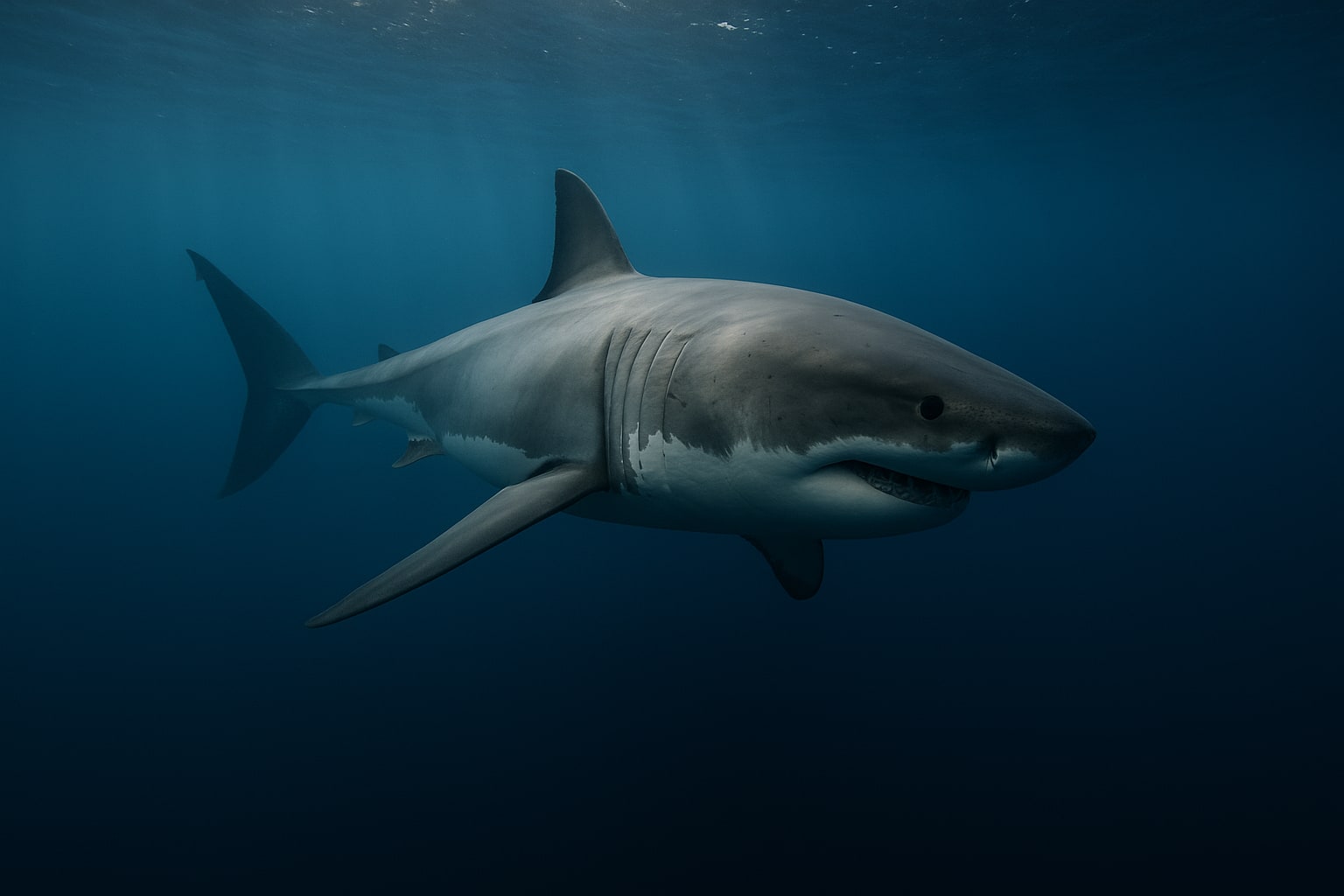
Few species carry as much cultural weight as the white shark (Carcharodon carcharias). Since the release of Jaws in 1975, its image has been fixed as that of a monster lurking for swimmers. The reality, backed by decades of research, is quite different: we are talking about an apex predator, long-lived, scarce and classified as Vulnerable (VU) by the IUCN.
In this article we separate what we know from evidence from what we have inherited from the movies.
Identification: what a white shark really looks like
The white shark is the largest active predatory fish on the planet. Adults usually measure between 4 and 6 metres, with females larger than males. The reliable documented record is around 6.1 metres, although inflated, unverified figures circulate.
Adults weigh between 680 and 1,900 kg. Its streamlined body, slate-grey dorsal surface and pure white belly provide countershading camouflage: seen from below it blends with the surface light; seen from above, with the dark background.
Other key features:
- Triangular, serrated teeth up to 7.5 cm long, arranged in several replacement rows.
- Regional endothermy: it keeps its muscles and brain up to 14 °C above the surrounding water.
- Longevity estimated at over 70 years, according to the study by Hamady et al. (2014) published in PLOS ONE using carbon-14 dating.
Habitat and distribution: where it really lives
The white shark is a cosmopolitan species of temperate and subtropical waters. It is found along the coasts of South Africa, Australia, New Zealand, California, Mexico (Guadalupe Island), the northeastern United States and the Mediterranean.
Yes, also in Spanish waters. There are historical records in the Balearics, Cartagena and the Strait of Gibraltar, although sightings are very rare. The Alnitak expedition in 2018 confirmed a specimen near Cabrera, the first documented sighting in the western Mediterranean in decades.
It moves between the surface and 1,200 metres depth, with transoceanic migrations of thousands of kilometres. The specimen nicknamed Nicole travelled 20,000 km between South Africa and Australia in nine months.
Feeding and behaviour: what it eats and how it hunts
Diet changes with age. Juveniles (up to about 3 metres) mainly eat bony fish, rays and other sharks. Once they exceed that size, their dentition adapts and they begin to prey on marine mammals: seals, sea lions, dolphins and stranded cetaceans.
Its most studied hunting technique is the vertical upward attack: it detects prey at the surface from below and rises at high speed, sometimes leaving the water entirely (breaching). It has been documented mainly in False Bay, South Africa.
Less is known about its reproduction than it seems. It is ovoviviparous: the embryos develop inside the female and practise oophagy (they eat unfertilised eggs). Gestation lasts about 11 months and litters range from 2 to 10 pups of roughly 1.2 metres at birth.
Attacks on humans: the real numbers
This is where the myth falls apart. According to the International Shark Attack File (University of Florida), in 2024 47 unprovoked bites were recorded worldwide, across all shark species combined. Of the annual total, the white shark is usually involved in 5 to 10 incidents, with an average of 5 to 6 deaths worldwide per year across all species together.
For comparison: dogs kill more than 25,000 people a year worldwide (WHO). Bees cause more annual deaths than sharks in countries such as the United States.
The prevailing hypothesis among researchers such as Dr. Peter Klimley is that of the exploratory bite: the shark does not recognise humans as its usual prey and, after the first contact, usually lets go. This explains why many victims survive despite serious injuries.
Conservation status: why it is a concern
The IUCN has classified the white shark as Vulnerable (VU) since 1996, with a decreasing population trend. It is included in CITES Appendix II, which regulates its international trade, and in Appendices I and II of the Convention on Migratory Species.
The main threats:
- Bycatch (bycatch) in fishing gear targeting tuna and swordfish.
- Sport fishing and illegal trade in teeth and jaws.
- Anti-shark nets on beaches in Australia and South Africa.
- Pollution by heavy metals that accumulate through biomagnification.
It is estimated that between 3,000 and 5,000 adult breeding individuals remain globally, although censuses are difficult because of the species’ migratory nature. As an apex predator, its disappearance destabilises entire food chains, a pattern similar to that observed with other large marine carnivores such as the blue whale.
Verifiable curiosities
- It does not survive in captivity. Monterey Bay Aquarium kept a juvenile for 198 days in 2004, the current record. Adults refuse to eat and strike the aquarium walls.
- It detects electric fields as weak as 0.000000005 volts thanks to the ampullae of Lorenzini, useful for locating prey hidden in the sand.
- Its bite exerts an estimated pressure of 1,800 kg/cm², according to models by Wroe et al. (2008).
- It can go several weeks without eating after a large meal, thanks to oil reserves in its liver.
FAQ
Is the white shark in danger of extinction? It is listed as Vulnerable by the IUCN, one step before “Endangered”. Extinction is not imminent, but its population is declining.
Are there white sharks in the Mediterranean? Yes, there is a resident population, although very small. Confirmed sightings are exceptional.
Why does it attack surfers? The silhouette of a surfer lying on the board, seen from below, resembles that of a seal. Researchers speak of mistaken identity, not deliberate hunting.
How long does a white shark live? More than 70 years according to recent carbon-14 dating, which makes it one of the longest-lived cartilaginous fishes.
Can you dive with white sharks? Yes, in a cage, at sites such as Guadalupe Island (Mexico), Gansbaai (South Africa) or Port Lincoln (Australia), always with regulated operators.