Chameleon: how this surprising reptile really changes color
The chameleon does not change color to camouflage itself; instead, it rearranges guanine nanocrystals in its skin. We explain the real mechanism discovered in 2015.
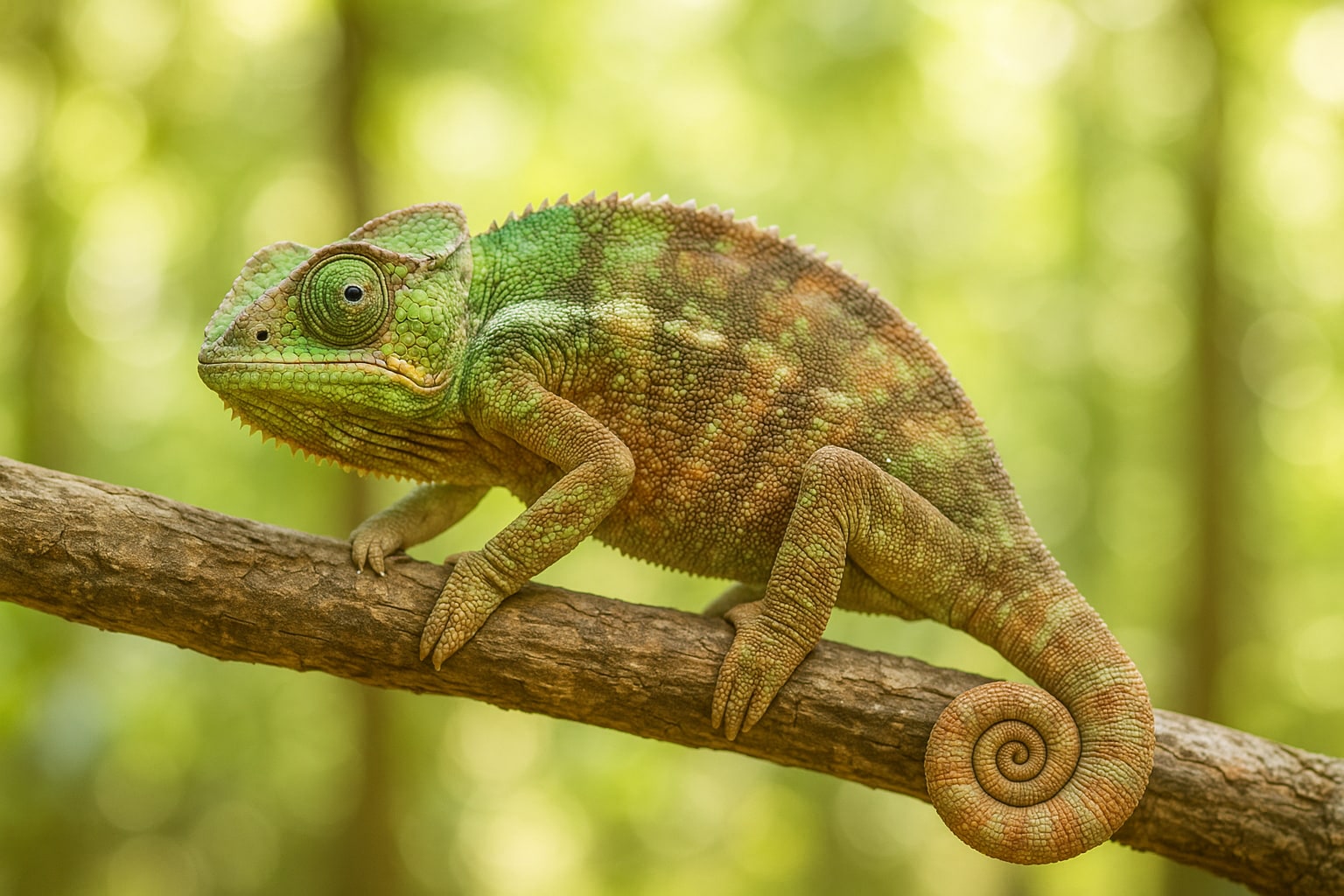
There are few animals as misunderstood as the chameleon. For decades it has been repeated that it changes color to blend in with what is behind it, like an octopus with scales. The reality, confirmed by modern biophysics, is far more interesting: its skin works as an active optical system that changes how it reflects light.
In this article I explain how it really does it, why it does it, and the role played by structures called iridophores, the protagonists of a discovery published in 2015 by the University of Geneva that changed what we thought we knew about these reptiles.
Chameleon quick facts
| Data | Value |
|---|---|
| Family | Chamaeleonidae |
| Described species | More than 200 |
| Main distribution | Sub-Saharan Africa and Madagascar |
| Size | From 1.5 cm (Brookesia nana) to 70 cm (Furcifer oustaleti) |
| Lifespan | 2-10 years depending on species |
| Diet | Insectivorous (some large species eat small birds) |
What a chameleon really is
Chameleons are reptiles of the family Chamaeleonidae, with more than 200 described species. Most live in Madagascar and mainland Africa, although there are representatives in southern Europe and the Middle East, such as the common chameleon (Chamaeleo chamaeleon), found in Andalusia and Portugal.
They have traits unique among reptiles: independent eyes capable of rotating 180°, a projectile tongue that can be twice the length of their body, zygodactyl feet (two toes facing forward and two facing backward), and, of course, skin that changes color.
The camouflage myth: what you were told wrong
The popular image says that a chameleon on a brick turns reddish, and on a leaf, green. This is false. Its base color is already adapted to its usual habitat (most are green or brown because they live among vegetation), but active color change does not respond to the visual background.
What the chameleon does do is modify its coloration depending on:
- Social communication: signaling dominance to other males, courting females, or indicating rejection.
- Thermoregulation: darkening to absorb more heat in the morning, lightening to reflect it at midday.
- Physiological state: stress, illness, or excitement.
A panther chameleon (Furcifer pardalis) male that turns bright red and yellow in front of a rival is not camouflaging itself. It is shouting in visual language.
How the chameleon changes color: the real mechanism
This is where the fine science comes in. The chameleon’s skin has two layers involved in color:
1. Pigment chromatophores. These are cells containing real pigments (brown-black melanin, yellow and red carotenoids). Through contraction and expansion, they expose more or less pigment. This explains dark and warm tones.
2. Iridophores. These are the key cells and the ones that solved the puzzle. They contain guanine nanocrystals organized in a three-dimensional lattice. Depending on the distance between those crystals, the skin reflects different wavelengths of light.
Iridophore crystals and the Geneva discovery
In 2015, the team led by Michel Milinkovitch at the University of Geneva published a decisive study in Nature Communications. They analyzed the skin of the panther chameleon and discovered that iridophores are not static: the animal can actively stretch or relax the network of guanine nanocrystals.
- Crystals close together → reflect short wavelengths → blues and greens.
- Crystals spaced apart → reflect long wavelengths → yellows, oranges and reds.
This is the key to the rapid and vivid color change. It is not pigment moving; it is structural optics: the same physical principle that gives color to the wings of a morpho butterfly or the feathers of a peacock.
Additionally, adult chameleons have a second, deeper layer of iridophores with larger crystals that reflect infrared. That is, they also manage heat through the skin.
Chameleon communication: speaking without sound
A chameleon that darkens with vertical black stripes is usually stressed or submissive. One that displays bright, high-contrast colors toward another male is marking territory. Receptive females and gravid ones show very different patterns: the pregnant female panther chameleon, for example, turns black with orange spots to reject males.
This visual system is so precise that researchers compare it to a chromatic language. In terms of communicative richness, it is closer to what the common octopus does with its skin than to simple reactive camouflage.
Which species change the most (and which barely change)
Not all chameleons are color virtuosos. Large arboreal species from Madagascar, such as the panther chameleon or Parson’s chameleon (Calumma parsonii), have the most spectacular repertoire. Small terrestrial species of the genus Brookesia are brown almost all the time: they live among leaf litter and that is enough for them.
The European common chameleon changes less than many people believe. It shifts from green to brown or yellowish, with some mottling, but it does not produce the electric reds and blues of its Malagasy relatives.
Is a chameleon a good pet?
Short answer: in most cases, no. They are exotic animals with very demanding requirements for temperature, humidity, UVB, ventilation, and live food. They stress easily, and chronic stress drastically shortens their lives.
Moreover, several species are listed in CITES Appendix II, which strictly regulates their trade. The European common chameleon is protected in Spain, and capturing or keeping it without authorization is illegal.
If you are fascinated by them, observe them in reserves or documentaries. A poorly set-up terrarium is not a home for an animal like this.
Frequently asked questions
Does a chameleon change color according to what it sees? No. It changes according to its emotional state, temperature, and need to communicate. The background color has little influence.
Can it turn any color? Each species has a palette limited by its genetics. None can imitate a chessboard, despite viral videos (which are edits).
Would a blind chameleon change color? Yes. Studies with vision-impaired specimens show that they maintain thermoregulatory changes and hormonal responses, although they lose part of their social signaling.
How long does a chameleon live? It depends on the species. The male panther chameleon lives 5-7 years; the Furcifer labordi from Madagascar lives only 4-5 months after hatching, one of the shortest life cycles among tetrapod vertebrates.
Why does my chameleon turn black? It usually indicates stress, cold, or illness. If you have one in captivity and it maintains that color, consult a veterinarian specialized in reptiles.