Sloth: why this mammal moves so slowly
Discover why the sloth moves so slowly: its ultra-slow metabolism, its leaf-based diet, and the evolutionary adaptations that make it a unique mammal.
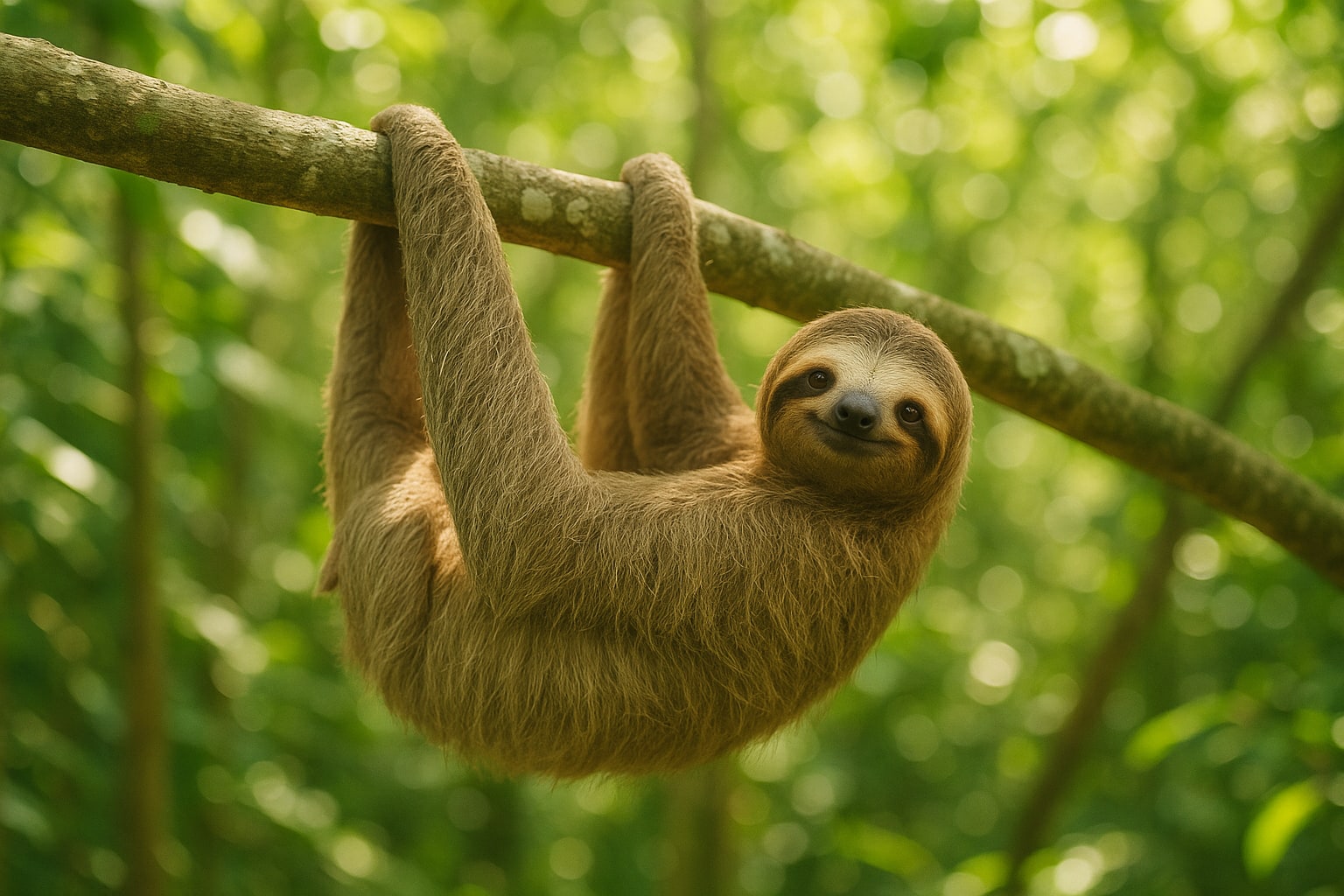
Few animals have turned slowness into a life strategy as refined as the sloth. Hanging upside down in the canopies of the Neotropical rainforest, it barely moves. It can remain for hours on the same branch, its head turned at an impossible angle, chewing a leaf. This is not laziness in the human sense of the word: it is physics, chemistry and evolution working together.
This arboreal mammal lives in the tropical forests of Central and South America, and it attracts curiosity precisely because of what sets it apart from almost any other mammal of its size: its basal metabolic rate is one of the lowest recorded in terrestrial vertebrates. Understanding why it moves the way it does means looking at its diet, its digestion, its body temperature and even the microorganisms that live in its fur.
Sloth quick facts
| Fact | Value |
|---|---|
| Scientific name | Bradypus spp. (three-toed) and Choloepus spp. (two-toed) |
| Size | 50-75 cm |
| Weight | 3.5-8 kg depending on species |
| Lifespan | 20-30 years in captivity |
| Habitat | Tropical rainforests of Central and South America |
| Diet | Folivorous (mainly leaves) |
| Average speed | 0.24 km/h on the ground |
| IUCN status | Varies by species (LC to CR) |
What exactly is a sloth
The name “sloth” covers six living species across two genera: the three-toed sloths (Bradypus) and the two-toed sloths (Choloepus). Despite their similar appearance, these are lineages that have been separated for more than 30 million years: their resemblance is a classic example of convergent evolution.
They belong to the superorder Xenarthra, which also includes armadillos and anteaters. Their ancestors, giant ground sloths such as Megatherium, weighed several tons and went extinct about 10,000 years ago.
A diet low in calories
The key to understanding the sloth’s slowness begins in its stomach. Bradypus are strict folivores: they eat leaves, shoots and some fruit. Leaves are abundant in the forest, but they are a difficult food: few calories, plenty of fiber and often toxic compounds that the plant produces as a defense.
Digesting that material takes time. A great deal of time. A sloth may take between two and four weeks to digest a single meal, according to measurements recorded by Montgomery and Sunquist in Panama in the 1970s. To process cellulose it has a multi-chambered stomach and a symbiosis with bacteria and archaea that ferment the leaves, much as ruminants do, though at a far more leisurely pace.
Sloth metabolism: the slowest engine among mammals
The sloth’s metabolism operates at roughly 40-45% of the expected rate for a mammal of its size, according to classic studies by Nagy and Montgomery published in The Journal of Mammalogy. In practical terms, it is a mammal running at half throttle.
This very low basal metabolic rate has several direct consequences:
- Variable body temperature, between 30 and 34 °C, uncommon in mammals.
- Reduced muscle mass: around 25-30% of body weight, compared with the usual 40-45%.
- Minimal daily energy expenditure, compatible with such a poor diet.
Moving fast requires oxygen, glucose and muscle. The sloth has little of all three. It is not that it does not want to move: it is that it cannot afford it energetically.
Sloth speed: real figures
Field measurements place the sloth’s speed at around 0.24 km/h on the ground and up to 0.30 km/h on branches. In emergencies it can speed up a little, but it never approaches the values of other arboreal mammals. A capuchin monkey, of similar weight, moves with ease about ten times faster.
In water, by contrast, they swim surprisingly well. They can cross Amazonian rivers and channels at about 1.5 km/h, using their arms in a motion similar to a crawl stroke.
Sloth adaptations for living slowly
Slowness is not a defect: it is part of a very effective defensive strategy. Among the main sloth adaptations are:
- Curved claws of 7-8 cm that allow them to hang without muscular effort; holding on costs them less energy than letting go.
- Fur with grooves colonized by green algae (Trichophilus welckeri) that give it a greenish tint and camouflage it among the foliage.
- Its own microbiome in the fur, with fungi, bacteria and moths (Cryptoses choloepi) that form a small ecosystem unique among mammals.
- Neck with 8 or 9 cervical vertebrae in Bradypus (other mammals have 7), which allows it to turn its head about 270°.
Moving little also makes it invisible to its main predators: the harpy eagle and the jaguar detect movement long before they detect shape.
Sloth behavior in the treetops
The sloth’s behavior is solitary and arboreal. They sleep between 15 and 20 hours a day, though less than was believed decades ago: a study by Rattenborg et al. (2008) published in Biology Letters recorded in the wild about 9.6 hours of sleep per day, considerably less than in captivity.
They come down to the ground roughly once a week to defecate, always at the foot of the same tree. It is a risky behavior—this is where they are most often caught by predators—but it is essential: the fall of their droppings fertilizes the tree that feeds them and enables the reproductive cycle of the moths that live in their fur. If you are interested in low-energy survival strategies, the Australian koala, which sleeps up to 20 hours a day, follows a similar logic with eucalyptus.
Females have a single offspring after a gestation of 6 months (Choloepus) or 10-11 months (Bradypus). The young clings to its mother’s belly during the first months and learns which leaves to eat by imitating her.
Conservation status
Threats vary by species. The pygmy three-toed sloth (Bradypus pygmaeus), endemic to the Panamanian island of Escudo de Veraguas, is listed as Critically Endangered (CR) by the IUCN, with a population estimated at fewer than 100 individuals. The collared sloth (Bradypus torquatus) of the Brazilian Atlantic Forest is listed as Vulnerable (VU). The most widespread species, such as Bradypus variegatus and Choloepus hoffmanni, are of Least Concern (LC), although they suffer from deforestation and road deaths.
The Sloth Conservation Foundation and organizations such as Costa Rica’s National Biodiversity Institute work on biological corridors and rescue of individuals.
Frequently asked questions
Why does the sloth move so slowly? Because its basal metabolic rate is 40-45% lower than expected for its size, its leaf diet provides few calories, and its muscle mass is reduced. Moving fast would be energetically unsustainable for it.
How long does a sloth live? In the wild estimates are around 15-20 years. In well-managed captivity they can exceed 30 years.
Can you keep a sloth as a pet? No. They are protected wild animals, with dietary, temperature and management requirements that no home can meet. Several species are included in CITES Appendix II or III, and keeping them is illegal in most countries outside their natural range.
Is it true they die if they come down to the ground? That is not true. They descend regularly to defecate and can walk and swim. What does happen is that on the ground they are vulnerable to predators and domestic dogs.
Why does the sloth’s fur look green? Because of algae (Trichophilus welckeri) growing in the grooves of its hair, favored by the humidity of the forest. It is natural camouflage and an example of symbiosis.