Why your cat brings you unappetizing 'gifts'
The mouse on the rug or the bird by the bed isn't an emotional gesture: it's hunting behavior. We explain what ethology says and what you can do.
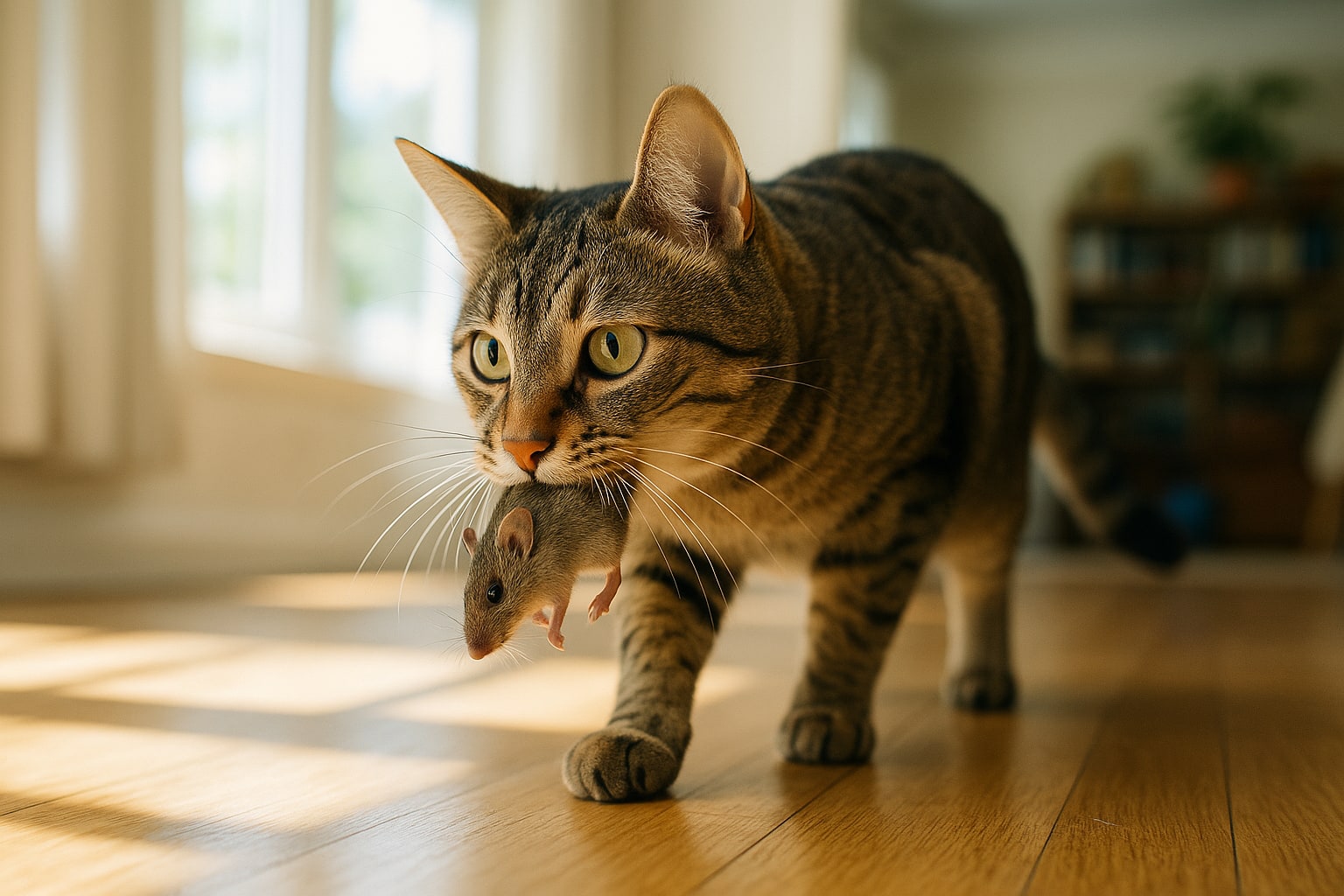
You open the bedroom door and there it is: a lifeless mouse, a stunned sparrow or, with luck, just a lizard escaping. Your domestic cat (Felis catus) watches you calmly from the hallway. It’s not a romantic gesture or a ritual offering. It’s a behavior with deep roots in its biology, and understanding it changes quite a bit the way you manage it.
The phenomenon is so common that it has generated specific studies. Projects such as the KittyCams Project at the University of Georgia, which placed cameras on the collars of cats with outdoor access, have documented that a large share of captured prey never makes it home: only about 23% is brought back. The rest is eaten or left where it was caught. What you see on your rug is just the tip of the iceberg.
Quick behavior overview
| Data | Value |
|---|---|
| Species | Domestic cat (Felis catus) |
| Most common prey | Small mammals, small birds, reptiles, insects |
| % of prey brought home | ~23% (KittyCams, Univ. Georgia) |
| Age hunting begins | 5-7 weeks (predatory play) |
| Peak activity hours | Dawn and dusk (crepuscular) |
| Estimated global impact | Billions of birds and mammals per year |
Not a gift: it’s hunting instinct
The cat’s hunting instinct does not depend on hunger. It has been decoupled from satiety for millennia. A well-fed cat hunts just the same, because the motivation to stalk and capture runs through a different neural pathway than appetite. The ethologist John Bradshaw described this clearly in Cat Sense (2013): the cat sees a moving stimulus and the predatory circuit activates, whether it has eaten or not.
That’s why your cat can finish its bowl of food and, half an hour later, be chasing a moth with the same intensity. These are parallel systems.
What science says about this behavior
The classic work of Dennis Turner and colleagues on feline behavior shows that hunting is a modular sequence: locate, stalk, chase, capture, kill, carry, consume. Each step can be performed in isolation. A well-fed cat usually stops before the last link: it captures, carries and abandons.
Carrying prey to a safe place—your home, its central territory—is part of the repertoire. It does not imply a communicative intent directed at you. It means that this is where it feels protected enough to handle what it has caught.
The “gift” myth for its human
The idea that the cat gives you a present as a sign of affection is anthropomorphism. There is no ethological evidence supporting that interpretation. What does exist are more sober explanations:
- Carrying to the safe core: your home is its refuge; bringing prey there is normal behavior.
- Interruption of the predatory sequence: the cat captures but isn’t hungry, so it doesn’t consume.
- Practice: young cats, above all, rehearse the sequence without completing it.
In females, especially those that have raised litters, it has been observed that they bring live prey to their kittens to teach them how to handle it. Some authors have extended this hypothesis to domestic cats living with people, but it has not been conclusively demonstrated.
Differences between males, females and young cats
Females tend to hunt more often and bring prey home more frequently, a pattern linked to maternal behavior. Males usually cover wider ranges but do not necessarily catch more. Young cats, between 6 months and 2 years old, are at the peak of trial and error: many of their “catches” are insects, leaves or toys.
The ecological impact you should not ignore
This is where the conversation gets serious. The domestic cat with outdoor access is one of the invasive predators with the greatest documented impact on wildlife. A study published in Nature Communications (Loss, Will and Marra, 2013) estimated that cats kill between 1.3 and 4 billion birds and between 6.3 and 22.3 billion mammals per year in the United States alone. The IUCN includes the cat on its list of the 100 most harmful invasive species on the planet.
On islands, the effect has been devastating: it is linked to the extinction or decline of dozens of endemic bird, reptile and small mammal species.
What to do (and what not to do) when it brings you prey
Reacting with shouting or punishment doesn’t help. The cat doesn’t associate your anger with the hunt, which happened minutes or hours earlier. What works best:
- Remove the prey calmly, using gloves or a bag. If it is alive and injured, contact a wildlife rehabilitation center.
- Don’t scold the cat. It won’t learn anything useful and you’ll increase its stress.
- Wash your hands. Rodents and birds can transmit parasites and bacteria.
- Check your cat if you notice wounds, limping or unusual signs after hunting episodes. If in doubt, see the veterinarian.
If your cat also scratches furniture when it arrives excited from a catch, this guide on how to redirect scratching without punishment may help.
How to reduce hunting without frustrating your cat
You cannot eliminate the instinct, but you can channel it:
- Structured daily play: 2 sessions of 10-15 minutes with wand toys or fabric mice that mimic prey movement. Always end with a real “catch” of the toy.
- Activity feeders: puzzle-type dispensers that make the cat work for its food.
- Collars with bells or high-visibility colors: brightly colored collars such as Birdsbesafe reduce bird captures by up to 87% according to studies published in Global Ecology and Conservation.
- Diet rich in animal protein and enrichment: a trial from the University of Exeter (2021) showed that feeding a higher proportion of meat protein and providing more play reduces prey brought home by between 25 and 36%.
- Controlled outdoor schedules: avoid dawn and dusk, when birds and small mammals are most active.
Keeping the cat indoors, with adequate enrichment, is the most protective option for both wildlife and its own health (road accidents, fights, infectious diseases).
FAQ
Does my cat bring me gifts because it loves me? Not in the human sense. It is hunting behavior with transport to a safe territory. The bond with its caregiver exists, but the prey is not an emotional offering.
Why does my cat hunt mice when it has plenty of food? Because the predatory motivation and hunger are independent circuits. A satiated cat still hunts when faced with the right stimulus.
Is it dangerous for it to bring dead prey home? It can be. Rodents and birds can carry parasites (toxoplasma, worms), fleas and bacteria. Remove the prey with gloves and keep deworming up to date with your veterinarian.
Should I punish it when it does this? No. Punishment after the fact doesn’t teach anything and damages the relationship. It is better to redirect with play and enrichment.
Do neutered cats hunt less? Neutering reduces the territory covered, especially in males, but does not eliminate hunting behavior. The instinct remains.