Blue whale: the largest animal ever to have lived on Earth
Discover the blue whale (Balaenoptera musculus), the largest animal in history, reaching up to 30 meters and 173 tonnes. Facts, habitat, diet and conservation status.
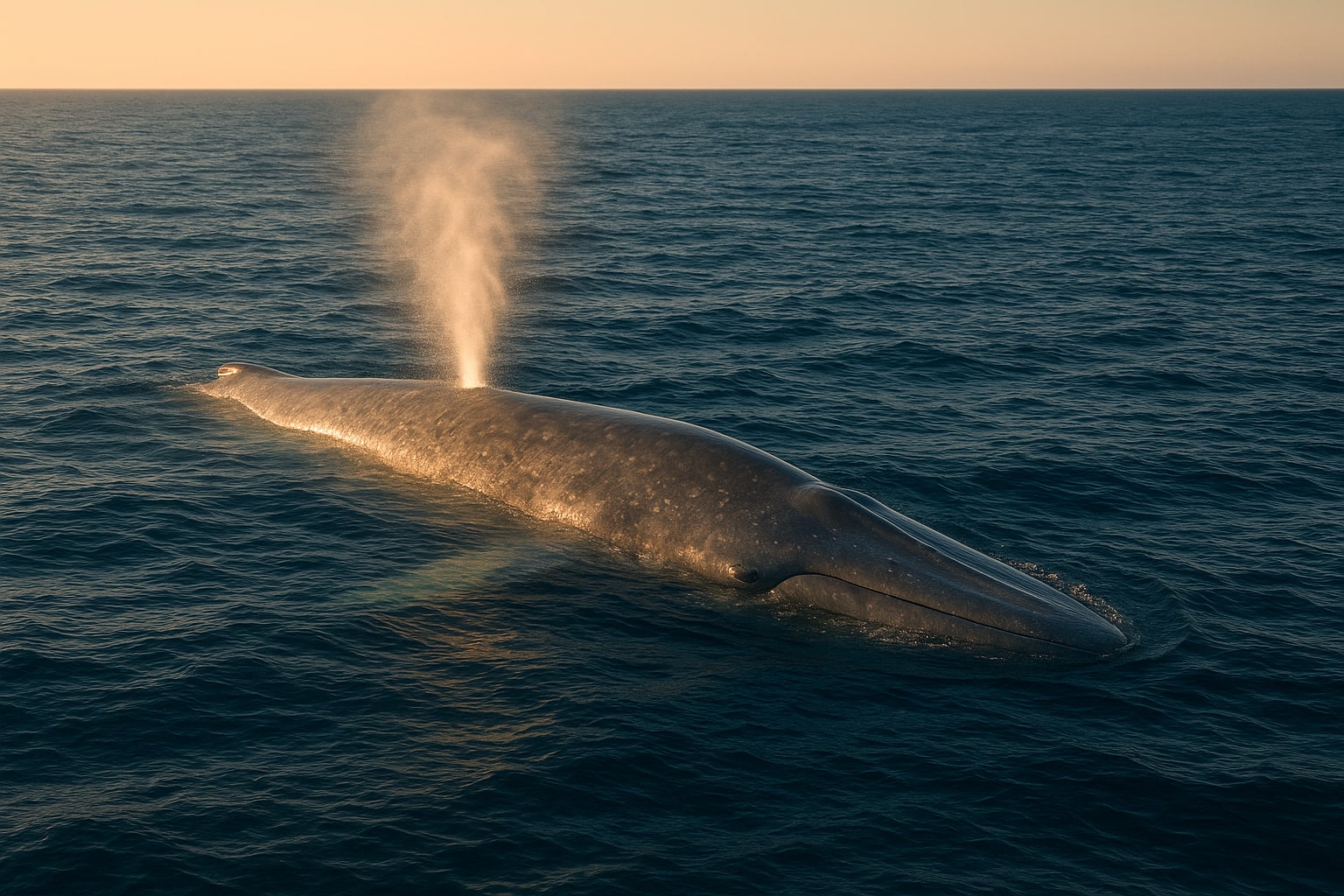
The blue whale (Balaenoptera musculus) is not only the largest living animal on the planet. As far as science knows, it is the largest creature that has ever existed on Earth, surpassing any known dinosaur. Neither Argentinosaurus nor Patagotitan reached its mass.
This cetacean roams almost all the world’s oceans and, despite its colossal size, feeds on one of the smallest animals in the sea: krill. Its recent history is also that of a species that was pushed to the brink of extinction by industrial whaling and that is now recovering very slowly.
Identification: size, weight and key features
The blue whale measures between 24 and 30 meters in length on average in adult specimens, although there are historical records of females up to 33 meters long, captured in the 20th century in the Antarctic Ocean. Females are larger than males, which is common in baleen whales.
Its weight is around 100-150 tonnes, with a documented record of 173 tonnes. To put it in perspective: that is equivalent to about 30 adult African elephants or 2,000 people.
Other features that identify it:
- Blue-grey skin with pale mottling, a pattern unique to each individual (used for photo-identification).
- Broad, flattened, U-shaped head.
- Very small dorsal fin, located far back on the body.
- Vertical blow of up to 12 meters when breathing.
- Heart weighing about 180 kg, the size of a small car.
- Calf at birth: 7 meters and 2,500 kg, the largest of any animal.
Its estimated lifespan exceeds 80-90 years, according to analysis of earwax plugs in the inner ear (a method developed by Trumble et al., 2013).
Habitat and distribution: oceans around the world
The blue whale is distributed across all oceans except the central Arctic. Several subspecies are recognized:
- B. m. musculus — North Atlantic and North Pacific.
- B. m. intermedia — Southern Ocean (Antarctica).
- B. m. brevicauda — the “pygmy blue whale”, in the Indian and South Pacific Oceans.
- B. m. indica — northern Indian Ocean.
It undertakes seasonal migrations of thousands of kilometers: it spends the summer in cold polar or subpolar waters, rich in krill, and in winter moves to temperate or tropical latitudes to breed and give birth.
It prefers deep, pelagic waters, although it approaches the coast in upwelling areas such as the Gulf of California, the coast of Chile, Sri Lanka or the Gulf of St. Lawrence.
Feeding and behavior
The blue whale is a specialized filter feeder. It feeds almost exclusively on krill (crustaceans of the genus Euphausia), although it may occasionally ingest small copepods and fish.
It uses the lunge feeding technique: it accelerates toward a krill swarm with its mouth open, engulfs a volume of water that can exceed its own body weight, and filters the prey through its baleen plates (around 300-400 keratin plates on each side of the jaw).
Figures on its appetite:
- It consumes up to 3,600 kg of krill per day during the feeding season.
- At the height of the austral summer it can reach 16 tonnes per day, according to recent studies published in Nature (Savoca et al., 2021).
- It partially fasts during migration and breeding.
Social behavior: it is usually solitary or forms mother-calf pairs. It communicates through very low-frequency vocalizations (10-40 Hz) that reach 188 decibels, one of the most powerful sounds produced by any animal. These calls can travel hundreds of kilometers underwater.
Gestation lasts 10-12 months, and the female gives birth to a single calf every 2-3 years. The nursing calf gains about 90 kg per day during the first 6-7 months.
Conservation status: Endangered
The IUCN classifies the blue whale as Endangered (EN) on its Red List, with a global population estimated at 5,000 to 15,000 adult individuals (2018 assessment). Before industrial whaling, it is estimated that more than 350,000 individuals existed in the Southern Hemisphere alone.
Commercial whaling decimated it in the 20th century: between 1900 and 1966, the year the International Whaling Commission (IWC) protected it, about 380,000 blue whales were captured. It is listed in CITES Appendix I, which prohibits international trade in it.
Current threats:
- Collisions with ships on shipping routes.
- Entanglement in fishing gear.
- Noise pollution that interferes with its communication.
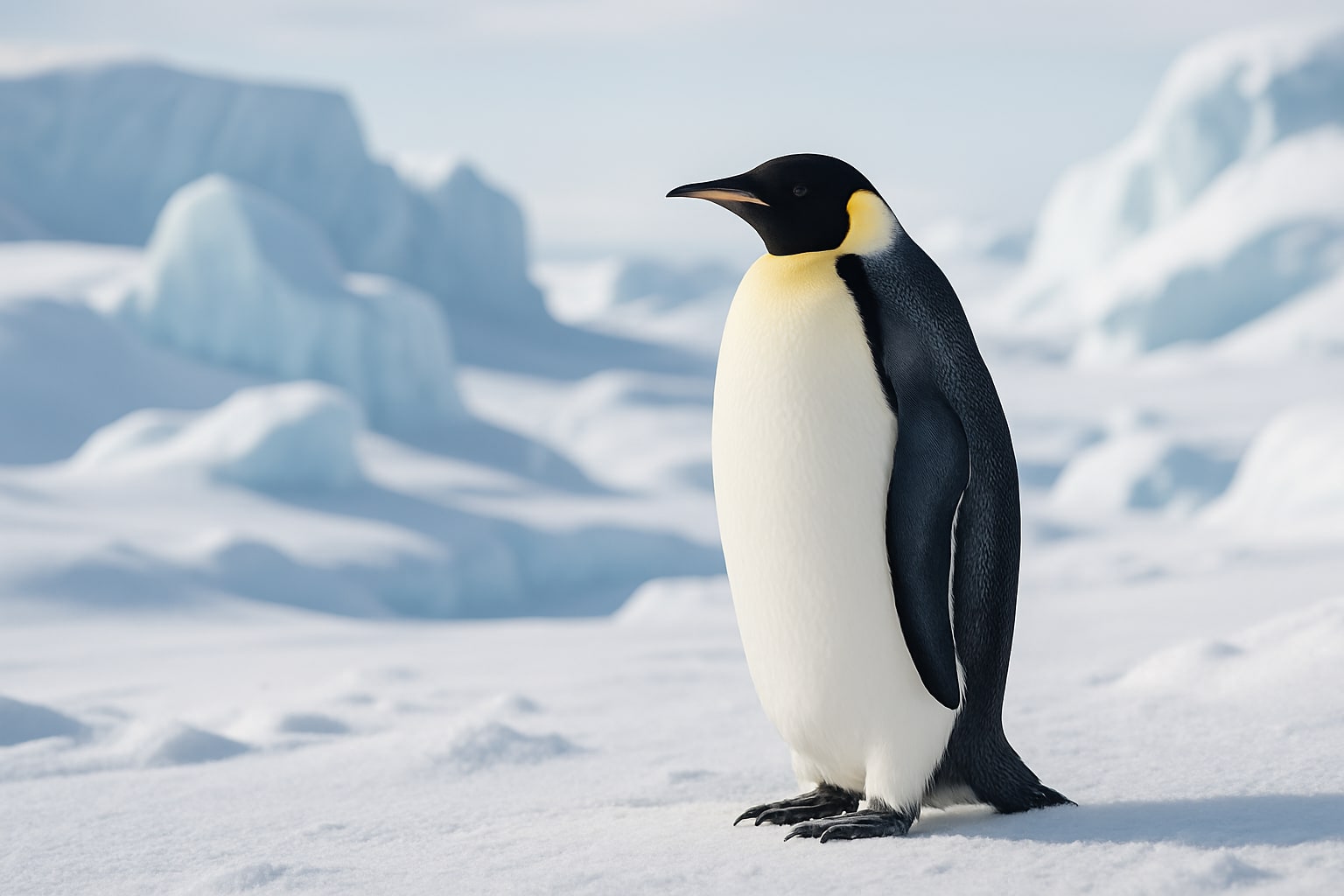
- Climate change, which alters the distribution of krill (especially critical for Antarctic populations, as it also affects the emperor penguin in the same ecosystem).
- Microplastics and bioaccumulative contaminants.
Organizations such as NOAA Fisheries, WWF and the IWC monitor its populations and promote measures such as rerouting shipping lanes in critical areas.
Verifiable curiosities
- Its tongue weighs about 2.7 tonnes, roughly the same as a young Asian elephant.
- A single heartbeat pumps about 220 liters of blood and can be heard more than 3 km away with hydrophones.
- The calf drinks about 220 liters of milk per day, with a 35-50% fat content.
- The scientific name musculus is a linguistic play by Linnaeus: in Latin it means “little mouse”.
Frequently asked questions
What is the largest animal in the world? The blue whale, with a length of up to 30 meters and a recorded weight of 173 tonnes. No known dinosaur exceeded its body mass.
How much does an adult blue whale weigh? Between 100 and 150 tonnes on average. The documented record is 173 tonnes, for a female captured in Antarctica in 1947.
What does it eat if it only eats krill? Enormous quantities: up to 3,600 kg per day during the feeding season. Krill is abundant in cold waters and very energy-rich, which allows it to sustain its size.
Is it in danger of extinction? Yes. It is listed as Endangered (EN) on the IUCN Red List. Its population is recovering very slowly after the industrial whaling of the 20th century.
Can a blue whale swallow a person? No. Its throat is only about 25-30 cm in diameter, adapted for swallowing krill and water, not large prey.