Chlorophytum comosum: the spider plant and its natural talent for purifying the air
Discover why the spider plant (Chlorophytum comosum) is one of the most recommended indoor plants for purifying the air, with practical care tips and data from NASA's Clean Air Study.
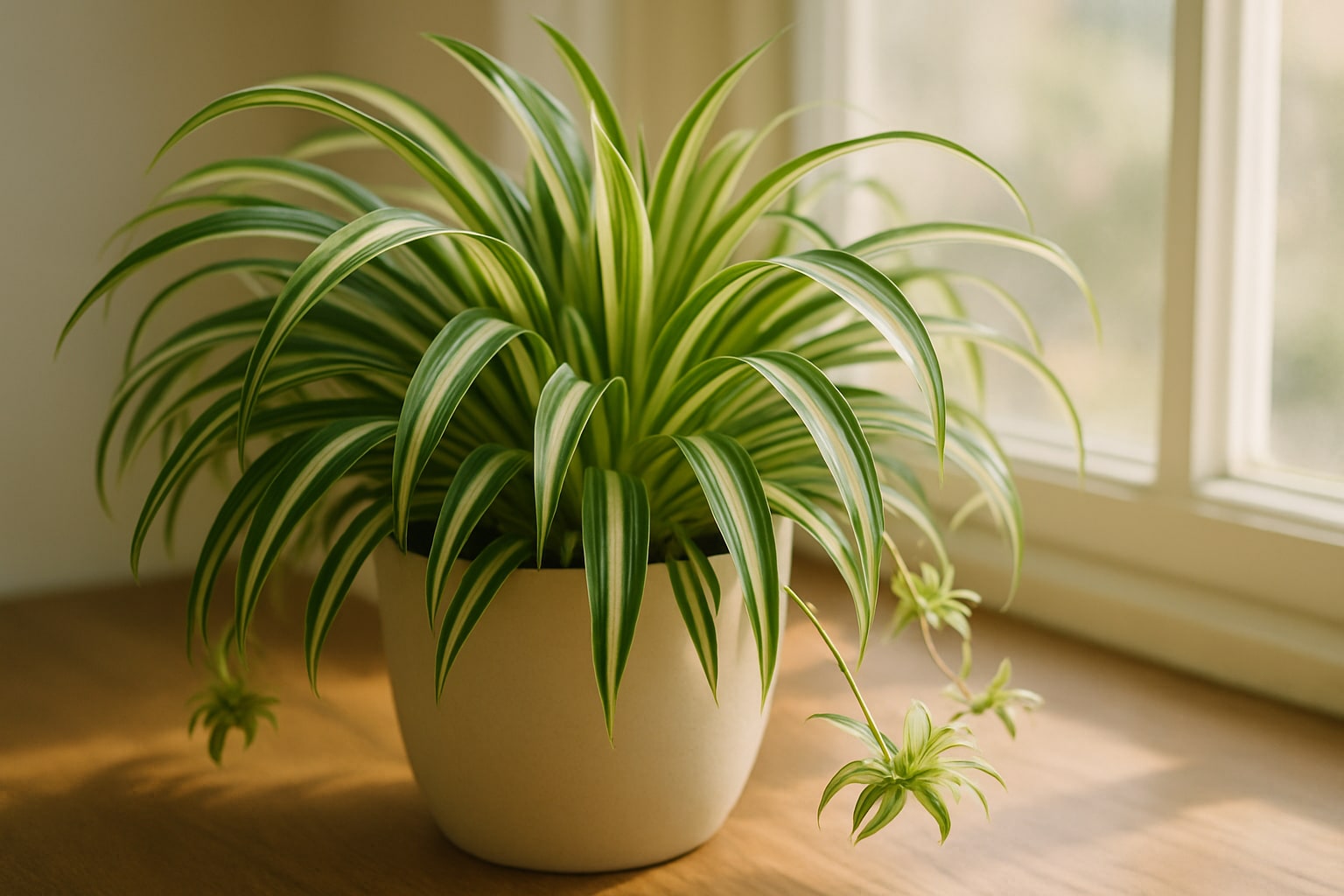
Few indoor plants have the track record of the spider plant (Chlorophytum comosum). You see it in living rooms, offices and kitchens across much of the world, hanging with its arching leaves and its runners laden with little offspring. It is hardy, cheap, almost indestructible… and on top of that it has a scientific past that put it on the map: it appeared in NASA’s famous Clean Air Study of 1989 as one of the species capable of reducing household air pollutants.
If you’re looking for a plant that puts up with almost anything and also does something useful for your home, the spider plant is a serious candidate. Here is the complete guide: origin, care, real (not marketing) purification, and how to multiply it without spending a penny.
What the spider plant is and where it comes from
The spider plant, also known as spider ivy, airplane plant or ribbon plant, is a perennial herb of the Asparagaceae family. It is native to the tropical and subtropical regions of southern Africa, especially South Africa, where it grows as a ground cover in open forest areas.
Its leaves are linear and arching, 20–45 cm long, green or variegated with white or yellow stripes. The most common variety in garden centres is Chlorophytum comosum ‘Variegatum’, with a white margin, and ‘Vittatum’, with a pale central stripe.
NASA’s study and which pollutants it removes
In 1989, NASA published the NASA Clean Air Study, led by researcher B. C. Wolverton, to evaluate plants capable of improving air quality in space stations. The spider plant appeared among the species that reduced volatile organic compounds (VOCs) common indoors:
- Formaldehyde (present in particleboard, varnishes, tobacco smoke).
- Xylene and toluene (solvents, paints, adhesives).
- Carbon monoxide (incomplete combustion).
In the sealed chambers of the experiment, the spider plant absorbed significant amounts of these compounds within 24 hours. That said, some context is needed: those tests were carried out in containers of about 0.88 m³, not in a real living room. Later studies, such as that of Cummings and Waring (2020, Journal of Exposure Science & Environmental Epidemiology), calculated that dozens of plants per square metre would be needed to match the ventilation of an open window.
In other words: the spider plant helps, but it does not replace ventilating. Think of it as a pleasant complement, not as a green HEPA filter.
Light, watering and substrate
The spider plant is tolerant, but it performs better with these parameters:
- Light: bright indirect light. Roughly 10,000–20,000 lux. It tolerates shade, but loses its variegation. Avoid direct midday sun.
- Watering: every 5–7 days in spring and summer, every 10–14 in winter. Let the top 2–3 cm of substrate dry out between waterings.
- Substrate: a light, well-draining mix. Peat, coconut fibre and perlite in equal parts work well. Ideal pH: 6.0–6.5.
- Humidity: 40–60%. It tolerates dry environments, although the tips turn brown if the air is very dry.
A tip: use water left to stand for 24 hours or filtered water. The spider plant is sensitive to fluoride and chlorine in tap water, and responds with brown tips.
Temperature and placement in the home
It is comfortable between 15 and 25 °C. Below 7 °C it suffers damage. In summer you can move it to a shaded balcony; in winter, keep it away from radiators and draughts.
Hanging, it shows its full potential: the runners cascade and the offspring are on display. It also does well on high shelves or on top of a cupboard near an east-facing window.
Seasonal care
Spring and summer: active growth. More frequent watering and a balanced fertiliser (NPK 10-10-10 diluted by half) every 3–4 weeks.
Autumn and winter: reduce watering and stop fertilising. The plant enters a semi-dormant state. If it lives indoors with heating, make sure the substrate does not dry out completely.
How to propagate the spider plant step by step
Here is one of its virtues: it multiplies on its own. When the mother plant is content, it sends out runners (long stems) with plantlets or “babies” at the tips.
- Wait until the baby has emerging roots, visible as small white bumps.
- Cut it with clean scissors, leaving 2–3 cm of stem.
- Option A: place it in a glass of water. In 7–14 days it will grow roots 3–5 cm long.
- Option B: plant it directly in moist substrate. Keep it consistently humid for 2 weeks.
- Repot into its permanent pot when the roots measure 4–5 cm.
You can also divide the mature clump every 2–3 years when repotting, separating the thickened rhizomes by hand.
Common problems
- Brown tips: excess fluoride/chlorine, dry air or over-fertilising.
- Yellow leaves: overwatering. Check drainage.
- Loss of variegation: insufficient light.
- Mealybugs and red spider mites: wipe the leaves with a damp cloth. For infestations, use potassium soap.
- Not producing offspring: usually because the pot is too large. Paradoxically, the spider plant flowers and produces runners when it feels somewhat root-bound.
Is it safe for dogs and cats?
Yes. The spider plant is non-toxic to dogs and cats according to the database of the ASPCA (American Society for the Prevention of Cruelty to Animals). That said, it contains mildly hallucinogenic compounds that attract cats, which nibble on it much as they do with catnip. It may cause mild vomiting from irritation, nothing serious, but if your cat becomes obsessed with it, hang it out of reach. If you notice persistent symptoms, consult your vet.
If you’re interested in how cats behave around houseplants, you might find this article on how to socialise an adult cat useful.
Other purifying plants to combine
The spider plant does not work alone. Combining it with other species from NASA’s study broadens the range of VOCs filtered. Good companions: pothos (Epipremnum aureum), snake plant (Dracaena trifasciata) or the hardy ZZ plant, ideal for low-light corners.
Frequently asked questions
How long does a spider plant live? With basic care, between 10 and 20 years. By dividing and propagating it, the genetic line can be extended indefinitely.
Why won’t my spider plant produce offspring? It usually needs a certain maturity (1–2 years), enough light and a snug pot. In very large pots it prioritises growing roots before reproducing.
How long does it take to purify the air of a room? There is no realistic figure for domestic use. NASA’s data were obtained in sealed chambers of less than 1 m³. In an ordinary room the effect is modest and always secondary to ventilating.
Can I keep it in the bathroom? Yes, as long as it gets natural light. High humidity suits it well and prevents brown tips.
Can it be grown only in water? Yes, indefinitely in hydroponics. Change the water every 7–10 days and add a few drops of diluted liquid fertiliser once a month.