How many hours a day does a cat sleep and why does it need to?
A domestic cat sleeps between 12 and 16 hours a day, and kittens and seniors can reach 20. We explain why, what their sleep cycles are like, and when to worry.
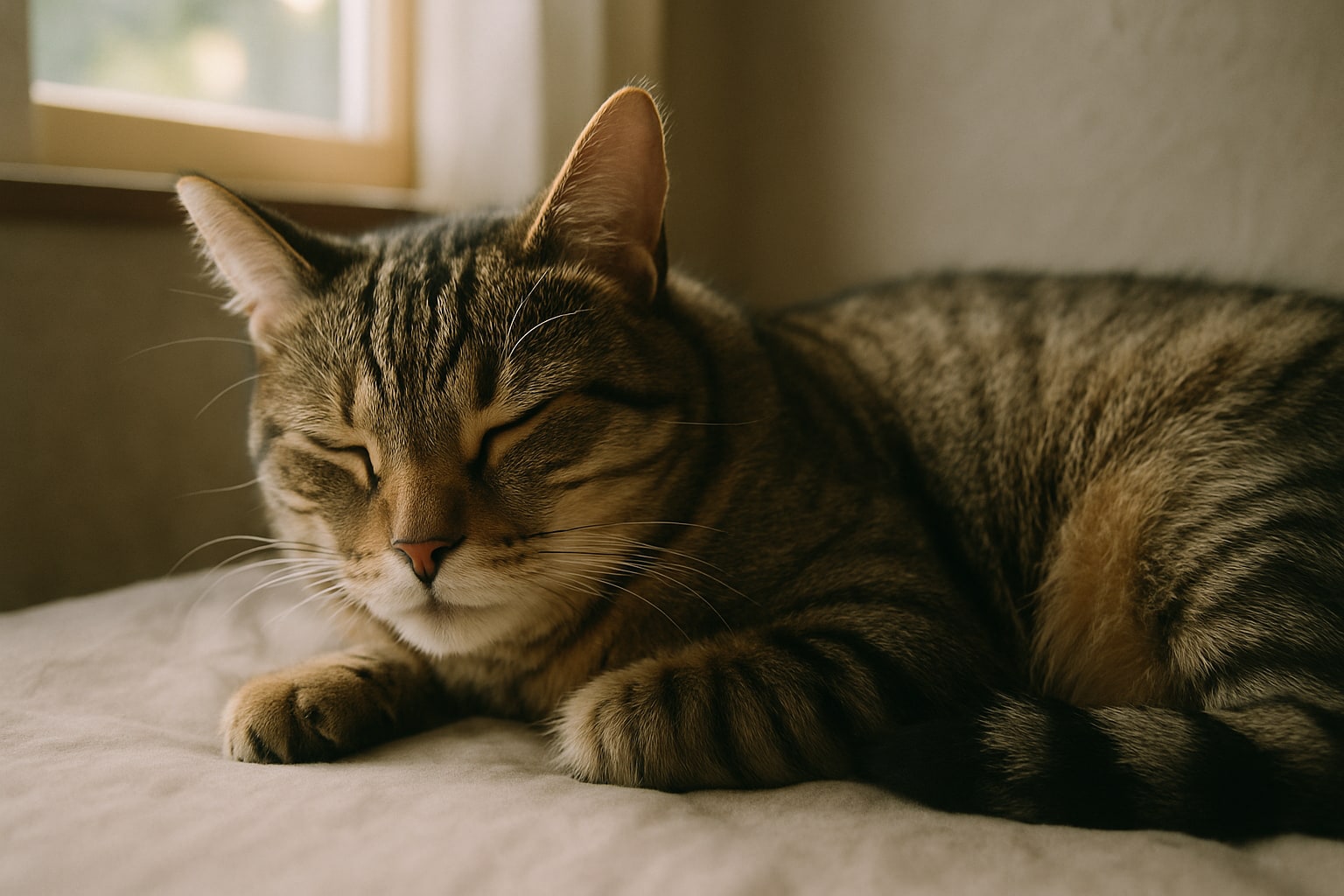
If you live with a cat, you’ve probably noticed: it spends much of the day lying down, dozing on the sofa or in a patch of sunlight by the window. It’s not laziness or boredom. It’s pure biology, inherited from its hunting ancestors.
The domestic cat (Felis catus) is a crepuscular predator. Its body is designed to store energy over long hours and release it in short bursts of hunting. Sleeping a lot is not a luxury: it is part of its physiology.
The key figure: between 12 and 16 hours a day
A healthy adult cat sleeps an average of 12 to 16 hours a day. The range is wide because it depends on age, activity, season of the year and the animal’s temperament.
The extremes stand out at two stages of life:
- Kittens (0-6 months): up to 18-20 hours a day. Sleep drives neurological and muscular development.
- Adult cats (1-7 years): 12-16 hours.
- Senior cats (over 10-12 years): rise again to 18-20 hours as their metabolism and activity slow down.
Compared with us, a 15-year-old cat has spent the equivalent of 10 years of its life sleeping. For an 80-year-old human, that proportion would be about 26 years.
Why cats sleep so much: the hunter’s inheritance
The cat’s prolonged sleep has an evolutionary explanation. Its wild ancestors, such as the African wildcat (Felis lybica), hunt small prey (rodents, birds, insects) that provide little energy per capture. Every hunting attempt burns a lot of metabolic fuel.
The strategy is simple: conserve energy between hunts. Sleeping is the best way not to spend calories when there is no prey to chase.
On top of this is their crepuscular nature: cats are genetically programmed to be more active at dawn and dusk, when their prey is also active. The rest of the day, they rest. That’s why your cat switches into turbo mode at seven in the morning or when the sun goes down.
How the feline sleep cycle works: light and REM
A cat’s sleep is not one continuous block. It alternates in short cycles, of about 20-30 minutes each, divided into two phases:
Light sleep (75-80% of the time)
This is the famous “cat nap”. The animal is relaxed but alert. Its ears move at the slightest noise, its muscles are not fully slack, and it can wake up in seconds if it detects something. This phase also comes from the wild hunter: sleeping without fully lowering its guard against larger predators.
Deep or REM sleep (20-25% of the time)
It lasts 5 to 10 minutes per cycle. Here the cat enters paradoxical sleep: its eyes move under its eyelids, its paws twitch, its whiskers tremble, and sometimes it vocalizes. This is when it is believed to dream, most likely of hunting scenes. During this phase, learning is consolidated and growth hormone is released.
Sleep in adult cats vs kittens and seniors
| Stage | Hours of sleep | Main reason |
|---|---|---|
| Kitten (0-6 months) | 18-20 h | Brain and physical development |
| Young (6 months – 2 years) | 12-14 h | High activity, exploration |
| Adult (2-7 years) | 13-16 h | Energy maintenance |
| Senior (10+ years) | 16-20 h | Slower metabolism, joints |
Seasonal changes also matter. In winter, many cats sleep 1-2 extra hours a day due to less light and lower temperatures.
When to worry: warning signs
It is normal for a cat to sleep a lot. What is not normal is for it to abruptly change its sleep pattern. These are signs to see the vet:
- Sleeps more than usual and seems lethargic when awake, with no interest in eating or playing.
- Sleeps much less and seems restless, meows at night or wanders without rest (common in senior cats with hyperthyroidism or cognitive decline).
- Wakes up with difficulty, seems disoriented or trembles when getting up.
- New snoring or noisy breathing during sleep (possible respiratory or weight problems).
- Changes accompanied by weight loss, increased thirst or vomiting.
Any of these signs deserves a professional check-up. Do not try to diagnose online or medicate on your own.
How to promote good rest at home
- Offer several resting spots: high, low, warm, and in quiet areas.
- Respect their naps. Repeatedly interrupting REM sleep generates stress.
- Schedule 2 play sessions of 10-15 minutes a day, preferably at dusk, to channel their peak activity.
- Keep feeding routines stable: a cat with irregular hunger sleeps worse.
If you have just adopted and your cat still does not relax, this guide on how to socialize an adult cat may help reduce its environmental stress.
FAQ
Is it normal for my cat to sleep 18 hours a day? In kittens and cats over 10 years old, yes. In an apparently healthy young adult, observe whether it eats, plays and interacts normally. If everything else is fine, it may simply be its usual pattern.
Do cats dream? During the REM phase they show rapid eye movements, twitches and vocalizations consistent with dream activity. Studies in felines since the 1960s (Michel Jouvet, CNRS) confirmed the existence of paradoxical sleep similar to that of humans.
Why does my cat sleep on top of me? It seeks warmth, security and a stable place. Your body emits constant temperature and rhythmic sounds (breathing, heartbeat) that it finds reassuring.
Do cats sleep more in winter? Yes. Shorter days and lower temperatures reduce their activity. It is common for them to add 1-2 extra hours of sleep compared with summer.
Does sleeping too much make my cat fat? Sleep itself does not make a cat fat. The problem arises when it is combined with overfeeding and lack of play. A sedentary cat with free access to food has a high risk of overweight.