Echeveria elegans: a guide to caring for and propagating this rosette succulent
Discover how to care for Echeveria elegans, the most popular Mexican hen-and-chicks, with clear step-by-step guidance on watering, light, and leaf propagation.
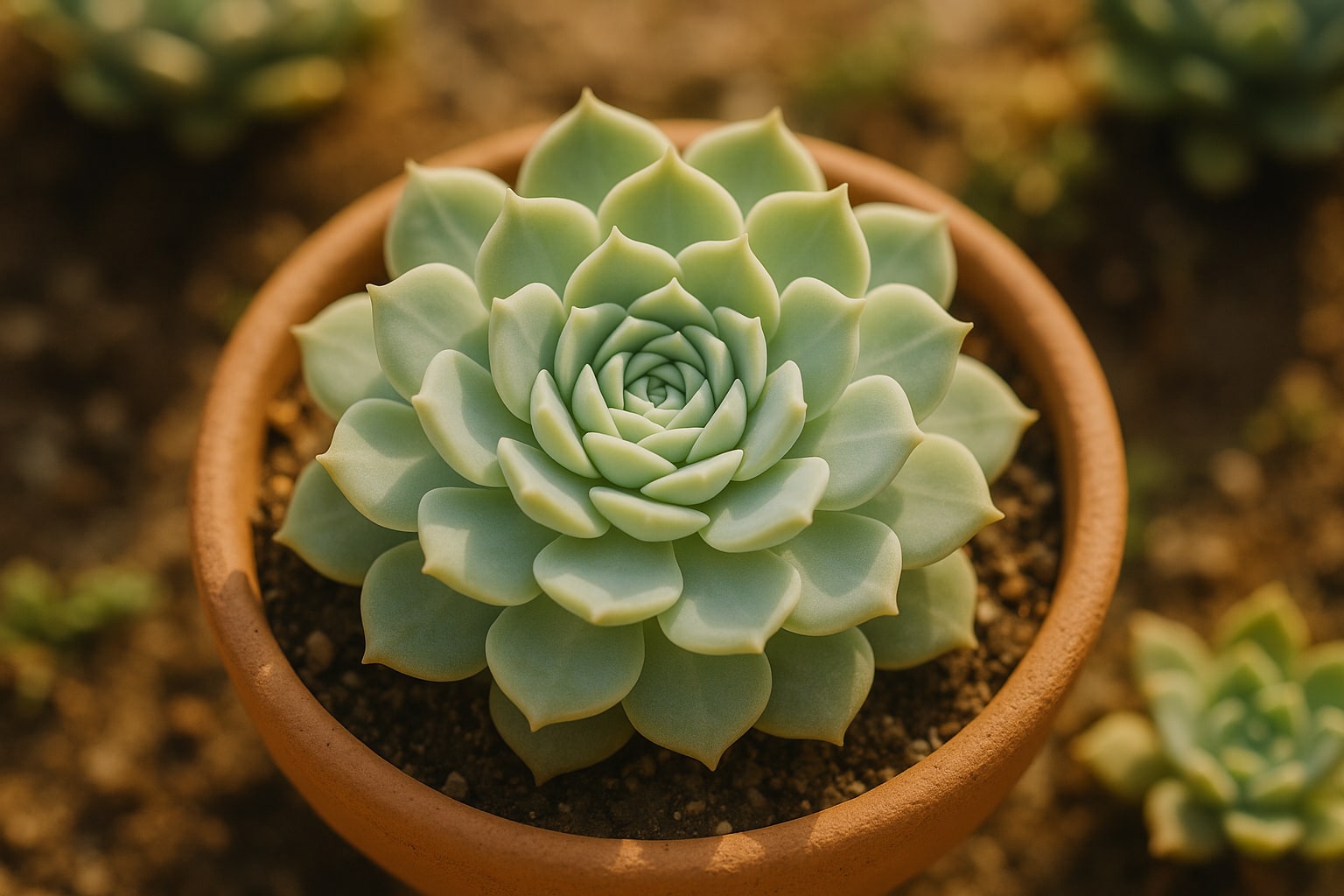
The Echeveria elegans is probably the most recognizable rosette succulent in the world. Its fleshy, blue-green leaves with translucent edges form compact rosettes that look like a stone flower. It is grown on balconies, sunny shelves, and Mediterranean gardens because it needs little and tolerates a lot.
Native to central Mexico, it has become an almost essential starter plant for anyone beginning with succulents. Here I explain, with concrete data, how to keep it healthy and how to multiply it without complications.
Quick facts about Echeveria elegans
| Detail | Value |
|---|---|
| Scientific name | Echeveria elegans |
| Common name | Mexican hen-and-chicks, alabaster rose |
| Origin | Hidalgo and central Mexico |
| Adult size | 5-10 cm tall, 8-15 cm in diameter |
| USDA hardiness | 9-11 (tolerates occasional frost down to -4 ºC) |
| Light | Full sun to bright partial shade |
| Watering | By soaking, when the substrate is dry |
| Flowering | Spring, pink flowers with yellow tips |
Origin and characteristics of the Mexican hen-and-chicks
The species was described by the botanist Augustin de Candolle in 1828 and owes its name to the Mexican botanical illustrator Atanasio Echeverría. It grows naturally on rocky outcrops and limestone cliffs in the state of Hidalgo, at altitudes between 1,800 and 2,400 meters.
The leaves have a waxy cuticle called farina that gives them that silvery blue tone and, in addition, protects them from intense solar radiation. Don’t rub it off: the farina does not regenerate and the rosette loses its characteristic look.
Light, temperature, and ideal location
It needs direct light for at least 4-6 hours a day. Indoors, place it right against a south- or east-facing window. If the leaves stretch and the rosette loses its shape (etiolation), that is a clear sign of insufficient light.
It tolerates temperatures between -4 ºC and 35 ºC, but the optimal range is between 15 and 25 ºC. In areas with hard frosts, it is best grown in a pot and brought indoors in winter.
Watering Echeveria elegans: the key to success
The mistake that kills the most echeverias is not drought, it is overwatering. This species stores water reserves in its leaves and prefers dryness to waterlogging.
- Spring and summer: water by soaking every 10-14 days, letting the substrate dry out completely between waterings.
- Autumn: space out to every 20-25 days.
- Winter: reduce to a minimum, once a month or not at all if it is resting in cold conditions.
Soak watering is the safest: submerge the pot in a container of water for 10 minutes, let it drain, and return it to its place. Avoid wetting the rosette, because standing water between the leaves causes neck rot.
Substrate and pot
The substrate must drain quickly. A reliable mix: 50% universal substrate, 30% coarse sand or perlite, and 20% pumice or volcanic gravel. The ideal pH is around 6-7.
Use clay pots with a drainage hole. Clay breathes and helps evaporate excess moisture, something glazed ceramic does not do.
Fertilizing
During spring and summer, apply a fertilizer specific to cacti and succulents diluted to half strength, once a month. In autumn and winter, none. Excess nitrogen produces soft leaves prone to pests.
How to propagate Echeveria elegans step by step
It is one of the easiest succulents to propagate. There are three methods: leaves, offsets, and decapitated stems.
Propagating echeverias from leaves
This is the most popular method, with a high success rate, around 70-90% if done correctly.
- Choose a healthy leaf from the base of the rosette.
- Gently wiggle it from side to side until it comes off cleanly, with the base intact. If it breaks in half, it will not work.
- Leave the leaf on a plate, in the shade and open air, for 2-4 days, until the wound calluses.
- Place it on barely moist substrate, without burying it.
- In 2-4 weeks, roots and a small rosette will appear at the base.
- When the mother leaf wrinkles and dries, the new plant is self-sufficient.
Offsets and stem cuttings
Offsets are small rosettes that sprout at the base of the mother plant. Separate them with a clean knife, let the wound dry for 2 days, and plant in dry substrate.
If your echeveria has etiolated and has a long stem, cut the top rosette with 2 cm of stem, let it callus for a week, and plant it. The lower part will keep producing new shoots.
If you are interested in this kind of home propagation project, the heart-leaf philodendron guide may also be useful, another plant that is very forgiving with cuttings.
Common problems
- Soft, translucent leaves: overwatering. Stop watering and check the roots.
- Leaves wrinkling downward: lack of water. Water by soaking.
- Dry brown spots: sunburn after a sudden move. Always acclimate gradually.
- Mealybug: the number one enemy. Remove it with a cotton swab dipped in 70° alcohol. If the infestation is large, ask a garden center for a specific insecticide.
As with other indoor plants that require reading their signals carefully, it is best not to obsess over the calendar and to observe the plant instead. The same applies to watering Phalaenopsis orchids: a rigid routine is usually worse than checking the substrate.
Frequently asked questions
How long does an Echeveria elegans live? Between 10 and 15 years under good conditions. The mother rosette eventually exhausts itself, but usually leaves many offsets that keep the plant going indefinitely.
Is it toxic to dogs and cats? No. The ASPCA classifies it as non-toxic to pets, although it is not advisable for them to chew on it.
Why is my echeveria growing upward and losing its rosette shape? It is etiolation from lack of light. Move it to a brighter spot and, if you want to recover the compact form, decapitate the rosette and replant it.
Can I keep it in the bathroom? It is not a good idea. The high ambient humidity and the scarce light of most bathrooms favor rot and loss of its characteristic blue color.
When should I repot it? Every 2-3 years, in spring, when the roots fill the whole pot. Use a pot only 2-3 cm wider than the previous one.