Anthurium andraeanum: how to get your anthurium to bloom nonstop
A practical guide to light, watering, humidity and fertilizer so your Anthurium andraeanum produces flowers continuously. Concrete data and mistakes to avoid.
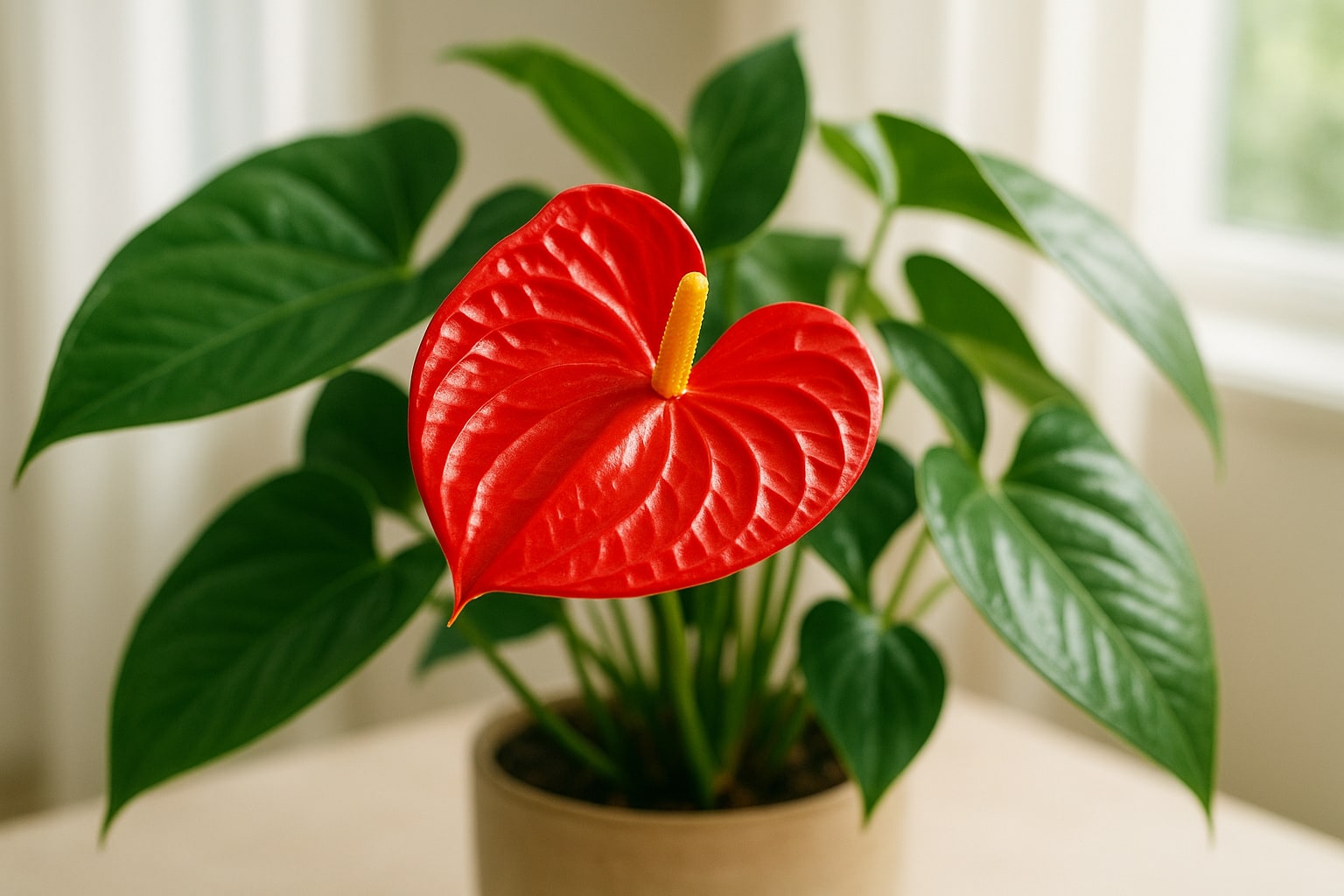
The anthurium (Anthurium andraeanum) is one of those plants that, once it finds its spot, never stops flowering. Its red, pink or white “flowers” (they are actually spathes, modified leaves) can last between 6 and 8 weeks each, and a healthy plant produces between 4 and 6 flushes a year.
The problem is that many people buy it in bloom, enjoy the first flush and then only get leaves. It’s not bad luck: it’s a mismatch in light, humidity or fertilizer. Let’s go over what it needs to bloom almost without pause.
Anthurium quick facts
| Factor | Value |
|---|---|
| Scientific name | Anthurium andraeanum |
| Origin | Humid forests of Colombia and Ecuador |
| Light | 10,000-20,000 lux, no direct sun |
| Temperature | 18-28 °C |
| Ideal humidity | >60 % |
| Watering | Every 5-7 days in summer, 10-14 in winter |
| Fertilizer | NPK 3-1-2 every 15 days (spring-summer) |
| Flowering | Continuous if conditions are stable |
Why your anthurium isn’t flowering (the 3 real causes)
Before changing anything, identify the problem. In 90% of cases it’s one of these three:
- Too little light. If it’s in a dark corner, it produces small leaves and no flowers.
- Lack of phosphorus. A generic fertilizer with low P keeps the plant alive but without spathes.
- Low humidity and dry air. Below 50% humidity, flower buds abort before opening.
Overwatering also slows flowering, because it rots the roots and the plant stops investing in reproduction.
Light: the number one factor
In nature the anthurium lives as an epiphyte or semi-epiphyte under the rainforest canopy. It needs bright, filtered light, never direct midday sun.
At home, the ideal spot is 1-2 meters from a window facing east or north. In a south-facing window, shield it with a sheer curtain. As a practical reference: if you can read without turning on the light all day, there is enough light.
If you live in a dark flat, a LED grow light of 20-30 W placed 30-40 cm from the plant, on for 10-12 hours a day, fully makes up for natural light.
Watering: neither puddle nor desert
The classic mistake is watering on a fixed schedule. The anthurium wants the substrate slightly moist, never waterlogged and never completely dry.
The rule: push your finger 2-3 cm into the substrate. If you feel moisture, wait. If that layer is dry, water until water comes out of the drainage holes and empty the saucer after 10 minutes.
- Spring-summer: every 5-7 days.
- Autumn-winter: every 10-14 days.
- Water: at room temperature, low in lime. If your water is hard, use rainwater or filtered water.
Ambient humidity: the trick almost nobody uses
Here is the key to continuous flowering. An anthurium at 40% humidity survives; at 60-80% it blooms nonstop.
Options, ordered by effectiveness:
- Humidifier near the plant (the most reliable).
- Tray with wet expanded clay or gravel under the pot, without the base touching the water.
- Grouping plants (they create a humid microclimate).
- Misting the leaves in the morning (helps little, but doesn’t hurt).
In bright bathrooms and kitchens it often blooms on its own, precisely because of the humidity.
Substrate and pot: aeration above all
Anthurium roots are aerial and need oxygen. A dense garden-soil substrate suffocates them.
Recommended mix:
- 40% fine pine bark (orchid-type)
- 30% coconut fiber or peat
- 20% perlite
- 10% charcoal
Pot with large drainage holes, preferably plastic rather than clay (clay dries out too much). Repot every 2-3 years, in spring, moving up only one pot size.
Fertilizer: the detail that triggers flowering
For continuous flowering, use a fertilizer with NPK 3-1-2 or similar, designed for flowering plants. Diluted to half the dose on the package, every 15 days from March to October.
In winter, suspend it or reduce to once a month. An occasional extra of phosphorus (P), such as an orchid fertilizer, helps produce new spathes. Never fertilize dry substrate: water first so you don’t burn the roots.
If you want to explore other houseplants with similar care, take a look at Calathea orbifolia and why calatheas are so dramatic: they share a love of high humidity.
Pruning and maintenance
With clean shears, cut the wilted flowers at the base of the stem, not halfway up. This keeps the plant from spending energy ripening the old spathe and redirects it to new shoots.
Also remove yellow or damaged leaves. Wipe dust off the leaves once a month with a damp cloth: a dirty leaf photosynthesizes less and produces fewer flowers.
Common problems
- Yellow leaves: overwatering or water with a lot of lime.
- Brown tips: low ambient humidity or hard water.
- Small, greenish spathes: lack of light.
- Mealybugs: clean with a cotton swab and 70% diluted isopropyl alcohol.
FAQ
How long does an anthurium take to bloom again? Between 6 and 12 weeks after the last flower drops, if conditions are right. If more than 4 months pass without a flower, check light and fertilizer.
Is it toxic to dogs and cats? Yes. It contains calcium oxalate crystals that irritate the mouth and digestive tract. Keep it out of reach of pets.
Can I keep it outside, on a terrace? Only if you live in a mild climate (minimums above 15 °C) and in protected shade. Below 12 °C it suffers and stops flowering.
Why do new flowers come out green? Usually lack of light. Move the plant to a brighter spot and the next spathes will come out in full color.