Phalaenopsis Orchid: Proper Watering and Other Myths Worth Dispelling
A practical guide to watering your Phalaenopsis orchid correctly and debunking the most common myths: ice cubes, daily misting, and a fixed weekly watering schedule. With data on light, substrate, and repotting.
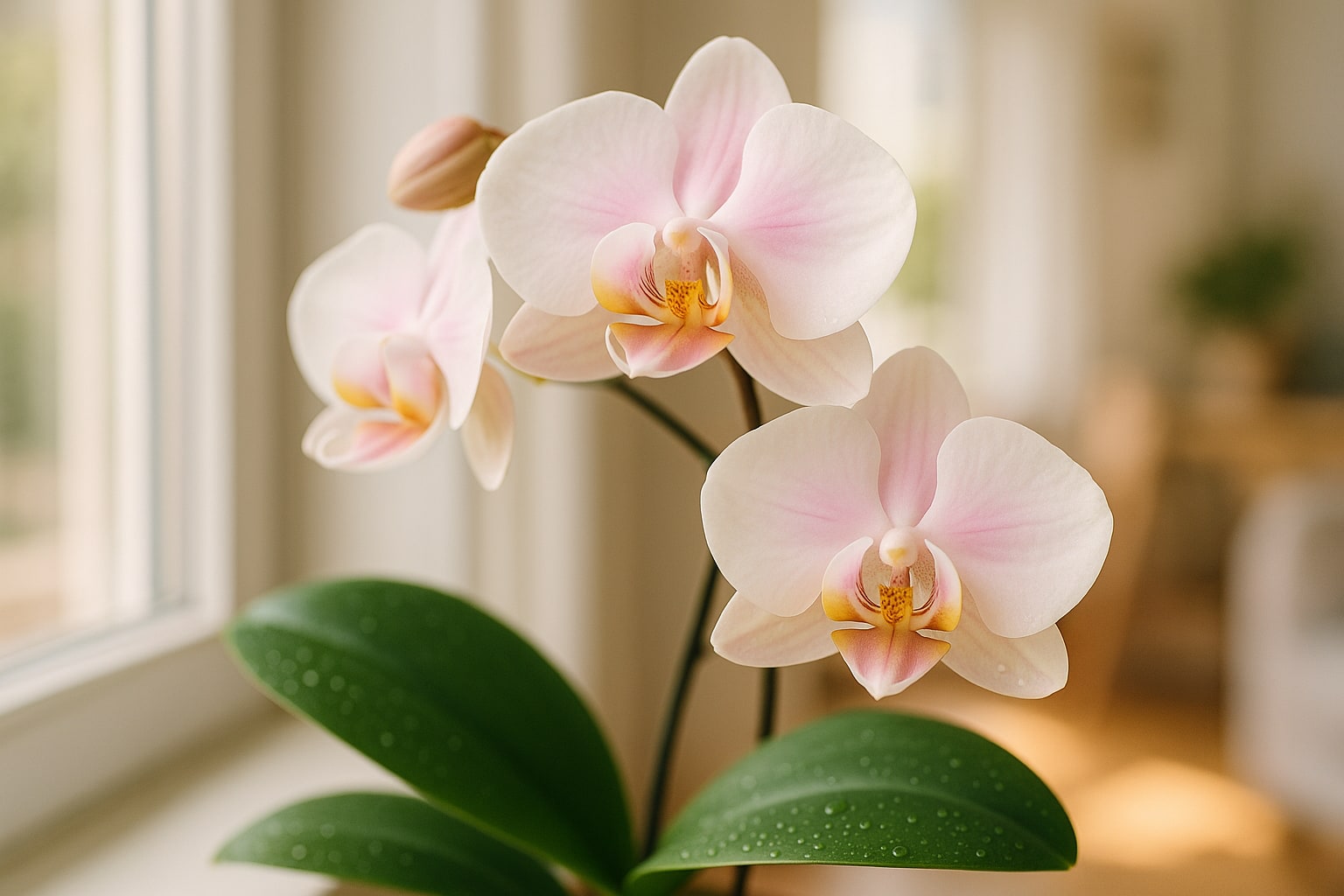
The moth orchid (Phalaenopsis spp.) is the most widely sold flowering plant in the world. It is tough, blooms for months, and adapts well to an ordinary living room. But it also carries more myths than almost any other houseplant: ice cubes, misting the leaves every day, watering every Sunday without fail.
The reality is simpler and, above all, more botanical. The Phalaenopsis is a tropical epiphyte: in its natural habitat (Southeast Asia, the Philippines, northern Australia) it grows clinging to tree trunks, with its roots exposed to the air and under filtered light beneath the canopy. Understand that, and you understand how to care for it.
Phalaenopsis quick facts
| Feature | Value |
|---|---|
| Scientific name | Phalaenopsis spp. |
| Origin | Southeast Asia, the Philippines, N. Australia |
| Type | Epiphyte (grows on trees) |
| Ideal light | 10,000–20,000 lux, no direct sun |
| Approx. watering | Every 7–14 days depending on the season |
| Temperature | 18–28 °C |
| Ambient humidity | 50–70 % |
| Lifespan | 10–15 years with good care |
Proper watering: forget the calendar
The most common mistake is watering by routine. The Phalaenopsis isn’t watered on Sundays; it’s watered when it asks for water. And how does it ask? By showing you its roots.
In a transparent pot (not decorative, functional), healthy, hydrated roots are green. When they start to turn silvery or grey, it’s time to water. It’s that simple.
In practice, this usually means:
- Spring–summer: every 7–10 days.
- Autumn–winter: every 12–20 days.
But the calendar is only a guide. A flat with heating dries out the substrate faster than a cool, humid one.
How to water step by step
The most reliable method is immersion watering:
- Take the transparent pot out of the decorative pot.
- Submerge it in a container of room-temperature water for 10–15 minutes.
- Let it drain thoroughly, for at least 10 more minutes. No standing water in the bottom.
- Put it back in its place.
The ideal water is soft and chlorine-free: rainwater, reverse-osmosis water, or tap water left to stand for 24 hours. Orchids are sensitive to limescale.
Watering myths: true or false
| Myth | Is it true? |
|---|---|
| Watering with ice cubes | False. Thermal shock for a tropical plant |
| Misting the leaves daily | False. Encourages fungus in the crown |
| Always water on Sundays | False. Depends on the substrate and season |
| Aerial roots must be buried | False. They are normal and functional |
| If it doesn’t bloom, it’s dead | False. It rests between blooming periods |
The ice cube myth
It has been circulating online for years. The theory holds that three ice cubes a week provide just the right amount of water. But the Phalaenopsis evolved in climates where temperatures rarely drop below 18 °C. Wetting its roots with water at 0 °C is unnecessary thermal stress, although some studies under very controlled conditions suggest plants survive it. Surviving is not thriving.
The misting myth
Misting the leaves creates a humid microclimate which, combined with the poor ventilation of a living room, is fertile ground for crown rot (the centre where the leaves emerge). If you want to raise the ambient humidity, use a tray of gravel with water beneath it, or a humidifier.
Light: neither darkness nor direct sun
The Phalaenopsis needs bright, filtered light, equivalent to 10,000–20,000 lux. A window facing east is the perfect spot. Facing south, always use a sheer curtain. Facing north, it can survive but will bloom less.
If the leaves turn reddish or yellowish, it’s getting too much sun. If they are deep, intense dark green and the plant doesn’t bloom, it needs more light.
Substrate: bark, not soil
Never use ordinary soil. The roots suffocate. The standard substrate is pine bark of medium grade, sometimes mixed with sphagnum moss or perlite.
- Bark: drains quickly, lower risk of rot. Requires more frequent watering.
- Sphagnum moss: retains a lot of water. Useful in very dry environments, dangerous if you water without control.
For beginners, pure bark is the safest option.
Repotting: every 2–3 years
The substrate breaks down. When the bark crumbles between your fingers, it’s time to change it. Do it after flowering, never with the flower spike still in bloom. Choose a transparent pot and only one size larger if the roots don’t fit. Orchids like to be snug.
Trim only roots that are clearly dead (brown, soft, and hollow) with disinfected scissors.
Common mistakes
- Leaving water pooled in the decorative pot.
- Watering with cold water or tap water with a lot of limescale.
- Cutting the aerial roots for aesthetic reasons.
- Moving it when the flower spike appears (causes the buds to abort).
- Over-fertilising: a specific orchid fertiliser diluted to half strength, every 2–3 waterings in spring–summer, is enough.
If you’re interested in other houseplants with a reputation for being dramatic but more manageable than they seem, take a look at how to handle the quirks of the Calathea orbifolia.
FAQ
How long does a Phalaenopsis live? With proper care, 10 to 15 years. It blooms once or twice a year, and each flowering can last up to 3 months.
What do I do with the flower spike after the flowers fall? If the spike is still green, cut it above the second or third node: it may rebloom. If it dries out and turns yellow, cut it from the base.
Can I keep the orchid in the bathroom? Yes, as long as it gets enough natural light. The bathroom usually offers the humidity this plant appreciates, provided there is ventilation.
Why do the leaves wrinkle? It is almost always a root problem: either they are dehydrated from lack of water, or rotten from too much. Take the plant out of its pot and check the roots.
Is it toxic to cats and dogs? Phalaenopsis orchids are not listed as toxic in the ASPCA databases, unlike some other houseplants. Even so, it is not advisable for pets to chew on them.