Zamioculcas zamiifolia: the ZZ plant and its surprising tolerance of shade
Find out why the ZZ plant (Zamioculcas zamiifolia) survives in corners with little light and how to care for it with spaced-out watering and minimal effort.
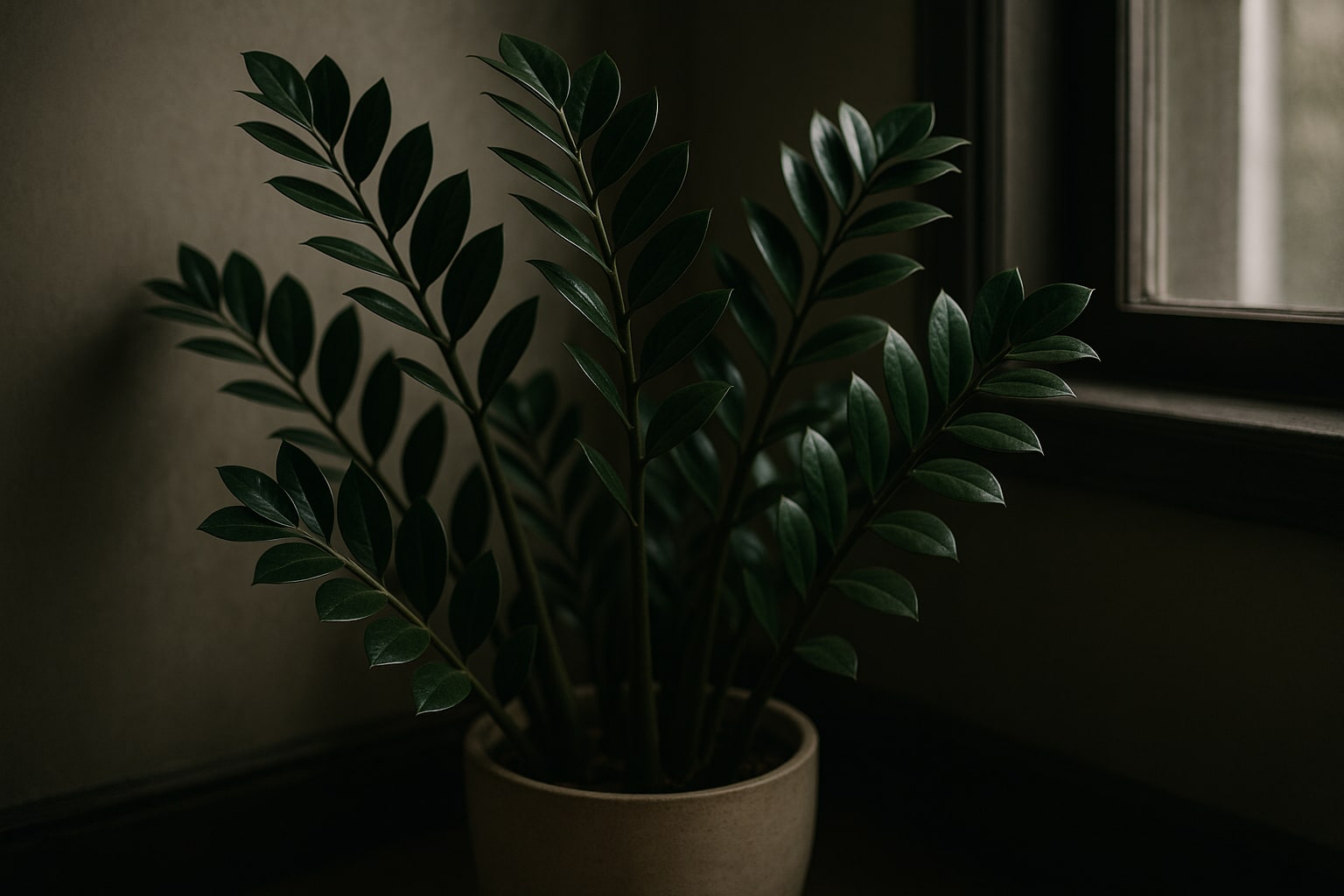
If you’re looking for a houseplant that can take whatever you throw at it (or whatever you forget), the ZZ plant is probably the undisputed champion. Its scientific name is Zamioculcas zamiifolia, and for a couple of decades it has been becoming the favorite of offices, dim hallways and apartments with north-facing windows. It can go weeks without water, tolerates shade and grows slowly but steadily.
Behind those glossy leaves lies some very interesting biology: underground rhizomes that act as water reservoirs. That explains almost everything you need to know to care for it.
Origin and why it has become so popular
The Zamioculcas zamiifolia is native to East Africa, specifically areas of Kenya, Tanzania and Zanzibar. It lives in environments where long dry seasons alternate with intense rains, so it has evolved to store water reserves.
It became popular as a houseplant from the 1990s onward, when Dutch nurseries began marketing it on a large scale. Today it is one of the best-selling houseplants in the world, mainly for one reason: it is nearly indestructible for the beginner gardener.
How to identify it: leaves, stems and rhizomes
It’s easy to recognize. Its stems (technically thickened petioles) grow upright from the base and can reach 60 to 90 cm indoors. From them sprout oval, fleshy, very glossy leaves, arranged in pairs along the stem. The appearance is so polished that many people, upon touching it, think it’s artificial.
Beneath the substrate you will find the rhizomes: tuber-like structures resembling potatoes that store water and nutrients. They are the key to its resilience.
Light: why it tolerates shade like few others
Here lies its great advantage over other houseplants. The ZZ plant tolerates low, indirect light without dying, something very few species can withstand. It can live in rooms with only 50-100 lux (a poorly lit office) for weeks, although its growth will almost completely stop.
Its optimum is bright indirect light, at around 800-1,500 lux. There it will produce new leaves every few weeks in spring and summer. Avoid direct sunlight: it scorches the leaves and turns them yellowish.
How long can it last without natural light? Plant physiology studies indicate it can survive on artificial light alone (office fluorescent or LED lighting) for months, although it won’t grow.
Watering: less is more
If you kill a ZZ plant, it’s almost certainly from overwatering. Its rhizomes rot easily if the substrate stays waterlogged.
The practical rule:
- Spring and summer: water every 10-15 days, letting the top 3-4 cm of substrate dry out completely.
- Autumn and winter: every 20-30 days is enough.
- Water: at room temperature, preferably left to stand for 24 hours to remove chlorine.
If you’re unsure whether to water or not, don’t. It endures 3-4 weeks of drought without batting an eye.
Substrate and repotting
It needs a well-draining substrate. A suitable mix: 60% universal potting soil, 30% perlite and 10% coarse sand. The ideal pH is around 6.0-7.0.
Repot it every 2-3 years, preferably in spring. You’ll know it’s time when the rhizomes start deforming the pot from within. Always use pots with drainage holes.
Temperature and humidity
It tolerates the typical household range well: 18-26 °C. Below 15 °C it stops growing, and below 10 °C it begins to suffer damage. Don’t keep it near cold windows in winter or in drafts.
Ambient humidity is not a major concern. It does well both in dry apartments with heating and in more humid areas. You don’t need to mist it.
Toxicity: watch out for pets and children
Let’s be clear: the ZZ plant is toxic if ingested. It contains calcium oxalate throughout its structure, especially in the leaves and stems. If a dog, cat or child chews on any part, it can cause mouth irritation, excessive salivation and vomiting.
It’s not fatal in small doses, but it is unpleasant. If you live with curious animals, place it up high or consider another species. If ingestion occurs, see a veterinarian. If you have young cats, you may also want to read about how to socialize an adult cat and prevent plant-exploring behavior.
Common problems
- Yellow leaves: almost always from overwatering. Let the substrate dry out and check the rhizomes.
- Soft, drooping stems: rhizome rot. Remove the plant, cut away the damaged parts and repot in dry substrate.
- Brown tips: too much direct sun or water with too much chlorine.
- Mealybugs: clean the leaves with a cotton swab soaked in 70% isopropyl alcohol.
Propagation: patience above all
It multiplies by rhizome division when repotting or by leaf cuttings. The second method is slow: a leaf placed in water or moist substrate can take 6-9 months to form a small rhizome. It’s not for the impatient.
Benefits: does it purify the air?
A study from the University of Copenhagen (2014, Fjeld & Bonnevie) showed that the Zamioculcas zamiifolia absorbs volatile organic compounds such as benzene, toluene and xylene from indoor air. The real effect in a home is modest, but it adds up.
FAQ
How long can the ZZ plant go without water? Between 3 and 4 weeks without problems indoors. In winter, even longer.
Can it live in a bathroom without a window? Yes, as long as artificial light is on for several hours a day. It will grow very slowly.
Why isn’t my ZZ plant growing? It’s usually a lack of light. Move it near a window with bright indirect light and wait for spring.
Is it suitable for beginners? Yes, it is one of the easiest houseplants there is. You just have to resist the temptation to overwater it.
Can I keep it with cats? It is toxic if chewed. Place it out of their reach or choose another non-toxic species.