Emperor penguin: life and survival in Antarctica
Discover how the emperor penguin (Aptenodytes forsteri) survives at -60 °C, breeds on sea ice, and why its future depends on the Antarctic thaw.
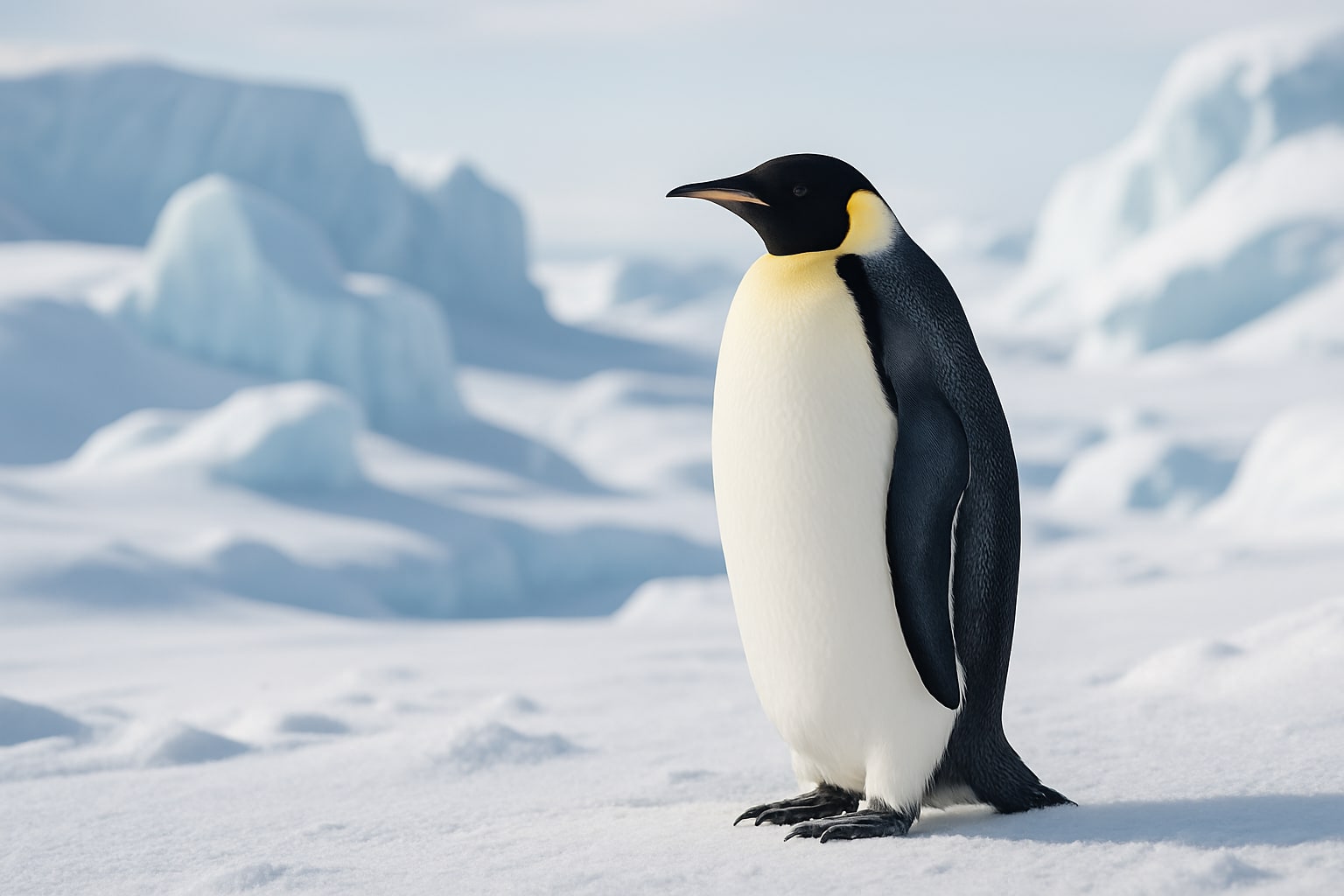
The emperor penguin (Aptenodytes forsteri) is the bird that best embodies extreme life. It breeds in the middle of the austral winter, on sea ice, with winds exceeding 150 km/h and temperatures close to -60 °C. No other vertebrate species breeds under such conditions.
And today it is back in the spotlight. The accelerated loss of Antarctic sea ice has led the IUCN to reclassify its status, and recent studies report massive breeding failures across entire colonies. Let’s look at the data.
Identification: the largest penguin in the world
The emperor is, by a wide margin, the largest living penguin species. Adults measure between 100 and 130 cm in height and weigh between 22 and 45 kg, with an annual peak just before the breeding season. Males are slightly heavier than females.
It is distinguished by its jet-black plumage on the back, white belly, and bright yellow patches on the sides of the neck that fade toward the chest. Chicks are grey with a white and black face, a pattern easy to recognise in documentaries.
Its life expectancy in the wild is around 15-20 years, although some individuals have been recorded living beyond 30. In captivity, very few zoos in the world keep it: its thermal and social needs are extreme.
Habitat and distribution: only in Antarctica
The emperor penguin’s habitat is circumantarctic. It lives exclusively in Antarctica and its coastal waters, between latitudes 66° and 78° south. You will not find it in South America, the Falklands, or New Zealand: those are other penguins.
It depends on a very specific type of ice: fast ice, the sea ice anchored to the continent that remains stable during the austral winter. It forms its breeding colonies on this platform, always close to the ice edge to have access to the sea.
Around 60-66 breeding colonies have been described along the continent, many of them identified by satellite thanks to guano stains visible from space.
Feeding and behaviour: extreme divers
Its diet consists mainly of Antarctic fish (especially of the genus Pleuragramma), krill (Euphausia superba) and squid. An adult can consume 2-3 kg of food per day during intensive feeding periods.
To obtain it, it dives like few others. Documented records describe routine dives to 150-250 metres and maximums of over 500 metres in depth, with breath-holds that can exceed 20 minutes. Its haemoglobin and myoglobin store oxygen in an exceptionally efficient way.
On land, the key behaviour for surviving the winter is huddling: hundreds or thousands of individuals crowd together and slowly rotate, so that those on the outside move gradually into the warm interior. Within the group the temperature can reach around 35 °C while outside it is -40 °C.
Emperor penguin reproduction: incubating on the feet
The breeding cycle is unique. At the start of the austral winter (March-April), the adults walk 50-120 km over the ice to the colonies. The female lays a single egg in May or June and transfers it to the male, who incubates it for about 65 days on his feet, covered by a fold of skin called the brood pouch.
During this time, the male does not eat: he survives on his fat reserves and can lose up to 45% of his body weight. The females, meanwhile, return to the sea to feed. When they come back in the middle of winter, they relieve the males, and both parents take turns until the chick becomes independent in December-January.
This calendar is calibrated to the sea ice. If the ice breaks up before the chicks have moulted their waterproof juvenile plumage, they drown or freeze to death.
Conservation status and threats
The IUCN reclassified the emperor penguin as Near Threatened (NT) in 2012, and several later studies have called for upgrading it to Vulnerable (VU) due to the projected impact of climate change. The global population is estimated at around 250,000-300,000 breeding pairs, according to satellite censuses published in journals such as Global Change Biology and Communications Earth & Environment.
The main threat is the loss of fast sea ice. In the 2022 season, a study published in 2023 (Fretwell et al., Communications Earth & Environment) documented the total breeding failure of four colonies in the Bellingshausen Sea after premature ice breakup. Current climate models project that, if emissions follow a high trajectory, more than 80% of colonies could be quasi-extinct by 2100.
In 2022, the USA included the emperor in its Endangered Species Act as a threatened species, an unusual move for a species not present in its territory. In the Antarctic context, the Antarctic Treaty and CCAMLR regulate krill fishing, although the underlying problem is global climate.
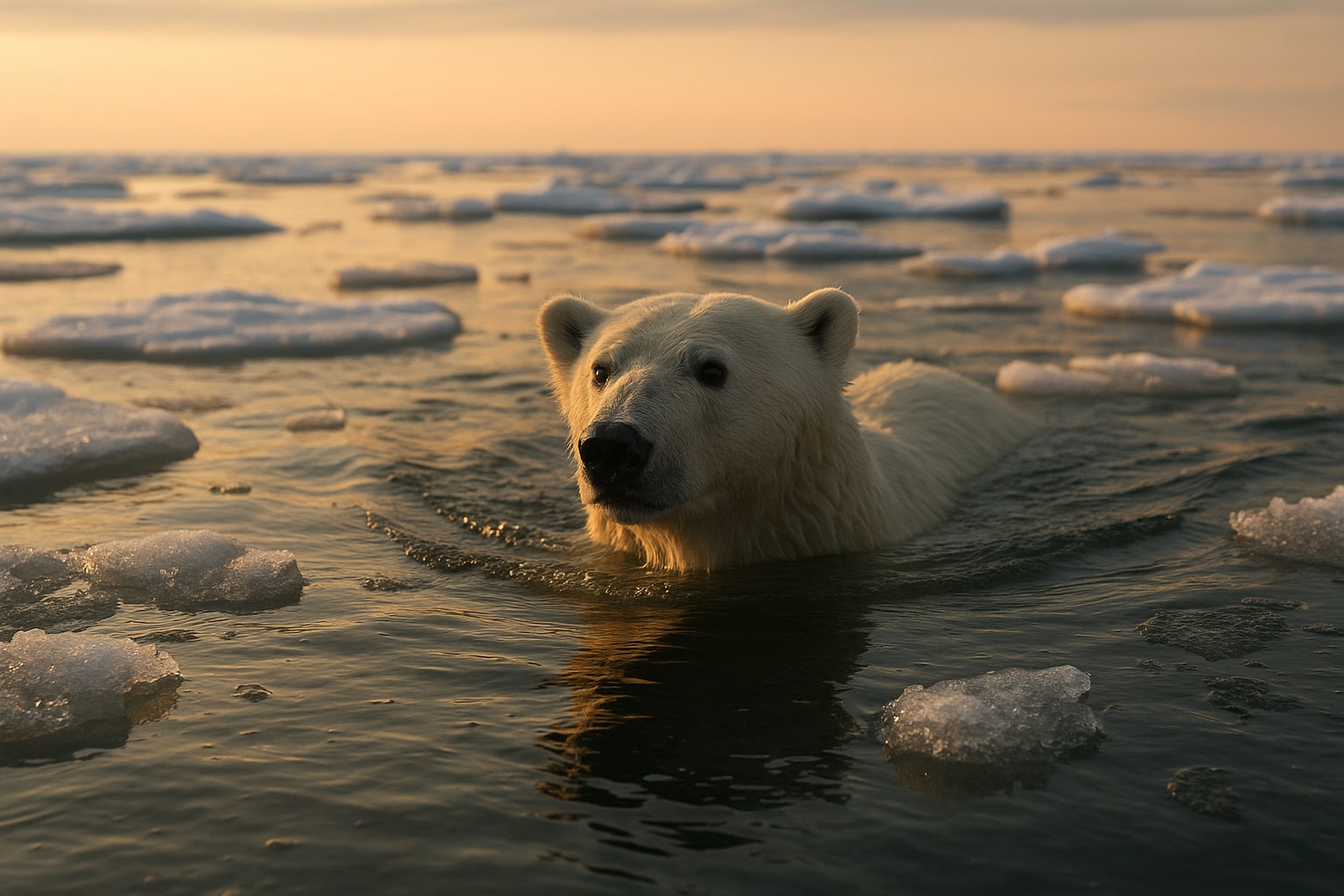
Another polar species in trouble from the same cause is the polar bear, whose decline is linked to Arctic sea-ice loss.
Verifiable curiosities
- It does not drink liquid water in winter: it obtains water by metabolising its fat and eating snow.
- Its feathers are the densest of any bird: about 100 feathers per cm², which, combined with a layer of fat up to 3 cm thick, act as insulation.
- Chicks form crèches called crèches while the adults go fishing.
- Colonies are discovered by satellite: the British Antarctic Survey identified several new ones in 2019 and 2023 thanks to guano stains visible in Sentinel imagery.
Frequently asked questions
How long does an emperor penguin live? Between 15 and 20 years in the wild, with exceptional cases above 30. Juvenile mortality in the first year is very high.
How many emperor penguins are left? Between 250,000 and 300,000 breeding pairs according to the latest satellite censuses, although the trend is downward.
Why is the emperor penguin endangered? Because it depends on fast sea ice to breed. If the ice breaks up too early, the chicks die. Climate change is the main threat.
Can you keep an emperor penguin as a pet? No. It is a wild species protected by the Antarctic Treaty. Its capture, possession, and trade are prohibited.
How deep does it dive? Usually between 150 and 250 metres, with documented records of over 500 metres and breath-holds longer than 20 minutes.