TOP 5 non-human artists: when nature creates by instinct
Five species display artistic behaviors: they build structures, patterns, or beautiful forms for courtship, protection, or communication.
On the vast stage of the animal kingdom, there are behaviors that go beyond mere survival. Among them are certain behaviors that, although born from evolutionary instincts, possess an undeniable aesthetic component. We are not talking about art as humans understand it, with the conscious intention of creative expression, but about creations that fulfill biological functions and, at the same time, exhibit beauty, precision, and a sense of design that captivates scientists and observers.
These behaviors are the result of millions of years of natural selection, where aesthetics and functionality are intertwined. The structures, patterns, or compositions these animals build are not superfluous decorations: they have a clear purpose, such as attracting a mate, protecting offspring, or communicating with other individuals. Yet what is surprising is that, in their execution, they reach levels of symmetry, harmony, and detail that evoke the most elaborate human creations.
From the ocean depths to the canopy of the tropical rainforest, we find fascinating examples. A fish that traces intricate sand mandalas, birds that design installations based on color criteria, primates that play with shape and texture, marine mammals that sculpt in water, and even arachnids that draw geometries suspended in the air. Each one, with its biological tools and limitations, creates pieces that disappear over time, reminding us that beauty in nature is often ephemeral.
In this article, we will explore five of the most striking cases of “artist” animals, analyzing not only how and why they develop these abilities, but also what they tell us about the relationship between instinct, intelligence, and aesthetics in evolution.
Japanese pufferfish (Torquigener albomaculosus)
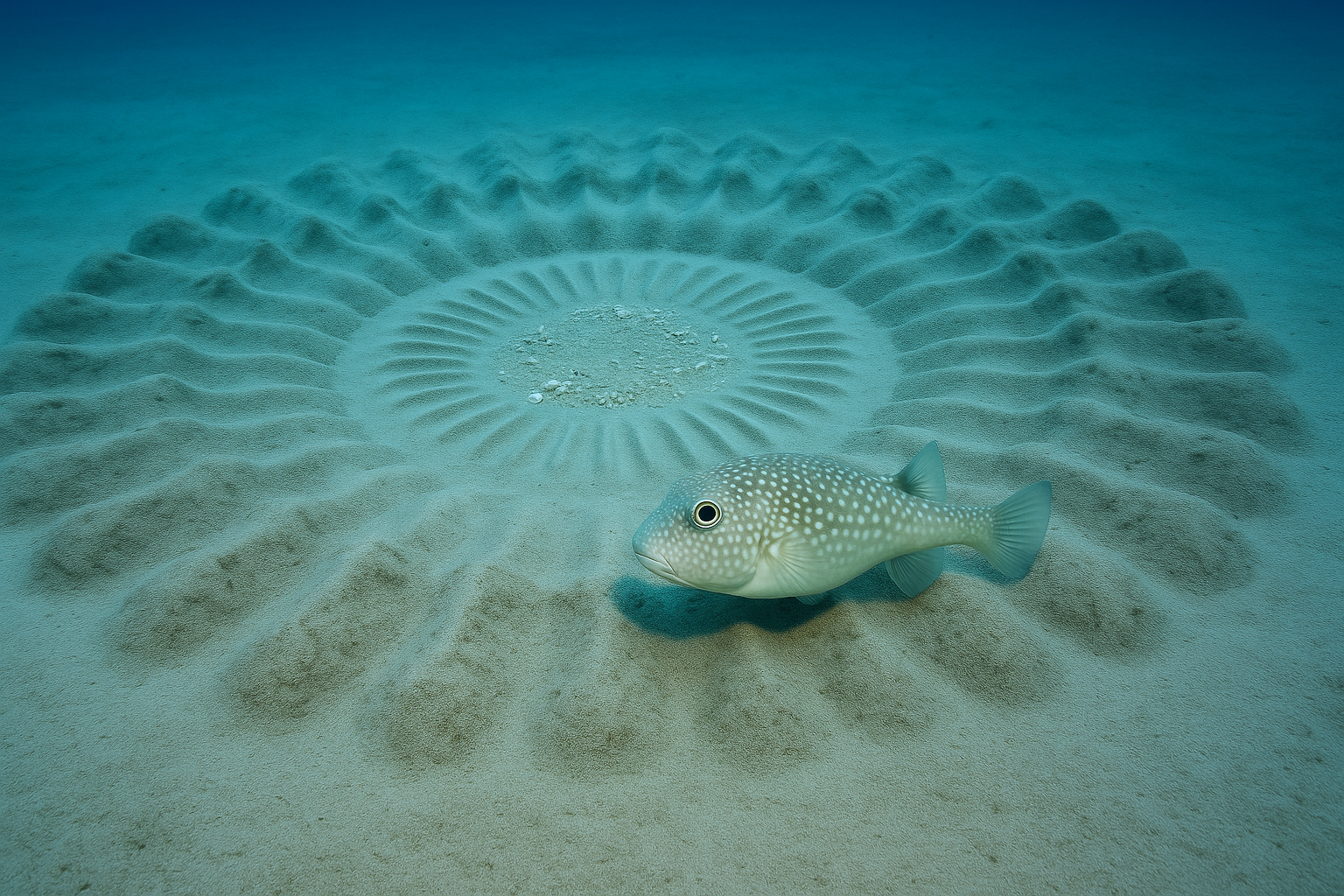
In the temperate waters of the Pacific, at depths of between 10 and 30 meters, lives a small pufferfish that has fascinated biologists and divers alike. Males of Torquigener albomaculosus, measuring barely 12 centimeters, carry out a monumental task: they build elaborate circles in the sand up to two meters in diameter. Through repetitive and precise movements of their fins, they sculpt ridges and valleys in concentric patterns, decorating the center with shells and fragments of coral.
This work can last between 7 and 9 days, during which the fish barely strays from its project. Its purpose is to court females, who inspect these structures before deciding with whom to mate. Research suggests that the symmetry, complexity, and cleanliness of the circle are indicators of the male’s health and skill. But what astonishes is the geometric perfection, worthy of a compass and ruler, achieved solely through the movement of its body. When ocean currents erase the work, the fish starts over, demonstrating that in nature art can be as fragile as it is constant.
Bowerbirds (Ptilonorhynchus and other species)
In the humid forests of Australia and New Guinea, the males of these birds have turned courtship into an exercise in architecture and interior design. Bowerbirds build structures called bowers, which are not nests for raising young but ornamental stages designed to impress females. There are different forms depending on the species: some erect avenues of aligned sticks, others build domes or even “walls” of branches.
Once the structure is built, decoration begins. They use flowers, feathers, stones, and eye-catching objects such as bottle caps or fragments of glass. They do not place these elements at random: they arrange them by color, creating gradients or contrasts, and in some cases manipulate perspective so that females see the structure as larger than it really is. Studies have shown that color variety and the order of objects influence the likelihood of reproductive success. What is fascinating is that this behavior combines sexual selection, spatial memory, and a remarkable aesthetic sensitivity.
Orangutan (Pongo pygmaeus and Pongo abelii)
High in the rainforests of Borneo and Sumatra, orangutans build a new nest every night. Although their main function is to provide a safe and comfortable place to sleep, the way they select, fold, and interweave branches reveals precise knowledge of materials and extraordinary manual dexterity. Some add leaves from certain species that repel insects or provide a special cushioning, and in certain cases they include elements that seem to have a more ornamental than practical purpose.
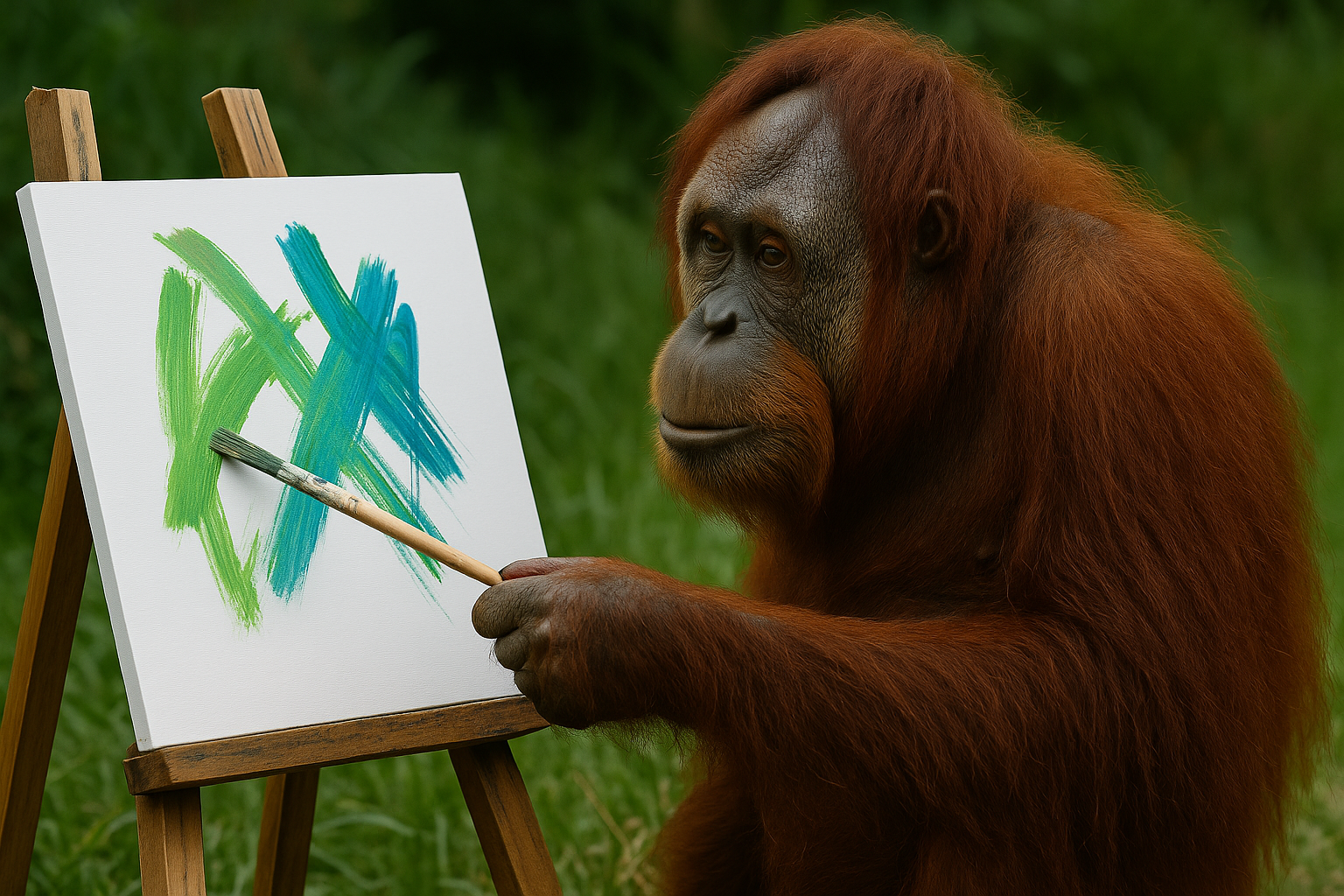
In captivity, the creativity of these primates manifests differently. Numerous zoos have documented orangutans painting with brushes or even with their hands, creating abstract patterns on paper or cloth. While it is debatable whether they understand the human concept of art, they do show intention in their choice of colors, repeating strokes and exploring new combinations. This behavior, beyond aesthetics, suggests that creativity may have deep roots in animal cognition.
Bottlenose dolphin (Tursiops truncatus)
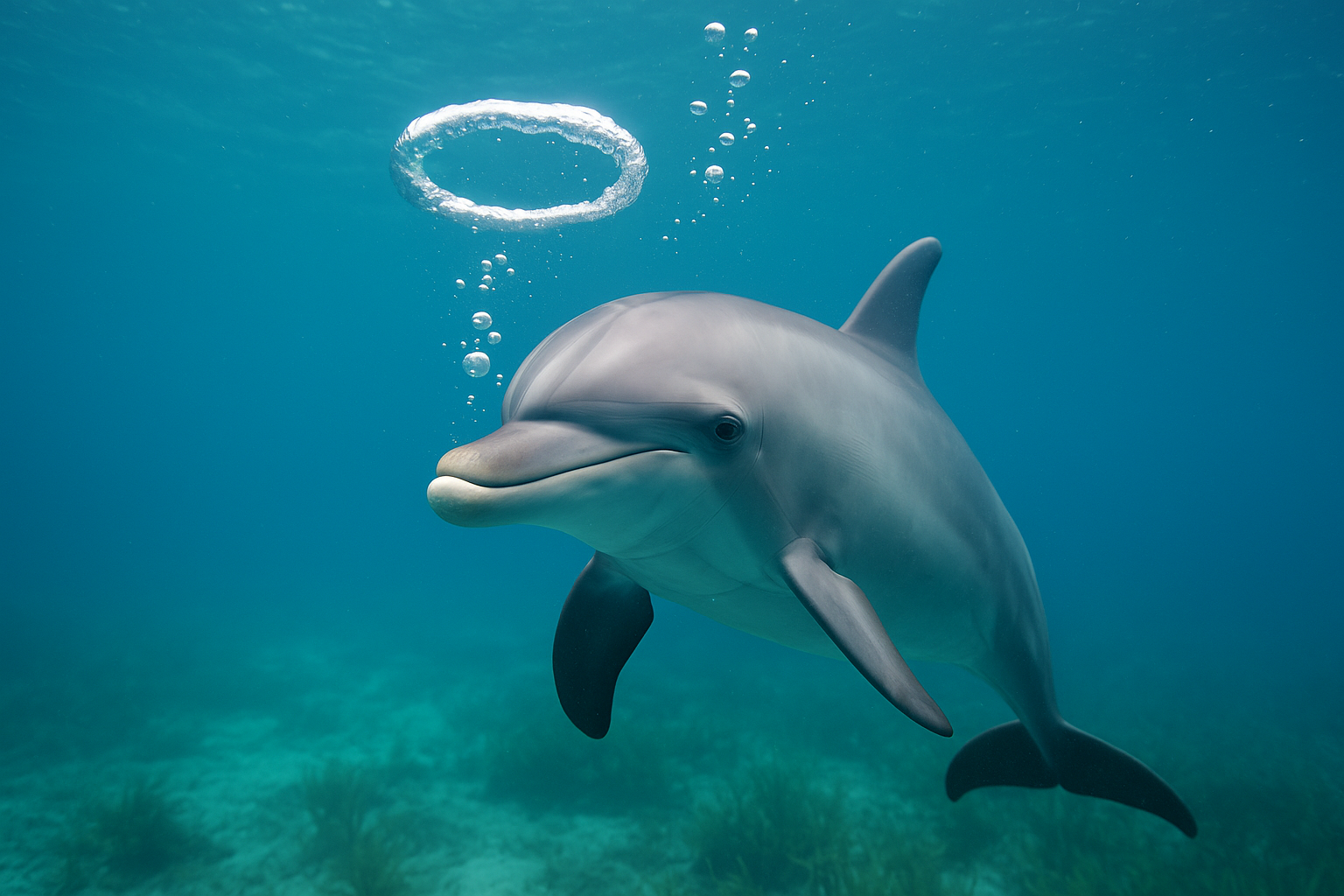
Bottlenose dolphins are known for their intelligence and complex social interactions, but also for their ability to “sculpt” in water. Using their blowhole or precise movements of their fins, they generate perfectly circular bubble rings that rise slowly to the surface. Once formed, they manipulate them: they spin them, split them, or swim through them, as if molding an ephemeral piece.
Although this behavior was initially interpreted as simple play, prolonged observations have shown that it may play a role in courtship and social cohesion. The precision needed to create stable rings requires control of breathing and an understanding of water flow, implying a remarkable capacity for planning. From an aesthetic perspective, these rings are authentic temporary sculptures, made of air and movement.
Orb-weaving spiders (Argiope and related species)
Orb-weaving spiders produce webs with nearly perfect radial symmetry, the result of a construction pattern programmed by their genetics, yet which to the human eye appears extraordinarily beautiful. In some species, such as Argiope argentata, stabilimenta appear, zones of thicker silk that form visible shapes, from zigzags to complete discs.
The purpose of these structures still generates debate. Some studies indicate they may serve to attract males, others suggest they act as signals so that birds and other animals avoid breaking the web, or even as camouflage elements. Whatever their function, the result is a complex design that combines materials engineering—spider silk is stronger than steel by weight—with a visual sense that seems to go beyond what is necessary for catching prey.