Meerkat: the clan life of the desert's tiny sentinels
Discover the meerkat (Suricata suricatta), the small carnivore from southern Africa that lives in hierarchical clans and organizes shifts of lookout duty. Data, habitat and cooperative behavior explained rigorously.
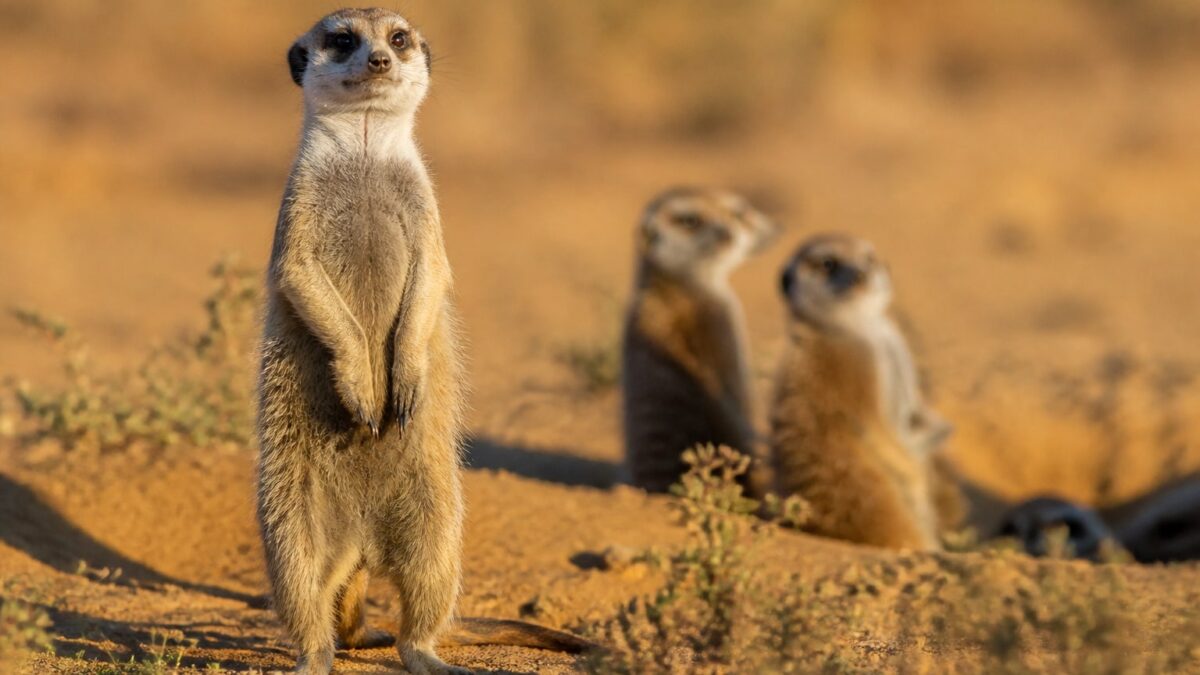
Few species have done as much for the fame of the southern African savanna as the meerkat (Suricata suricatta). Standing upright on its hind legs, scanning the horizon, it has become an icon of nature documentaries. But behind that posture lies a complex social system, studied for decades in the Kalahari.
It lives in a very specific region of the planet and depends on cooperative behavior so strict that, without a clan, a meerkat has only slim chances of survival. Let’s look at it calmly.
Meerkat quick facts
| Data | Value |
|---|---|
| Scientific name | Suricata suricatta |
| Family | Herpestidae (mongooses) |
| Size | 25-35 cm body + 17-25 cm tail |
| Weight | 620-970 g |
| Lifespan | 6-7 years in the wild, up to 12-14 in captivity |
| Habitat | Deserts and arid savannas of southern Africa |
| IUCN status | Least Concern (LC) |
Identification: what a meerkat looks like
The meerkat is a small carnivore of the family Herpestidae, the same as the mongooses. It is not a rodent, although its slender silhouette may cause confusion.
It measures between 25 and 35 cm in body length, with a thin, pointed tail of 17 to 25 cm that it uses as a tripod when it stands up. Its weight ranges from 620 to 970 grams. Its fur is sandy brown with dark transverse bands on the back, a pointed snout and prominent black eye patches that reduce sun glare in the eyes, very useful in such a bright environment.
Its long, curved front claws are digging tools. It digs a lot and fast.
Habitat and distribution: the Kalahari realm
The meerkat inhabits southern Africa: South Africa, Namibia, Botswana and southwestern Angola. Its typical territory is arid and semi-arid plains, with a particular presence in the Kalahari Desert and the Namib.
It prefers hard or sandy soils with good visibility, where it can detect predators at a distance. It is rarely found in dense forests or areas with tall vegetation. It needs to see.
It lives in extensive burrows, often inherited or shared with Cape ground squirrels (Xerus inauris) and yellow mongooses (Cynictis penicillata). A single tunnel system may have several dozen entrances and be used for years by successive clans.
Diet: opportunistic insectivore
The meerkat is mainly insectivorous. Its diet is based on beetles, larvae, grasshoppers, termites, spiders and scorpions. Yes, scorpions too: it has developed a certain resistance to venom and a technique for pulling out their stinger before eating them.
It completes its menu with small vertebrates: lizards, geckos, young snakes, rodents and, occasionally, bird eggs. It hunts by digging through sand with its claws and relying on its sense of smell. It barely drinks water: it obtains it from its prey and from juicy tubers.
Life in a clan: social structure
A meerkat clan brings together between 3 and 50 individuals, with an average of 10-15. It is a cooperative matriarchal society: a dominant pair monopolizes reproduction and the rest of the group takes part in shared tasks.
The dominant female usually gives birth to 2-5 pups after a gestation of 70 days, and may have 2-3 litters a year if conditions allow. Subordinate females that give birth often see their litters killed by the alpha female; it is a strict reproductive system, documented by the Kalahari Meerkat Project since 1993.
Non-breeding members take on key roles:
- Sentinels: keep watch from a high point.
- Babysitters: look after the pups in the burrow while the others forage.
- Teachers: instruct juveniles in handling dangerous prey, such as scorpions, a rare case of active teaching in non-human mammals (Thornton and McAuliffe, Science, 2006).
The sentinel: why a meerkat keeps watch
The meerkat sentinel is one of the most recognizable images of cooperative animal behavior. One individual climbs onto a termite mound, a rock or a bush and scans the sky and horizon while the clan forages.
If it detects danger, it emits different calls depending on the type and proximity of the threat: a martial eagle approaching is not the same as a jackal 50 meters away. The others react specifically to each call, a referential communication system described by Manser (Proceedings of the Royal Society B, 2001).
Interestingly, lookout shifts are rotational and voluntary, and the sentinel usually eats before starting its watch. It is not sacrificing itself; it is coordinating.
Reproduction and shared rearing
The pups are born blind and weigh about 25-35 grams. They spend the first three weeks in the burrow under the care of rotating babysitters, while the mother goes out to feed. From about a month old they begin accompanying the clan on short outings.
Learning is gradual: first they receive dead prey, then live but harmless prey, and finally scorpions with their stingers intact. It is gradual training that reduces the risk of accidents.
Conservation status
The IUCN classifies the meerkat as Least Concern (LC), with stable populations across much of its range. It is not listed in CITES.
The main local threats are habitat loss due to agricultural expansion, persecution in areas where it is considered a minor pest, and episodes of extreme drought linked to climate change, which affect the availability of insects. Nothing comparable, for now, to the pressure faced by other African carnivores.
Can you keep a meerkat as a pet?
No, and it is worth stressing this. The meerkat is an exotic wild species. In Spain it appears in the Spanish Catalogue of Invasive Alien Species, its possession is restricted, and in most EU countries keeping it requires very specific permits.
On ethical grounds, it is a clan animal: kept alone, it develops stereotypies, aggression and health problems. It is not a ferret or a cat; its social and environmental needs cannot be replicated in an apartment. If you are interested in small domestic carnivores, there is more useful information in the guide to ferrets as pets.
Verifiable curiosities
- They resist scorpion venom at doses that would kill an animal of similar size, although they are not immune and a poorly managed sting can be fatal.
- The Kalahari Meerkat Project, led by Tim Clutton-Brock (University of Cambridge), has followed individually identified clans for more than 30 years, making the meerkat one of the best-documented wild species in the world.
- The black eye patches work in a similar way to the eye black used by American football players: they reduce glare.
- They share burrows with other species without aggression, a notable case of interspecific coexistence.
FAQ
How long does a meerkat live? Between 6 and 7 years in the wild, with high juvenile mortality. In captivity, well cared for, they can reach 12-14 years.
Is a meerkat dangerous? Not to adult humans under normal conditions, but it bites hard if it feels threatened and can transmit rabies. It is not a docile animal.
How many meerkats are there in a clan? From 3 to 50 individuals, with an average of 10-15. The size depends on food availability and the survival of the year’s litters.
Why do they stand up? To widen their field of view and detect aerial and ground predators. They also thermoregulate in the morning, exposing their less furred belly to the sun.
Where can I see them in the wild? In reserves in southern Africa such as the Kgalagadi Transfrontier Park (South Africa/Botswana) or the Makgadikgadi Pans National Park, with frequent sightings at dawn and dusk.
0 comments · Comment