Leatherback sea turtle: the largest marine reptile and its long journey
The leatherback sea turtle (Dermochelys coriacea) is the largest marine reptile on the planet and the only sea turtle without a bony shell. Discover its biology, its transoceanic migration, and why it is classified as vulnerable.
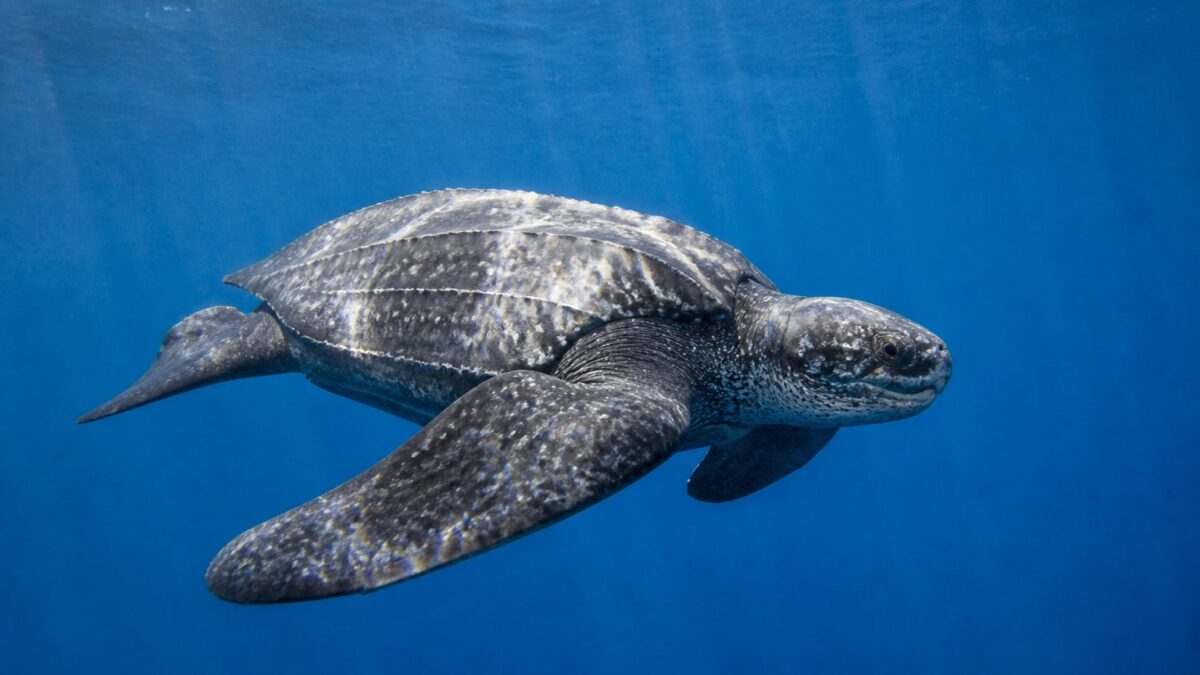
Imagine a reptile capable of diving to more than 1,000 meters deep and crossing entire oceans without resting on dry land for months. That is the leatherback sea turtle (Dermochelys coriacea), the largest sea turtle in existence and one of the reptiles with the longest documented migration.
It lives in virtually every ocean on the planet, from tropical waters to subarctic seas, and its biology breaks several rules one would expect of a turtle. It has no hard shell. It does not warm itself with the sun alone. And it depends almost exclusively on a food as low in nutrition as jellyfish.
Identification: the largest sea turtle on the planet
Unlike other sea turtles, the leatherback lacks a bony shell. Instead, it has a leathery, rubbery skin reinforced by thousands of tiny bony plates, hence its scientific name, coriacea. This flexible structure, marked by seven longitudinal ridges, is its most distinctive feature.
Adult specimens reach between 1.8 and 2.2 meters in carapace length and weigh on average between 250 and 700 kg, although individuals of more than 900 kg have been recorded. It is, by far, the heaviest turtle in the world. Its estimated lifespan is around 45-50 years in the wild, although scientists still lack precise data because it is nearly impossible to keep it in captivity.
| Data | Value |
|---|---|
| Scientific name | Dermochelys coriacea |
| Adult length | 1.8 – 2.2 m carapace |
| Adult weight | 250 – 700 kg (maximum recorded: over 900 kg) |
| Estimated lifespan | 45 – 50 years in the wild |
| Maximum diving depth | More than 1,000 m |
| IUCN status | VU (Vulnerable) |
| CITES appendix | I |
Habitat and distribution: oceans around the world
The leatherback sea turtle has the widest distribution of all marine reptiles. It is found in the Atlantic, Pacific, and Indian Oceans, from tropical nesting areas to waters as cold as those of the Norwegian Sea or the coast of Canada. This is possible thanks to a capacity rare in reptiles: it can maintain its body temperature several degrees above that of the surrounding water, a phenomenon called gigantothermy.
It nests on tropical and subtropical beaches in West Africa, the Caribbean, the Mexican Pacific coast, and Indonesia, among other areas. Outside the nesting season, it spends most of its life in open ocean, far from the coast.
Feeding: an almost exclusive diet of jellyfish
The leatherback’s diet centers on gelatinous cnidarians: jellyfish, salps, and siphonophores. It can consume the equivalent of its own body weight in jellyfish over a day of intensive feeding, a figure necessary because this food provides very little energy per bite.
Its throat is lined with papillae that point toward the stomach, an adaptation that prevents the slippery prey from escaping once caught. This feeding behavior makes it a natural regulator of jellyfish populations in the open ocean, which is relevant to the balance of pelagic ecosystems.
Behavior and deep diving
The leatherback is the turtle that dives to the greatest depths: dives of more than 1,280 meters have been recorded, comparable to those of some whales. It usually makes these dives following layers of water where its gelatinous prey concentrates.
Outside of reproduction, it is a solitary animal. It does not form stable groups, and adults only come together in feeding areas rich in jellyfish or, in the case of females, on nesting beaches.
Reproduction and nesting
Females return, every two or three years, to beaches near where they were born to lay their eggs, a behavior known as philopatry. Each clutch can contain between 80 and 100 eggs, and the same female makes several clutches in a single season, at intervals of about ten days. Incubation lasts between 55 and 75 days, and the temperature of the sand determines the sex of the hatchlings: warmer temperatures produce more females.
Migration: thousands of kilometers between beaches and cold seas
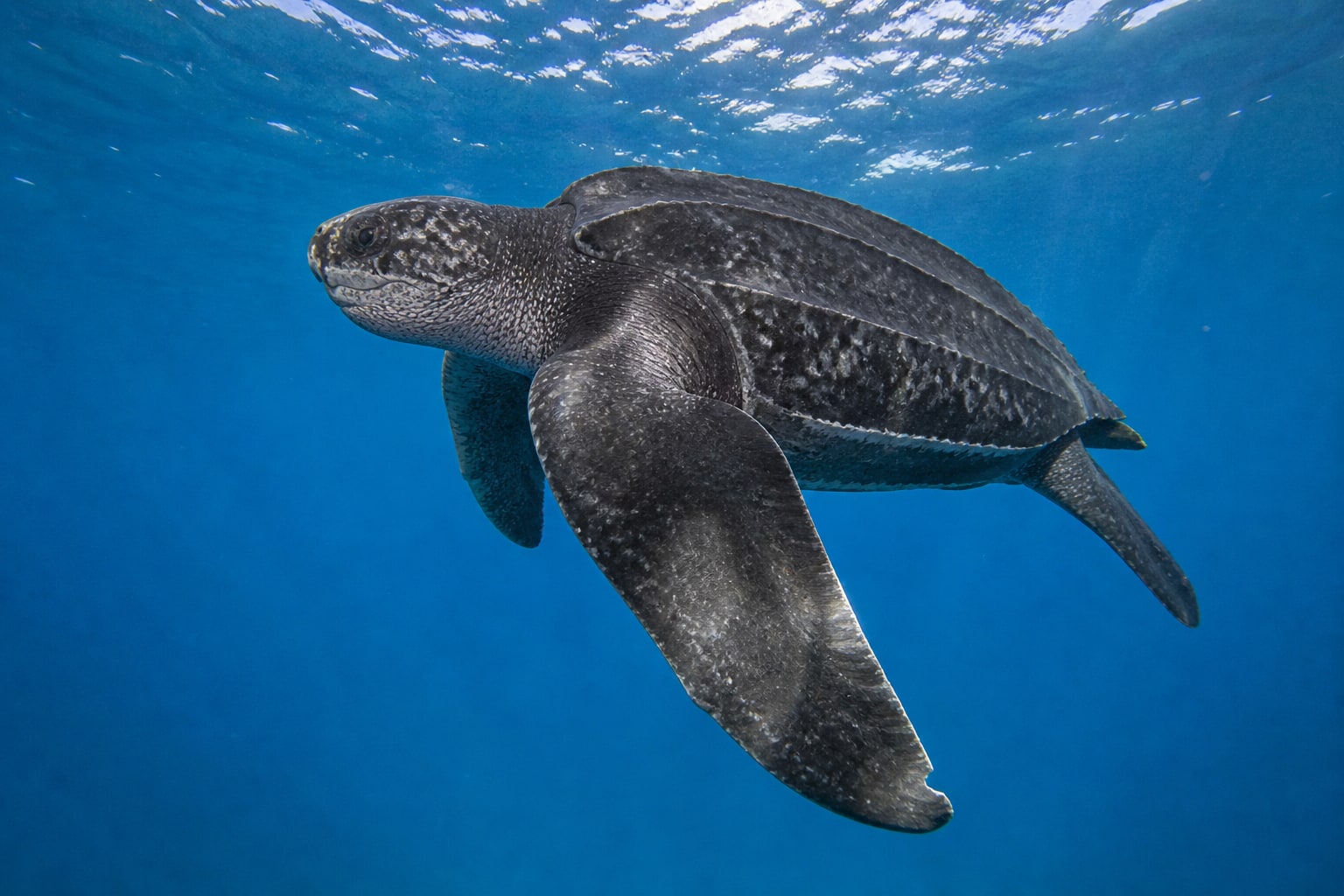
The migration of the leatherback is among the longest documented in reptiles. Satellite-tracking studies have recorded movements of more than 10,000 km between tropical nesting areas and feeding grounds at temperate or cold latitudes, crossing entire oceans on routes that can last several months.
Conservation status: a species in danger
The International Union for Conservation of Nature (IUCN) classifies Dermochelys coriacea as Vulnerable (VU) globally, although some regional subpopulations, such as the eastern Pacific one, are in a considerably worse situation. The species is listed in CITES Appendix I, which prohibits its international trade.
Main threats
- Accidental capture in fishing gear, especially longlines and drift nets.
- Ingestion of plastic bags, which it mistakes for jellyfish.
- Loss and degradation of nesting beaches due to coastal development.
- Historical collection of eggs in some regions.
- Alteration of the sex ratio due to rising temperatures on nesting beaches.
Protection programs
Organizations such as the CBD-Habitat Foundation and various national programs in Costa Rica, Gabon, and Indonesia work to protect nesting beaches and reduce accidental capture through excluder devices in fishing gear. The Ministry for the Ecological Transition and the Demographic Challenge (MITECO) also collaborates in monitoring sightings in Spanish waters, where the species appears occasionally during its migratory movements.
Verifiable facts
- It is the only living member of the family Dermochelyidae; all its related species became extinct.
- It can maintain its body temperature up to 18 °C above the surrounding water thanks to its large body mass and an insulating layer of fat.
- Its front flippers can measure up to 2.7 meters in total span in the largest specimens.
- Unlike other reptiles, it cannot retract its head or flippers under any shell, because it has no rigid structure that allows it.
FAQ
How long and heavy is an adult leatherback sea turtle? Between 1.8 and 2.2 meters in carapace length and between 250 and 700 kg in weight, although specimens of more than 900 kg have been documented.
Where does the leatherback sea turtle live? In virtually every ocean, from tropical nesting beaches to cold high-latitude waters where it feeds on jellyfish.
What does the leatherback sea turtle eat? Almost exclusively jellyfish and other gelatinous organisms such as salps and siphonophores, and it can eat the equivalent of its own body weight in a day.
Is the leatherback sea turtle endangered? It is classified as Vulnerable (VU) by the IUCN globally, with some regional subpopulations in a worse conservation status. The main threats are accidental fishing and plastic ingestion.
Is it the sea turtle that migrates the most? It is one of those that travels the greatest distances: migrations of more than 10,000 km have been recorded between nesting areas and feeding grounds, among the longest known in reptiles, comparable to those of other large marine animals such as certain surprisingly adaptable reptiles that have developed equally unique strategies to survive in their environment.
0 comments · Comment