Axolotl: the Mexican amphibian that never grows up and regenerates
The axolotl is a critically endangered Mexican amphibian that keeps larval features throughout its entire life and regenerates whole limbs. We explain how it lives, why it does not metamorphose, and what it entails to keep one as a pet.
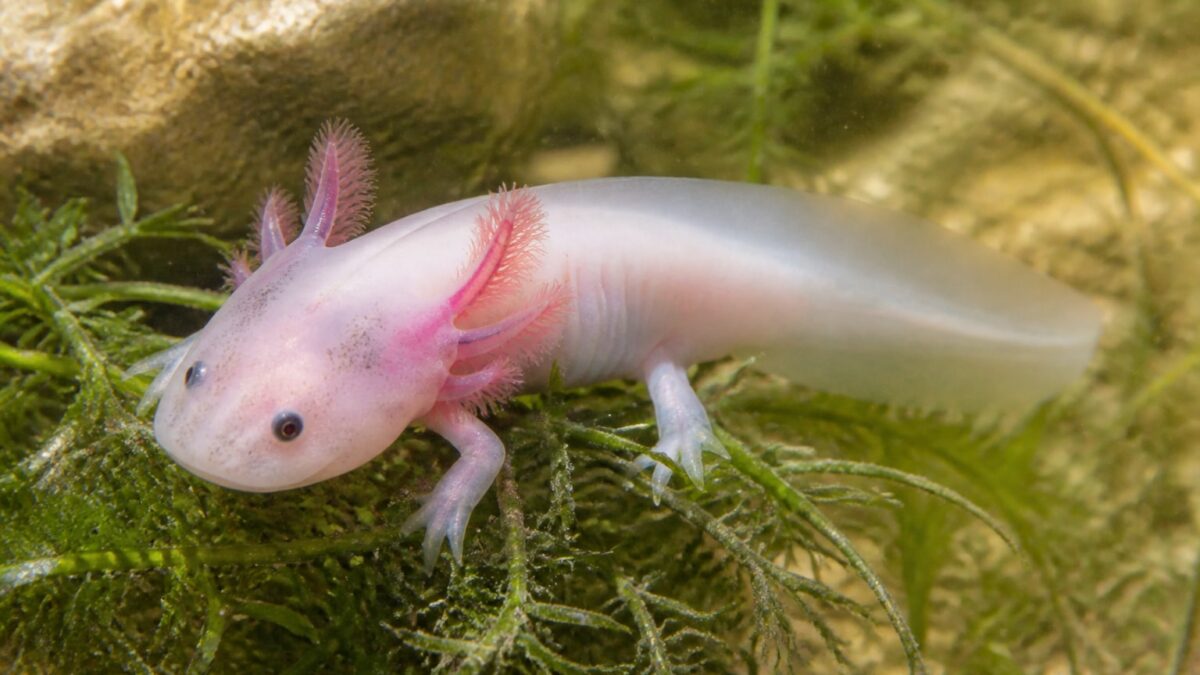
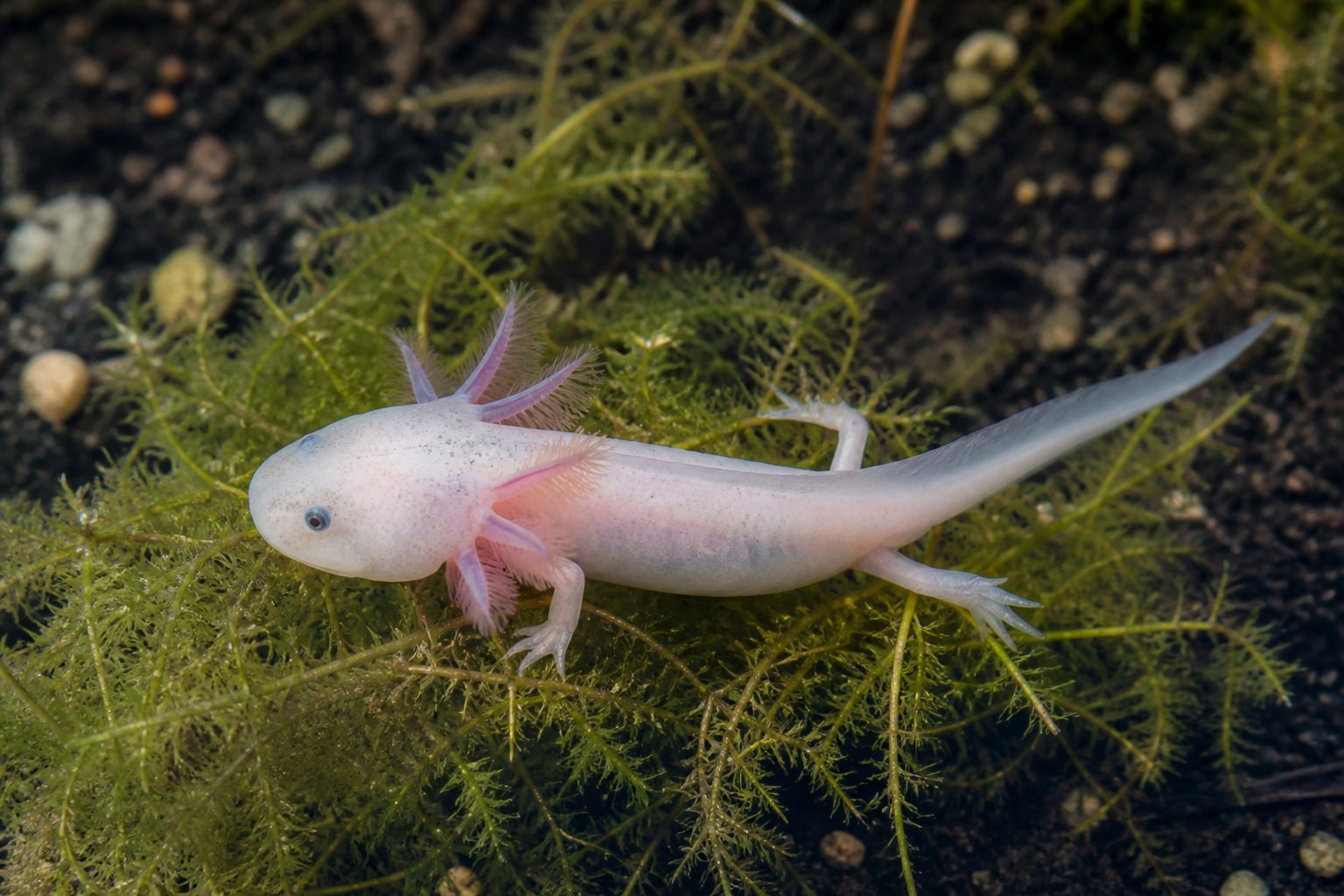
There is an amphibian that spends its entire life looking like a larva, with external gills like feathers and a permanent smile drawn on its mouth. It is the axolotl or Mexican walking fish (Ambystoma mexicanum), and for decades it has fascinated biologists for a very specific reason: it can lose a leg, part of its heart, or even brain tissue, and regrow it almost without scarring.
It matters more than ever today because its wild population is collapsing in the canals of Xochimilco, while science uses it as a model to study tissue regeneration for human medicine.
Identification: what is an axolotl?
The axolotl is a urodele amphibian (with a tail) of the family Ambystomatidae, related to the tiger salamanders. It measures between 15 and 30 cm in length, although some specimens in captivity exceed 40 cm. Its most striking feature is the three pairs of external gill branches surrounding its head, and a flattened tail that it uses to swim like a fish.
There are color varieties: the wild type, brownish with dark mottling, and those bred in captivity—leucistic (pale pink with black eyes), albino, and melanistic (almost black). It lives 10 to 15 years in well-kept captivity; in the wild, life expectancy is estimated to be shorter, poorly documented given how scarce current populations are.
| Data | Value |
|---|---|
| Scientific name | Ambystoma mexicanum |
| Adult size | 15-30 cm (up to 40 cm in captivity) |
| Approximate weight | 60-120 g |
| Lifespan in captivity | 10-15 years |
| Original habitat | Lakes and canals of Xochimilco and Chalco (Mexico City) |
| Conservation status (IUCN) | Critically endangered (CR) |
| Legality as a pet in Spain | Permitted, but not captured from the wild |
Neoteny: why the axolotl does not grow up or metamorphose
Most urodele amphibians hatch in water with gills and, over time, metamorphose into a terrestrial adult that breathes with lungs. The axolotl breaks that rule: it reaches sexual maturity and reproduces while keeping its larval form. This phenomenon is called neoteny or paedomorphosis.
The cause lies in a hormonal deficiency: its body does not produce enough thyroid-stimulating hormone to trigger complete metamorphosis. In the laboratory, administering thyroid hormone can force the transformation into a terrestrial form, but the specimen then loses much of its regenerative capacity and tends to live less.
Habitat and distribution: Xochimilco and the canals of Mexico
The axolotl is endemic to a single lake system: the canals and chinampas of Xochimilco, in the south of Mexico City, with historical populations also in the now-dried Lake Chalco. It inhabits cold, shallow waters with abundant aquatic vegetation, between 15 and 20 °C.
It is an exclusively aquatic species: it never leaves the water at any point in its adult life. Its natural distribution range is extremely small, which makes it very vulnerable to any alteration of its ecosystem.
Feeding and behavior
In the wild it is an opportunistic nocturnal predator. It feeds on small crustaceans, aquatic insects, worms, and fish fry, which it captures by suction by suddenly opening its mouth. It does not chew: it swallows its prey whole.
It is a solitary animal with slow activity, spending much of the day motionless on the bottom or among vegetation. Reproduction occurs through external fertilization: the female lays between 100 and 1,000 eggs attached to aquatic plants, which hatch in 2-3 weeks without any subsequent parental care.
Regenerative capacity of limbs and tissues
This is the reason the axolotl appears in so many biomedical studies. It can regenerate a complete leg—bone, muscle, nerves, and skin—in a few weeks, with barely any scarring. It also regenerates part of the tail, the jaw, the spinal cord, and even fragments of heart and brain.
Research such as that of Elly Tanaka’s team (Institute of Molecular Pathology, Vienna), published in journals such as Science and Nature, has identified progenitor cells that “remember” which tissue they must rebuild depending on the amputated area. This process differs from that of reptiles such as the lizard, which only regenerate a simplified tail, or the chameleon, which does not regenerate limbs at all.
Conservation status
The IUCN classifies the axolotl as Critically endangered (CR). Population estimates in Xochimilco, compiled by studies from the Institute of Biology of UNAM, point to a drastic decline: from around 6,000 specimens per km² in 1998 to fewer than 36 individuals per km² in surveys of the last decade.
The main threats are water pollution, the introduction of invasive species such as the common carp (Cyprinus carpio) and tilapia (which prey on eggs and larvae), and the loss of canals due to urbanization. Conservation programs exist with refuge chinampas and assisted reproduction, promoted by UNAM and the Government of Mexico City.
Verifiable curiosities
- The name “axolotl” comes from Nahuatl and is associated with the god Xolotl, although its exact translation remains a subject of debate among linguists.
- It is one of the model organisms most used in regenerative genetics, alongside the zebrafish.
- In captivity it exists all over the world—mostly as an aquarium pet—while its original wild population goes extinct.
- Unlike most amphibians, it can accept an organ transplant from another axolotl without significant immune rejection.
Axolotl as a pet: home care
Owning an axolotl is legal in Spain and requires no special license, since specimens sold commercially come from captive breeding, not wild capture. It is an exotic aquatic pet, not suitable for those seeking physical interaction: it should not be handled excessively because its skin is very sensitive.
Feeding in captivity
Adults are fed 2-3 times a week (daily for juveniles) with bloodworms, axolotl-specific pellets, or pieces of peeled shrimp. The amount should be adjusted to what is consumed in 5 minutes, leaving no leftovers that foul the water.
Aquarium habitat
It needs an aquarium of at least 80 liters per adult specimen, without a heater: the water must be kept between 16 and 20 °C, since above 23-24 °C it suffers heat stress. The substrate should be fine sand (never gravel, which can cause blockages if swallowed) and gentle filtration, because it is sensitive to strong currents.
Health and warning signs
Signs such as shrunken gills, prolonged loss of appetite, white spots, or abdominal swelling require consultation with a veterinarian specialized in exotics. Self-medicating or adding table salt without professional guidance is not advisable, a common mistake among beginners.
Common mistakes when keeping an axolotl
- Placing it with fish: many nip at its gills or try to eat it.
- Using tap water without dechlorinating it.
- Keeping the temperature above 22 °C continuously.
- Handling it with dry hands or with excessive frequency.
- Mistaking its daytime inactivity for illness: it is a nocturnal animal.
FAQ
Is the axolotl dangerous to other pets? It poses no risk to dogs or cats, unless these try to hunt it near the aquarium. The danger runs the other way: other aquatic animals can injure it.
Why is it said that the axolotl does not age? It is not immortal and does not stop aging, but its neoteny means it retains juvenile features throughout life and its regenerative capacity remains high even in adulthood, something exceptional among vertebrates.
Can it live out of water? No. It is a strictly aquatic animal throughout its adult life, unless its metamorphosis is artificially induced with thyroid hormone, something not recommended for aquarium pets.
How much does it cost to keep an axolotl? The initial cost of the aquarium, filter, and substrate is usually higher than that of the animal itself. Monthly maintenance (food and water changes) is moderate compared with other exotic reptiles or amphibians.