Canary breeding: a guide to successfully raising canaries at home
A practical, veterinary-informed guide to breeding domestic canaries: when to breed, how to prepare the cage, and step-by-step feeding and care of the chicks.
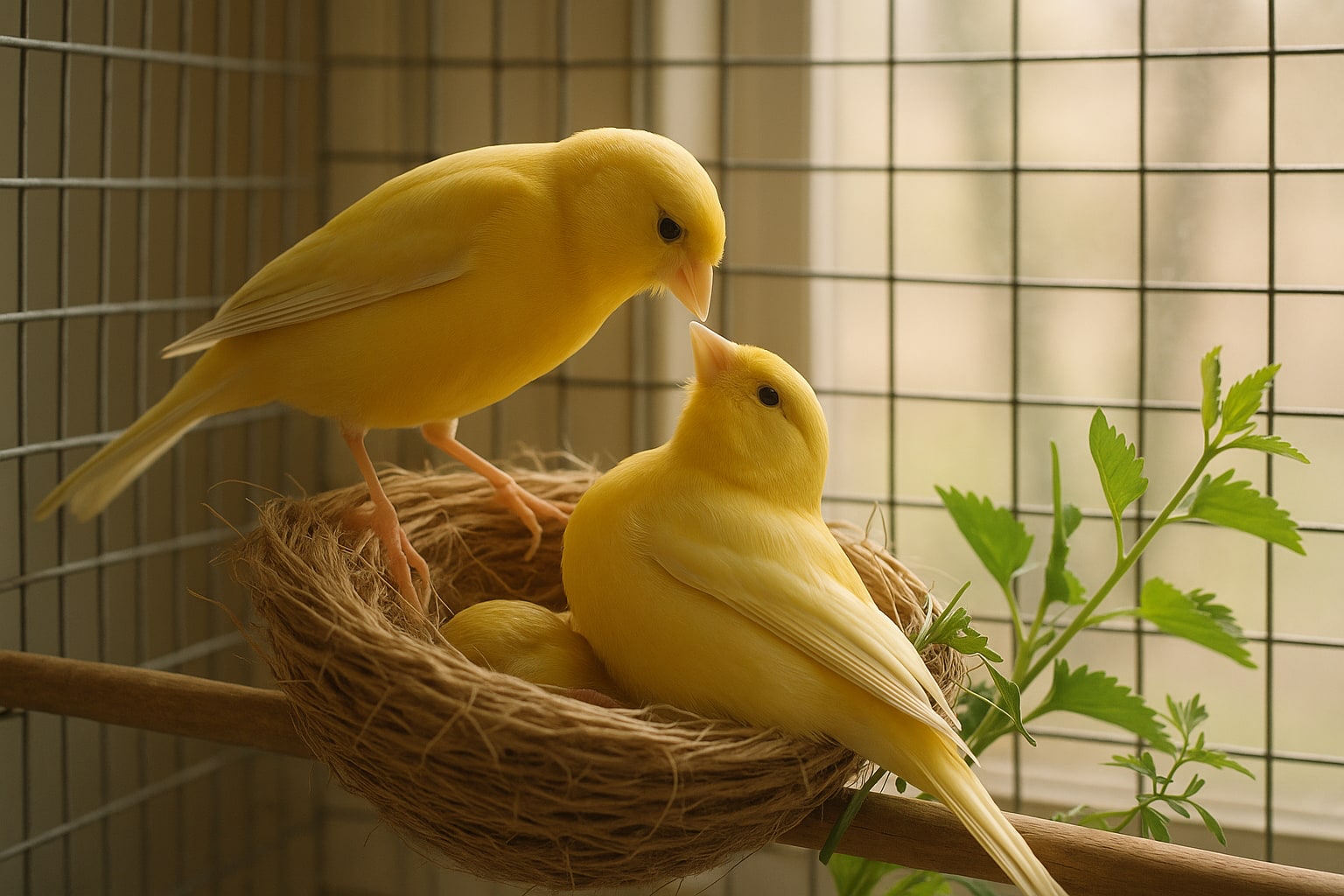
Breeding canaries at home is one of the most rewarding experiences for any bird enthusiast. The domestic canary (Serinus canaria domestica) has been bred in captivity for more than 500 years, and today there are dozens of varieties of colour, song and plumage. But being a widespread practice does not mean it is simple: breeding requires preparation, patience and respect for the bird’s natural rhythms.
This guide covers the whole process, from selecting the pair to weaning the chicks, with concrete data and proven management criteria.
When canaries breed
The canary breeding season in the northern hemisphere runs from March to July, coinciding with longer daylight hours and rising temperatures. Under controlled indoor conditions, many breeders bring breeding forward to February by using artificial lighting that simulates 14 hours of daylight per day.
The signs that a pair is ready are clear:
- The male sings with greater intensity and frequency.
- The female tears up the paper lining the bottom of the cage and carries strands in her beak.
- Both show a swollen and reddened vent.
How to choose the breeding pair
For breeding canaries at home, it is best to select birds between 1 and 4 years old, healthy, not overweight and free of plumage defects. Avoid crossing siblings: inbreeding weakens the offspring.
A healthy breeding canary weighs between 18 and 24 grams, has compact, glossy plumage and breathes without noise. If you have doubts about a bird’s health, consult a veterinarian specialised in birds before putting it into breeding.
Breeding cage for canaries: dimensions and equipment
The ideal breeding cage measures at least 60 x 30 x 40 cm for one pair. It should include:
- A movable central divider to introduce the pair gradually.
- A plastic or wicker nest of 10-12 cm diameter, fixed in a high, quiet area.
- Nesting material: coconut fibre, jute or short cotton (never long threads, which can strangle).
- Two feeders and two drinkers, one for each bird while they are separated.
- A bath two or three times a week; bathing keeps the plumage moist and aids incubation.
Place the cage in a draught-free spot, with a stable temperature of 18-22 °C and humidity of 50-60%.
Mating canaries: how to introduce the pair
Place the male and female in adjacent compartments separated by a grille for 7-10 days. When the female starts carrying material and the male feeds her through the bars, remove the divider.
Copulation lasts only a few seconds and is repeated several times a day. Within 4-7 days the female begins laying.
Laying and incubation of canary eggs
The female lays between 3 and 5 eggs, one per day, always early in the morning. Many breeders remove each egg and replace it with an artificial one, storing the real ones in a container with millet at 15 °C. On the day the fourth egg appears, all of them are returned: this way the chicks hatch together and there are no older siblings monopolising the food.
The incubation of canary eggs lasts 13-14 days. Only the female incubates; the male feeds her. Do not handle the nest more than necessary and avoid loud noises during this period.
Hatching and the first days of the chicks
Chicks hatch blind and with little down. They weigh barely 1.5-2 grams. The female feeds them with regurgitated pap that she produces from the rearing food.
At 5-6 days their eyes open. At 12-14 days the first feathers appear. And by 18-21 days they leave the nest, although the male continues feeding them for another week.
Feeding breeding canaries and chicks
Throughout breeding, the diet must be enriched. The base of seed mix (canary grass seed, niger, rape seed) is supplemented with:
- Rearing food daily, dry or moistened, rich in protein (18-20%).
- Hard-boiled egg grated twice a week.
- Fresh vegetables: dandelion leaves, endive, broccoli in small amounts.
- Grit and cuttlebone always available for calcium intake.
- Sprouted seed of canary grass once a week.
For the first 15 days the chicks eat exclusively what the parents regurgitate for them. From weaning onwards, they begin pecking at soft food and shelled seeds.
Common mistakes when breeding canaries
- Introducing the pair too early, before the female shows interest.
- Handling the nest frequently, causing abandonment.
- Insufficient lighting: less than 12 hours of light slows breeding.
- A diet low in protein, which causes clear eggs or weak chicks.
- Reusing the same nest without disinfecting between clutches (it encourages mites).
If you notice ruffled plumage, diarrhoea or loss of appetite in any bird, see a veterinarian. As with other domestic and aquarium birds, self-medicating canaries is dangerous.
How many clutches per year
A healthy female can raise 2 or 3 clutches per season. Beyond that she depletes her calcium reserves and shortens her reproductive life. Once the last laying is finished, remove the nest and return to the maintenance diet.
Frequently asked questions
How many eggs does a canary lay? Between 3 and 5 per clutch, one a day. It is common for the first one to be infertile.
How long does it take for a canary to hatch? Incubation lasts 13-14 days from the moment the female starts sitting in earnest, usually after laying the third egg.
At what age are the chicks separated from the parents? Between 28 and 35 days of age, when they already eat on their own and shell seeds without help.
Can I breed canaries in a small flat? Yes. You need a suitable cage, natural or adjustable artificial light and a quiet corner. The male’s song can be quite loud, so keep this in mind if you live in a shared space.
Is it legal to breed canaries in Spain? Yes. The domestic canary is not protected by CITES and breeding it for private purposes is legal. If you sell birds regularly, you must register as a zoological establishment under regional regulations.