Calathea orbifolia: why calatheas are so dramatic (and how to calm them down)
Find out why the Calathea orbifolia curls its leaves and reacts to any change. Complete care guide: humidity, watering, light and common mistakes.
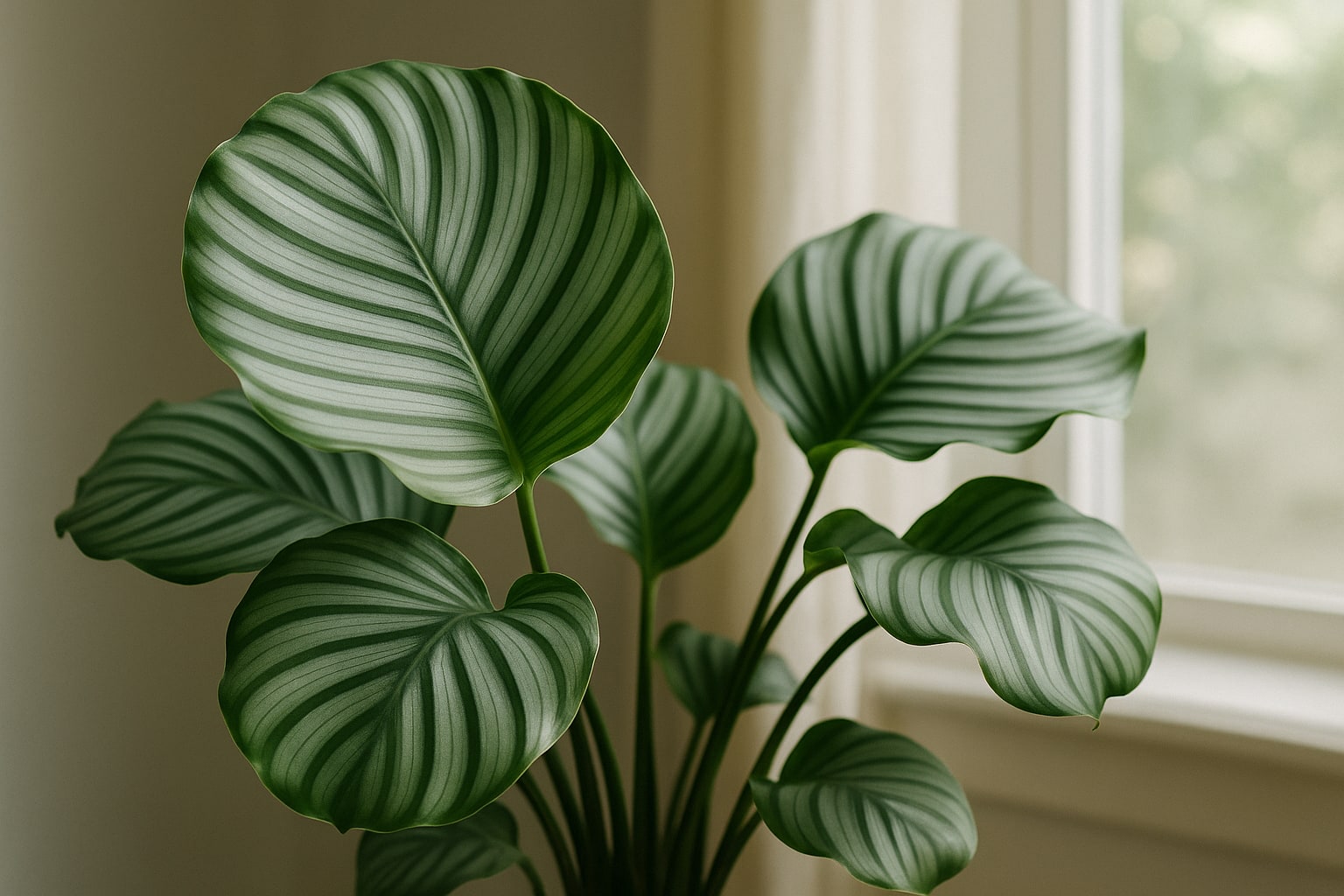
If you have a Calathea orbifolia at home, you already know what we’re talking about. One day it shows off huge silver-tinged round leaves worthy of a magazine cover, and the next day they’re curled, drooping or with brown edges. It’s not that the plant is capricious. It’s a demanding tropical, and its body language is literal.
Native to the humid rainforests of Bolivia, this plant belongs to the Marantaceae family, a group known for a peculiar behaviour: it moves its leaves following a day-night rhythm. Understanding this detail is the key to no longer suffering with it.
Why calatheas seem so dramatic
Calatheas display nyctinastic movement: their leaves rise at night and lower during the day. This movement takes place in the pulvinus, a thickened joint at the base of the petiole that works as a hydraulic hinge. When the turgor of those cells changes, the leaf folds or opens.
The problem is that this same mechanism reacts to any water stress. Low humidity, chlorinated water, a cold draught or substrate that is too dry: the leaf curls as a defensive response to reduce the evaporation surface. It’s not a whim, it’s pure physiology.
Identification and origin: what exactly a Calathea orbifolia is
Its current scientific name is Goeppertia orbifolia (reclassified from Calathea orbifolia in 2012), although nurseries and shops still sell it as a calathea. It is recognised by almost circular leaves of 20-30 cm in diameter, with silver bands over a green background and a pale green underside.
In its natural habitat it grows in the Bolivian tropical understorey, under dense canopy, with constant ambient humidity above 70% and stable temperatures. That context explains everything about its domestic quirks.
Light: bright but indirect, never direct sun
It needs bright indirect light. Near an east- or north-facing window works well; a south-facing window only if you filter it with a sheer curtain. Direct sun, even for 30 minutes at midday, burns the leaves and fades the silver bands within days.
If you notice the patterns losing contrast or the leaves getting smaller, it probably lacks light. If dry, crispy brown spots appear, it has too much.
Watering: the water matters as much as the amount
Water when the top 2-3 cm of the substrate feel slightly dry to the touch. In spring and summer this usually means watering every 5-7 days; in winter, every 10-14. Never leave standing water in the saucer.
Here is the important part: the Calathea orbifolia is very sensitive to chlorine, fluoride and the salts in tap water. These residues cause the classic brown tips. Use one of these options:
- Rainwater, filtered.
- Distilled or reverse osmosis water.
- Tap water left to stand 24 hours in an open container (it evaporates the chlorine, not the fluoride).
Water temperature should be lukewarm, never straight cold from the tap.
Humidity: the factor that changes everything
Ideal humidity is between 60% and 70%. In a flat with central heating in winter it can drop to 30-40%, and that is when the plant collapses. Options that really work:
- Humidifier near the plant (the most effective).
- Grouping it with other tropicals to create a microclimate.
- A tray with expanded clay and water under the pot, without the roots touching the water.
Misting the leaves helps very little and can encourage fungi on the large, velvety leaves. Better to invest in a cheap hygrometer and a humidifier.
Temperature and location
Comfortable range: 18-24 °C. Below 15 °C it suffers, and above 27 °C with dry air too. Keep it away from radiators, air conditioners and windows that open in winter. Cold air draughts are one of the most common triggers of overnight leaf drop.
Substrate and pot
A light, airy mix: peat or coconut fibre, perlite and a little pine bark, with a slightly acidic pH (6.0-6.5). Drainage is non-negotiable. A pot with drainage holes, always. If you’re looking for a more forgiving tropical companion, take a look at the rubber plant care guide, which tolerates far more.
How to revive a Calathea orbifolia with fallen leaves
If you find it listless, don’t repot it all at once. Follow this order:
- Check the substrate moisture with your finger. If it’s dry, water with lukewarm settled water.
- Measure the ambient humidity. If it’s below 50%, place a humidifier nearby.
- Move the plant away from heat sources or draughts.
- Give it 48-72 hours before touching anything else.
Recovery is gradual. New leaves will unfurl again, but those that already have brown edges won’t regenerate: you can trim just the damaged area with clean scissors, following the original shape.
Common mistakes that kill it
- Watering with tap water without letting it stand.
- Putting it in direct sun “so it grows more”.
- Dry air from heating without compensating for humidity.
- Frequent repotting: it prefers to be slightly root-bound.
- Mistaking leaves that close at night for disease. It’s normal.
Propagation by division
It multiplies by clump division in spring, coinciding with repotting every 2 years. Carefully separate the rhizomes making sure each section has roots and at least 2-3 leaves. Moist substrate, a warm environment and patience: it takes weeks to recover.
Frequently asked questions
Why do my calathea’s leaves curl? Almost always due to low ambient humidity or substrate that is too dry. Also from chlorinated water or cold draughts. Check those three factors before anything else.
Is it toxic to dogs and cats? No. The ASPCA classifies it as non-toxic for pets, although ingesting it may cause mild digestive upset.
How long does a well-cared-for Calathea orbifolia live? It can live for many years indoors if you maintain adequate humidity and watering. With periodic divisions, the plant can be rejuvenated indefinitely.
Can I keep it in the bathroom? Yes, if it gets enough natural light. It’s one of the best spots in the house thanks to the humidity generated by the shower.