How to Stop Your Cat from Scratching Furniture Without Scolding Him
Scratching is a natural need for cats, not a whim. With the right scratching post, a good location, and positive reinforcement, you can protect your furniture without damaging the bond.
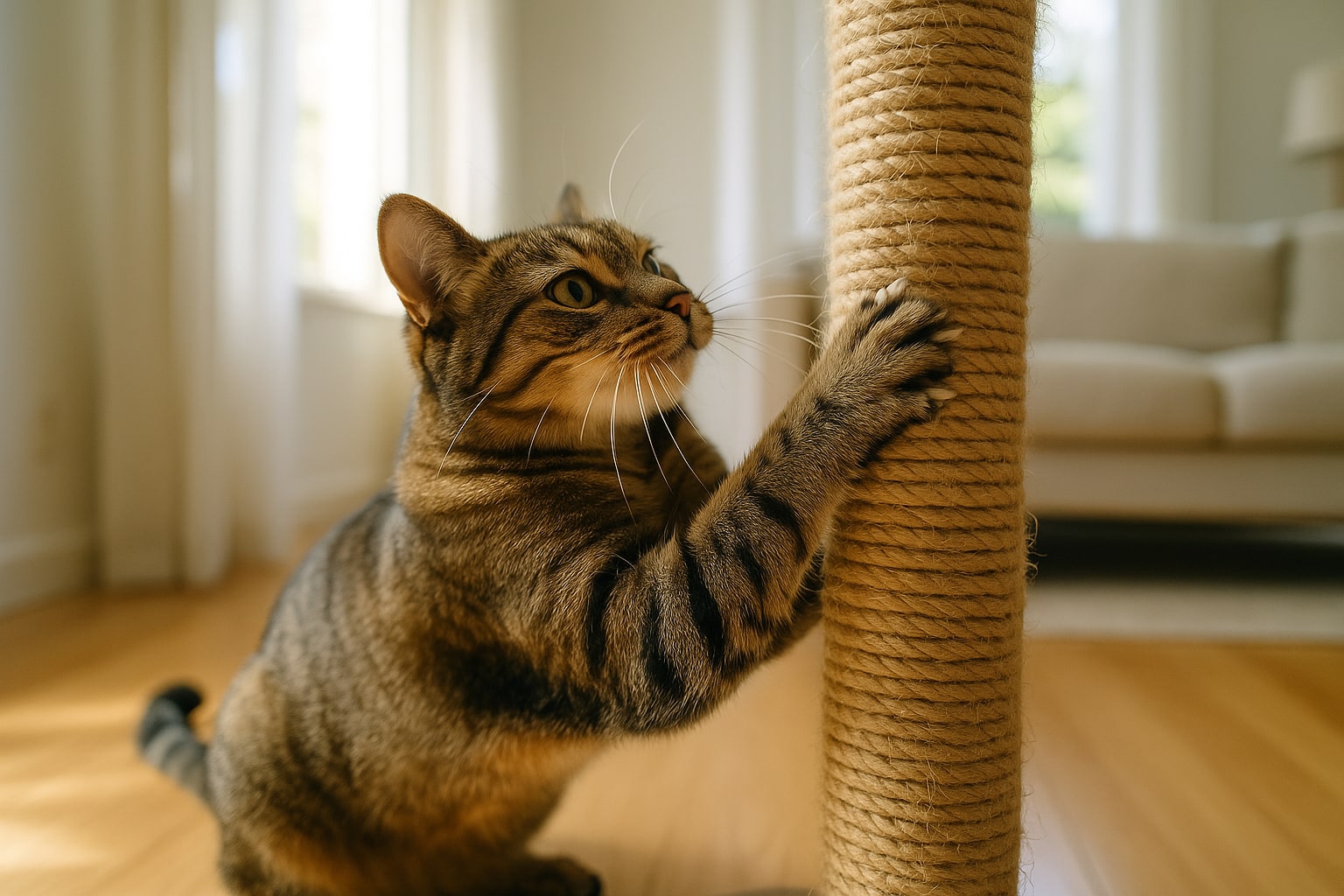
You come home and find the sofa corners frayed. The typical reaction is to scold the cat (Felis catus), but that doesn’t work and, on top of that, it damages your relationship with him. Scratching is not an act of rebellion: it is natural behavior, as basic as eating or sleeping.
The good news is that you can redirect this behavior. Not with punishment, but by understanding why he does it and offering him a better alternative than your armchair.
Why cats scratch furniture (and it’s not to annoy you)
Scratching serves several functions at once. First, nail maintenance: by scratching, the cat removes the outer layer of keratin that he no longer needs. Second, territorial marking: his paw pads have glands that leave pheromones, and the visible marks from scratching reinforce that chemical message.
It is also muscle stretching. When he stretches against a vertical surface, he activates the muscles of the shoulders, back, and legs. And finally, it is a release for emotional tension: many cats scratch more after a long nap, when someone arrives home, or after a moment of excitement.
Understanding this changes the approach. It is not about eliminating the behavior, but about channeling it.
Why scolding or punishing doesn’t work
Cats don’t associate a scolding that comes later with what they did minutes before. If you yell at him when he is already grooming himself in another room, he only learns one thing: that sometimes you are frightening for no apparent reason.
Physical punishment, sprays in the face, or loud noises generate chronic stress. A stressed cat scratches more, not less. And worst of all: he may start doing it when you are not around, precisely to avoid your presence.
Feline ethology is clear on this. Authors such as John Bradshaw (University of Bristol) have spent decades demonstrating that positive reinforcement and environmental modification are the only effective routes with this species.
Choose the right scratching post: material, height, and stability
Not every scratching post is worth it. These are the criteria that really matter:
- Minimum height of 70-80 cm for vertical posts. Your cat needs to stretch fully, with his front paws extended above his head.
- Heavy, stable base. If it wobbles at the first scratch, the cat will abandon it and go back to the sofa, which doesn’t move.
- Rough material: rolled natural sisal is the option most cats prefer. Carpet and corrugated cardboard also work, but they wear out faster.
- Variety of orientations: some cats prefer scratching vertically, others horizontally (flat boards on the floor), and some even at an angle.
If your cat ignores the scratching post, check these three points before changing anything else.
Where to place scratching posts in the home
Location is just as important as the model. Place one next to the furniture he scratches, not on the other side of the living room. The logic is simple: if you ask him to change surfaces, the alternative has to be within reach.
Put another near the resting areas. On waking up, almost all cats stretch and scratch immediately. And add one in passageways or entrances, where territorial marking makes sense for him.
In an apartment with a single cat, 2-3 scratching posts is reasonable. With several cats, one per cat plus one extra.
Positive reinforcement: how to teach him to use it
When the cat uses the scratching post, even by chance, reinforce him immediately. A small food treat (a piece of cooked chicken, a specific snack) or petting if he likes it.
You can attract him by rubbing catnip (Nepeta cataria) on the post, or using valerian root if catnip has no effect on him (about 30% of cats don’t respond to it due to genetics). Never grab his paws to “teach” him to scratch: this is invasive for them and generates rejection toward the object.
Be patient. Learning to prefer the scratching post can take between one and three weeks.
Protecting the furniture while he learns
While the habit settles in, protect the problem areas:
- Clear plastic covers or double-sided tape designed for cats on the sofa corners. The sticky texture discourages them.
- Thick blankets covering armrests and backrests.
- Aluminum foil temporarily in specific spots; most cats dislike the feel and the noise.
They are not pretty solutions, but they are temporary. As soon as the scratching post becomes his preferred surface, you can remove them.
Synthetic pheromones: when they can help
Synthetic facial pheromones (such as Feliway Classic) imitate the signal a cat leaves when rubbing his face against furniture. Applied to the areas he scratches, they convey the message “this is already marked, nothing more is needed.”
They work best in cats whose scratching is associated with stress: moving house, the arrival of another animal, construction work. They are not magic and do not replace the scratching post, but they can speed up the transition. Consult your veterinarian if you suspect an underlying anxiety component.
Trimming nails: how often and how
Trimming the tips every 3-4 weeks reduces the damage when he scratches where he shouldn’t. Use nail clippers designed for cats and cut only the transparent part, avoiding the pink area (the quick, with blood vessels and nerves).
If you have never done it, ask your veterinarian to show you the first time. And never resort to onychectomy (surgical removal of the claws): it is banned in Spain and in much of Europe as it constitutes mutilation.
When scratching hides something else
If the scratching appears suddenly, intensifies for no reason, or is accompanied by other signs (urine marking, aggression, hiding), there may be an underlying problem: stress, pain, changes in the environment. In these cases it is worth also reviewing how many hours your cat sleeps per day and his general routine, and consulting a veterinary ethologist.
Frequently asked questions
Why does my cat scratch right when I get home? It’s a mix of excitement, territorial marking, and greeting. Offer a scratching post near the entrance and reinforce him when he uses it as you arrive.
Do citrus repellent sprays work? They may deter him in specific areas, but on their own they solve nothing if you don’t offer a clear alternative. Use them as support, not as a solution.
Can I teach an adult cat to use a new scratching post? Yes. Adult cats learn perfectly well if the scratching post is suitable and you reinforce its use. The same principles that apply to socializing an adult cat apply here: patience and positive reinforcement.
How many scratching posts do I need if I have two cats? At least three: one per cat plus one extra, distributed in different areas to avoid competition.
What if he still scratches the sofa despite everything? Check the height and stability of the scratching post, move it to a different spot, and consider consulting a feline ethologist. Sometimes simply moving the post 50 cm is enough for it to start working.