Dracaena marginata: the dragon tree, an easy-care false palm
A practical guide to caring for Dracaena marginata at home: watering, light, propagation and solutions to the most common problems of this popular houseplant.
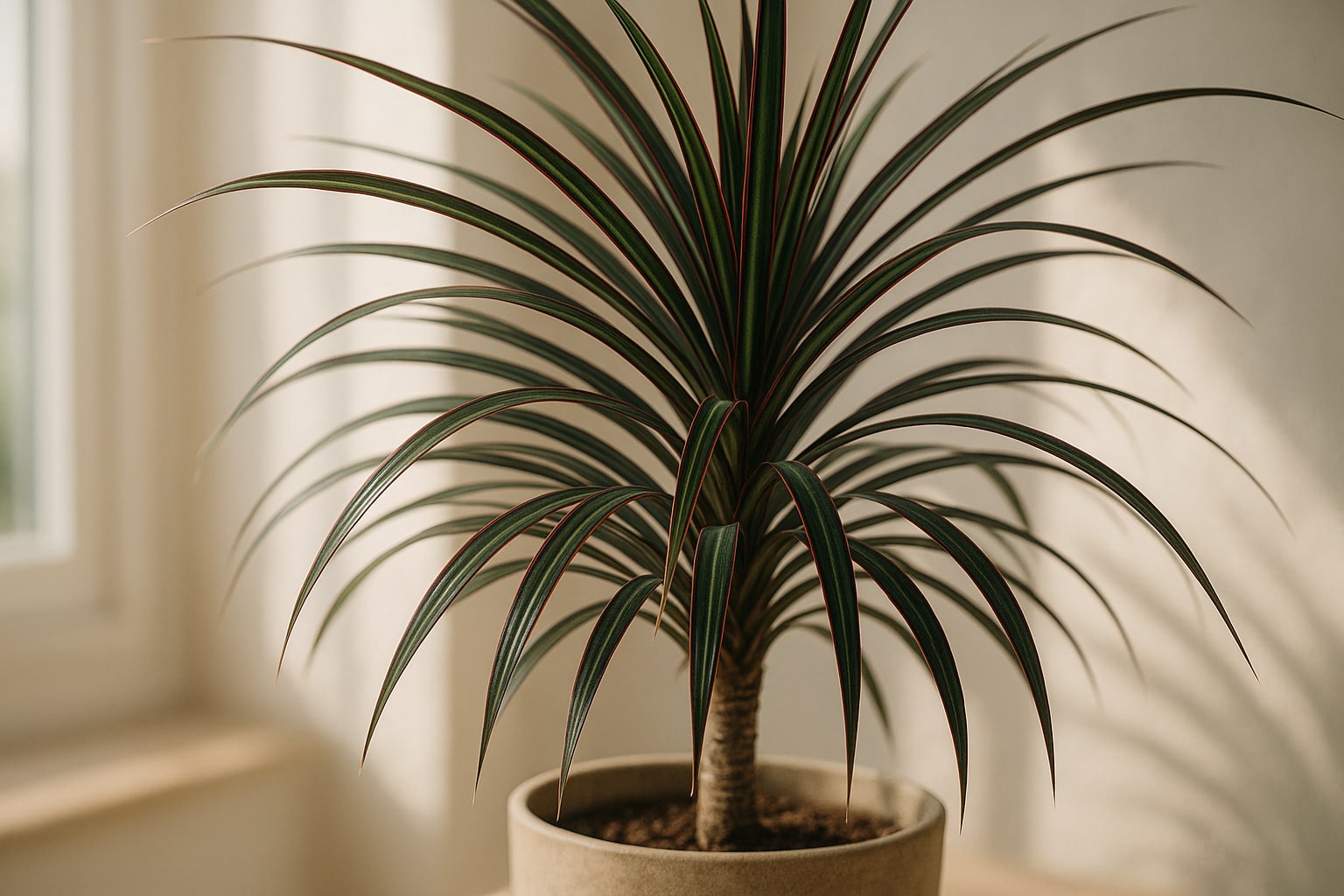
The Dracaena marginata, also known as Madagascar dragon tree or false palm, is one of those plants that survives almost anything: forgotten waterings, winter heating and corners with little light. Its slender silhouette, with a thin trunk and tufts of narrow leaves, has made it a classic of interior design since the 1970s.
It is not a true palm, although it looks like one. It belongs to the Asparagaceae family, the same as asparagus. And, despite its tropical appearance, it tolerates fairly harsh conditions as long as you follow two rules: do not waterlog it and protect it from cold.
What Dracaena marginata is and why it is called false palm
The Dracaena marginata (Dracaena marginata, now reclassified by some botanists as Dracaena reflexa var. angustifolia) is native to Madagascar and the island of Mauritius. In its natural habitat it can reach 4-5 metres in height; in a pot, in a Spanish living room, it usually stays between 1 and 2 metres after several years.
It is nicknamed false palm because, over time, it loses its lower leaves and leaves a bare trunk topped with a crown of long, thin leaves. That shape recalls a dwarf palm, but it is not one.
Identification: leaves, trunk and varieties
The leaves are linear, 30-40 cm long and barely 1-2 cm wide, with a distinctive reddish or purple edge (hence the epithet marginata, “margined”). The trunk is thin, grey and slightly rough, and it tends to branch once the plant is older or if it is pruned.
The most common varieties in nurseries:
- ‘Tricolor’: leaves with green, cream and red stripes.
- ‘Colorama’: intense pink predominates, covering almost the whole edge.
- ‘Bicolor’: green and red, the classic one.
Light, watering and substrate
Light is the factor that makes the difference. The dragon tree prefers bright indirect light, near a window facing east or filtered through a curtain. It tolerates darker areas, but it loses colour in variegated leaves and grows very slowly. Direct midday summer sun scorches its tips.
On watering the Dracaena marginata: less is more. In spring and summer, water when the top 2-3 cm of substrate are dry, roughly every 7-10 days. In winter, space it out to every 15-20 days. Use room-temperature water and, if possible, low-chlorine, low-fluoride water (fluoride browns the tips). Rainwater or filtered water is ideal.
The substrate must drain well. A suitable mix: 60% universal substrate, 30% perlite and 10% peat. Slightly acidic pH, between 6 and 6.5. Always a pot with drainage holes.
Seasonal care
- Spring-summer: growing season. Feed every 3-4 weeks with liquid fertiliser for green plants, diluted to half the recommended dose. Ideal temperature: 20-27 °C.
- Autumn-winter: reduce watering and stop feeding. Avoid cold draughts and keep it away from radiators. Below 12 °C it suffers, and below 10 °C it starts to drop leaves.
Ambient humidity helps, especially in flats with central heating. Misting the leaves once or twice a week, or standing the pot on a tray of pebbles and water, improves its appearance.
Common problems: dragon tree with yellow leaves and other faults
- Yellow leaves at the base: normal if they are the oldest ones. If it happens en masse, suspect overwatering.
- Brown, dry tips: dry air, excess fluoride in the water or accumulated fertiliser salts.
- Soft leaves and wrinkled trunk: root rot. Remove the plant, cut away the damaged parts and repot into dry substrate.
- Sticky spots: mealybug. Remove with a cotton swab soaked in alcohol and check weekly.
- Fine cobwebs on the underside: red spider mite, favoured by dry air. Increase humidity and wash the leaves.
If you are weighing up other tough indoor plants, you might want to compare it with the ZZ plant and its shade tolerance, which shares that reputation for being “almost indestructible”.
How to propagate Dracaena marginata step by step
The simplest method is by stem cuttings, in spring or early summer:
- Cut a section of trunk 15-20 cm long with a clean knife.
- Let the cut air-dry for 24 hours so it can callus.
- Place it in a glass of water (2-3 cm submerged) or directly in moist substrate with perlite.
- Keep it in indirect light at a temperature of 22-25 °C.
- In 3-6 weeks it will develop roots. Repot when they measure 2-3 cm.
You can also use the top section with leaves (apical cutting), and the parent stump will sprout again below the cut.
Does it purify the air? What NASA said
The dragon tree features in the well-known NASA Clean Air Study (Wolverton et al., 1989), a study that evaluated plants capable of reducing volatile organic compounds in enclosed environments. Dracaena marginata showed the capacity to absorb xylene, toluene and formaldehyde.
That said, an important caveat: those trials were carried out in sealed laboratory chambers. In a real home with normal ventilation, the effect of a single plant is modest. If you are looking for another option with a similar track record, the spider plant and its reputation as an air purifier plays in the same league.
Toxicity: beware of dogs and cats
The dragon tree contains saponins, compounds toxic to dogs and cats according to the ASPCA database. Ingestion causes vomiting (sometimes with blood), excessive salivation, lethargy and dilated pupils in cats. It is not fatal in most cases, but if your pet chews the leaves, see your vet.
Keep it up high or in rooms that animals cannot access.
Frequently asked questions
How long does a Dracaena marginata live? With good care, it can exceed 15-20 years indoors. Old specimens reach three metres in height.
Why do its leaves suddenly drop? It is usually a sudden change: moving house, a cold draught, a recent repotting or watering with very cold water. Stabilise the conditions and be patient.
Can I keep it in the bathroom? Yes, provided the bathroom has natural light. It appreciates the ambient humidity but needs a window.
How often should it be repotted? Every 2-3 years, in spring, into a pot 2-3 cm wider. It does not like frequent changes.
Can it be pruned? Yes. Cut the trunk to the desired height in spring and it will sprout below, producing two or three new branches.