White rhinoceros: the difficult survival of the savanna giant
Discover the history of the white rhinoceros (Ceratotherium simum), its two subspecies, and the projects trying to save the northern one from functional extinction.
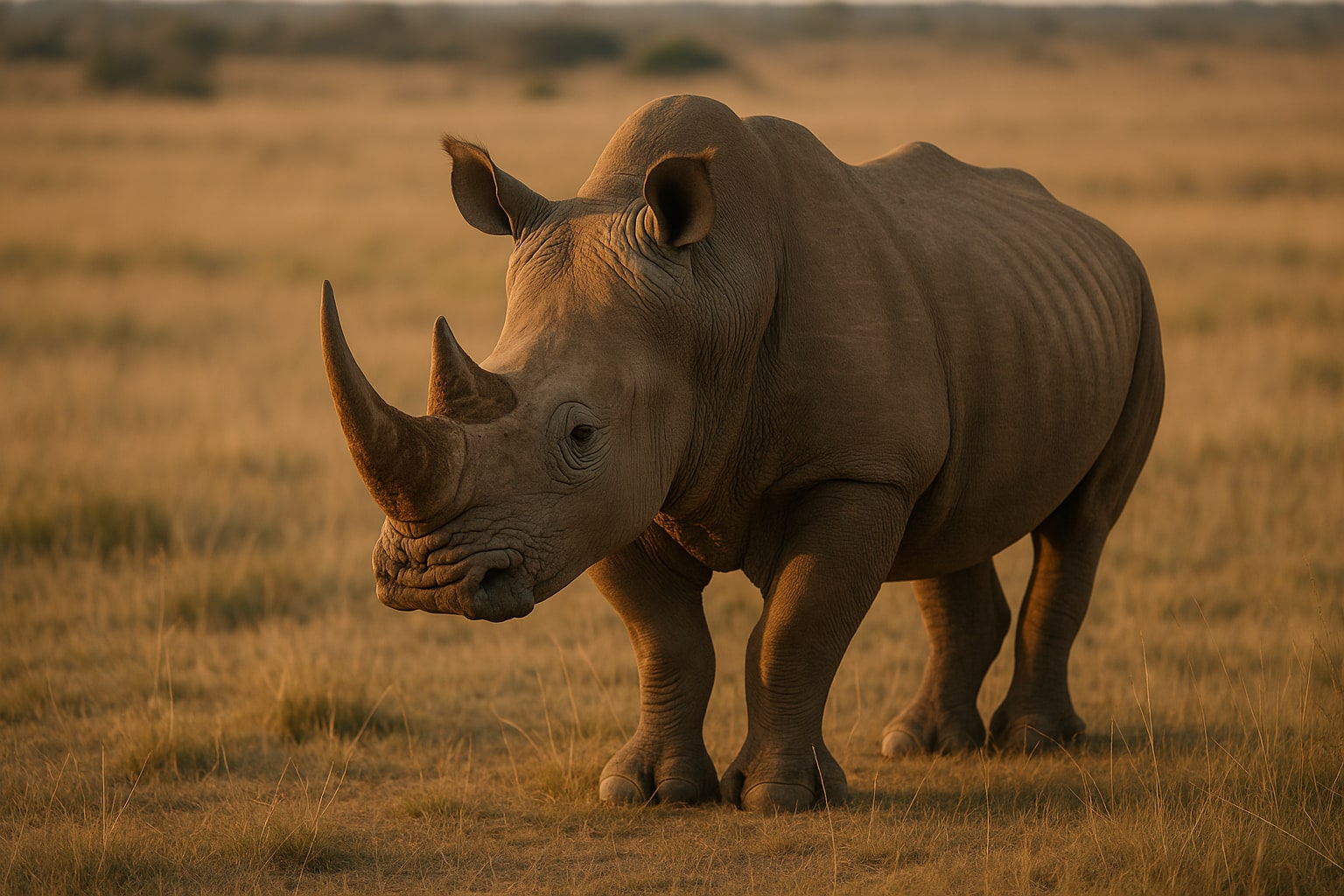
The white rhinoceros (Ceratotherium simum) is the second heaviest land mammal on the planet, behind only the African elephant. An adult can weigh up to 2.3 tonnes and stand up to 1.8 metres tall at the shoulder. Despite its size, its recent history is that of an animal that came close to disappearing twice: once at the end of the 19th century and again right now, in the 21st century.
Its name is misleading. It is not white. The most widely accepted hypothesis is that “white” comes from a mistranslation of the Afrikaans wyd (“wide”), referring to its square upper lip, adapted for grazing. This anatomical detail sets it apart at a glance from the black rhinoceros (Diceros bicornis), which has a prehensile lip for browsing.
Identification: a giant with two horns
The white rhinoceros has two keratin horns on its snout. The front one usually measures between 60 and 150 cm; the rear one is shorter. Its greyish-brown skin is hairless, except on the ears and tail. Adult males weigh 1,800-2,500 kg, females 1,400-1,700 kg. In the wild they live 35-40 years; in captivity they can exceed 45.
Habitat and distribution in Africa
It inhabits open savannahs and grasslands of southern and central-eastern Africa, with access to water and mud wallows. Its historical range covered much of the continent, but today it is concentrated in South Africa, Namibia, Kenya, Zimbabwe and Uganda. The northern subspecies, by contrast, has disappeared from the wild: its last wild individuals were found between South Sudan, the Central African Republic, Uganda and the DR Congo.
Diet: a pure grazer
It is a strict herbivore of the grazer type. Its broad lip works like a mower: it cuts short grasses close to the ground. An adult consumes 50-70 kg of vegetation per day and needs to drink every one or two days if water is available. It usually feeds at dawn and dusk, and rests during the hottest hours.
Social behaviour and reproduction
Females and calves form small groups called “crashes”, of up to a dozen individuals. Adult males are more territorial and solitary, and mark their territories with dung heaps. Gestation lasts 16 months, one of the longest among mammals, and a single calf is born, which stays with its mother for 2-3 years. Females reach sexual maturity at around 6-7 years; males at around 10-12.
The two subspecies: northern and southern
Two subspecies are recognised, with radically opposite fates.
Southern white rhinoceros (C. s. simum)
At the end of the 19th century it was believed to be extinct. In 1895 a relict population of fewer than 100 animals was discovered in the Hluhluwe-iMfolozi reserve in South Africa. Thanks to decades of management, it now exceeds 15,000-17,000 individuals according to the latest census by the African Rhino Specialist Group (2023). It is listed as Near Threatened (NT) by the IUCN. It is the great success story of rhino conservation.
Northern white rhinoceros (C. s. cottoni)
Its situation is critical. It is functionally extinct: only two living females remain, mother and daughter, named Najin and Fatu, at the Ol Pejeta reserve (Kenya). The last male, Sudan, died in 2018. The IUCN lists it as Critically Endangered (CR), possibly extinct in the wild.
Threats: poaching above all else
The main threat is poaching to supply the illegal horn market, especially in Vietnam and China, where it is wrongly attributed medicinal properties with no scientific basis. In South Africa alone, 499 rhinos were killed in 2023 according to the country’s Department of Environment. Added to this are habitat loss, armed conflict in the historical range of the northern subspecies, and the low genetic diversity of the southern one, descended from those 100 survivors.
International trade is prohibited: the species is listed in CITES Appendix I, except for the populations of South Africa and Eswatini, which are in Appendix II with restricted quotas.
Conservation and assisted reproduction: the BioRescue project
The BioRescue consortium, led by the Leibniz Institute for Zoo and Wildlife Research (Germany) together with Kenya Wildlife Service, Ol Pejeta Conservancy and Avantea (Italy), has been working since 2019 to rescue the northern subspecies. They have obtained more than 30 viable embryos through in vitro fertilisation using eggs from Fatu and cryopreserved semen from males that have already died. The idea is to implant them into southern white rhinoceros females, which would act as surrogate mothers.
In parallel, WWF, Save the Rhino International and the South African authorities maintain translocation programmes, anti-poaching surveillance and preventive dehorning (removing the horn under anaesthesia to discourage poaching).
Verifiable curiosities
- Its horn is not bone: it is compacted keratin, the same protein as your fingernails.
- It can run at 50 km/h despite its weight.
- It shares a mutualistic relationship with birds such as the oxpecker (Buphagus africanus): they remove parasites and warn of danger.
- Sudan, the last northern male, had a Tinder profile in 2017 as a fundraising campaign for BioRescue.
FAQ
How many white rhinoceroses are left in the world? Around 15,000-17,000 of the southern subspecies and only 2 females of the northern one (IUCN/African Rhino Specialist Group data, 2023).
Why is it called “white” if it is grey? Because of a probable mistranslation of the Afrikaans wyd (“wide”), referring to its lip, not its colour.
Can the northern white rhinoceros be saved? The BioRescue project has produced viable embryos via IVF, but implantation into southern surrogate mothers has not yet produced offspring. It is a race against the biological clock of Najin and Fatu.
Is it legal to own rhino horn? No. It is prohibited by CITES (Appendix I) and by EU and Spanish legislation. Possessing it or trading in it is a crime.