Polar bear: how melting ice threatens the king of the Arctic
Polar bears depend on sea ice to hunt, and the Arctic is losing it at a rate of 13% per decade. We explain what science says, how many remain, and what is being done to prevent their disappearance.
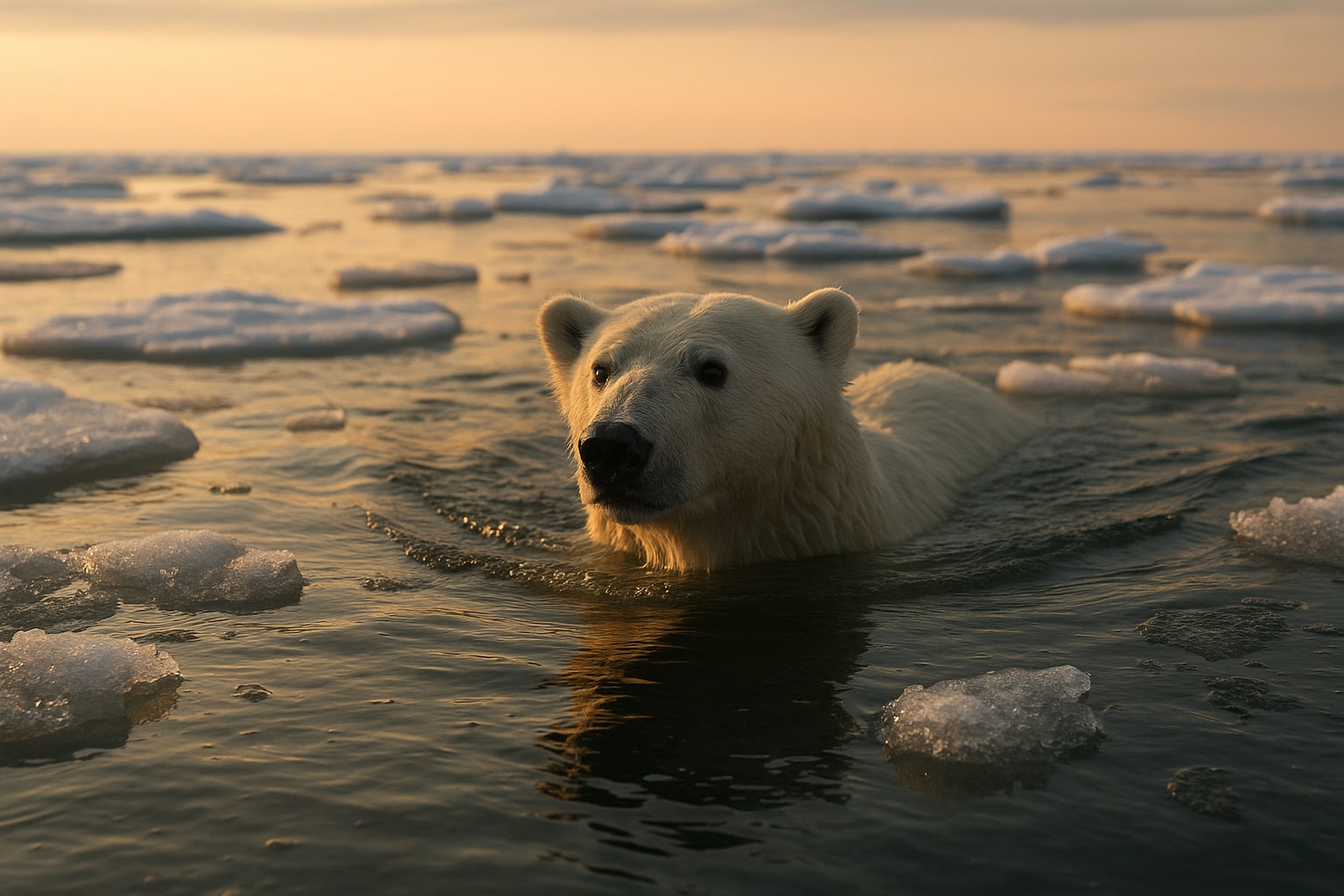
The polar bear (Ursus maritimus) has become the visible symbol of climate change. This is no coincidence: its entire life revolves around sea ice, and that ice has been shrinking for decades. When the Arctic loses frozen surface, the bear loses its food supply, its hunting route and its shelter all at once.
Today between 22,000 and 31,000 individuals remain across five Arctic countries, according to the latest IUCN assessment (2015, updated by the Polar Bear Specialist Group). The figure may seem high, but the problem is not the current number, it is the trend. And the trend, if the planet keeps warming at the rate projected by the IPCC, points downward.
Identification: the largest land carnivore on the planet
The polar bear is the largest living land carnivore. Adult males weigh between 350 and 700 kg and measure 2.4 to 3 metres in length. Females are considerably smaller: 150-300 kg. In the wild they live about 15-18 years; in captivity, individuals over 30 have been recorded.
Its fur looks white, but each hair is in fact hollow and translucent. The skin underneath is black, which helps it absorb heat. Beneath the skin, a layer of fat up to 11 cm thick acts as insulation in waters at -2 °C.
Habitat and distribution: a life on the ice
It lives in the Arctic regions of five countries: Canada, the United States (Alaska), Russia, Norway (Svalbard) and Greenland (Denmark). Canada is home to approximately two thirds of the world population.
It is not a "land" bear that occasionally approaches the sea. It is the opposite: it spends most of the year on sea ice, hunting seals from floating platforms. When the ice retreats in summer, it is forced to fast on land until it forms again in autumn.
Diet and behaviour: the seal hunter
Its diet is based on the ringed seal (Pusa hispida) and the bearded seal (Erignathus barbatus). They hunt them by ambush beside breathing holes in the ice. An adult bear needs to catch a seal every 10-12 days on average to maintain its fat reserves.
Females normally give birth to two cubs in December-January, inside a den dug into the snow. They emerge in March or April, and the cubs depend on their mother for about two and a half years.
Conservation status: Vulnerable on the Red List
The IUCN has classified the polar bear as Vulnerable (VU) since 2006. It is listed in CITES Appendix II, which regulates (though does not fully prohibit) international trade in parts of the animal.
Of the 19 subpopulations recognised by the Polar Bear Specialist Group, four are clearly declining, five are stable, two are growing, and there is insufficient data for the rest. The Western Hudson Bay subpopulation, one of the most studied, has fallen by nearly 30% over the last three decades.
Polar melt: figures of a measured crisis
This is where the numbers matter. According to the National Snow and Ice Data Center (NSIDC), the extent of Arctic sea ice in September —the annual minimum— has been decreasing at a rate of 13% per decade since 1979.
In other words: over 40 years the Arctic has lost an area of ice several times the size of Spain. The IPCC, in its Sixth Assessment Report (AR6, 2021-2023), considers it likely that the Arctic Ocean will be practically ice-free in summer before 2050, even under moderate emissions scenarios.
A study published in Nature Climate Change (Molnár et al., 2020) projects that, if emissions follow the current trajectory, most polar bear subpopulations could collapse before 2100, as females are unable to accumulate enough fat during ever-longer summers without ice.
Threats beyond climate
Warming is the main threat, but not the only one:
- Heavy metal and organochlorine pollution, which accumulates in fat through biomagnification.
- Maritime traffic and oil exploration along routes previously blocked by ice.
- Human-wildlife conflict: as bears spend more time on land, they enter Arctic villages in search of food.
- Regulated legal hunting by Indigenous communities (around 700-800 animals per year), sustainable according to quotas, but sensitive to population decline.
What is being done
The International Agreement on the Conservation of Polar Bears (1973), signed by the five countries within the species’ range, remains in force and is periodically reviewed. The WWF, together with Polar Bears International, funds GPS collars, subpopulation studies and coexistence programmes in places such as Churchill (Canada).
In parallel, the framework of the United Nations Framework Convention on Climate Change is, in practice, the tool that can do the most for the species: without curbing global warming, no local plan is enough.
If you are interested in how traffic and habitat loss affect other flagship species, you can also read about the Bornean orangutan, another large mammal critically endangered.
What you can do
- Reduce your carbon footprint: transport, diet and energy consumption are real levers, not slogans.
- Support organisations with verifiable work in the Arctic (WWF, Polar Bears International, IUCN PBSG).
- Reject products derived from uncertified Arctic wildlife.
- Inform yourself and share data, not decontextualised images.
FAQ
How many polar bears remain in 2026? The current estimate is still the IUCN’s: between 22,000 and 31,000 individuals. There is no annual global census because counting is done by subpopulation and varies by area.
What happens if the polar bear disappears? As an apex predator, it regulates seal populations. Its disappearance would alter the Arctic food chain and would above all be an indicator that the polar ecosystem has collapsed.
Why aren’t polar bears relocated to colder areas? Because there are no alternative "colder areas". The Arctic is their only habitat, and the problem is global, not local.
Can polar bears be kept in zoos to save them? Captive breeding is not a conservation solution for this species. Their welfare in captivity is complex and does not solve the underlying problem: the loss of sea ice.
Can polar bears and brown bears interbreed? Yes. Hybrids have been documented in the wild ("pizzly" or "grolar"), resulting from the brown bear’s northward expansion as the climate changes. It is one more consequence of warming.