Mountain gorilla: social behavior and conservation in Africa
Discover the biology, social behavior and conservation status of the mountain gorilla, a subspecies that has moved from critically endangered to showing real signs of recovery.
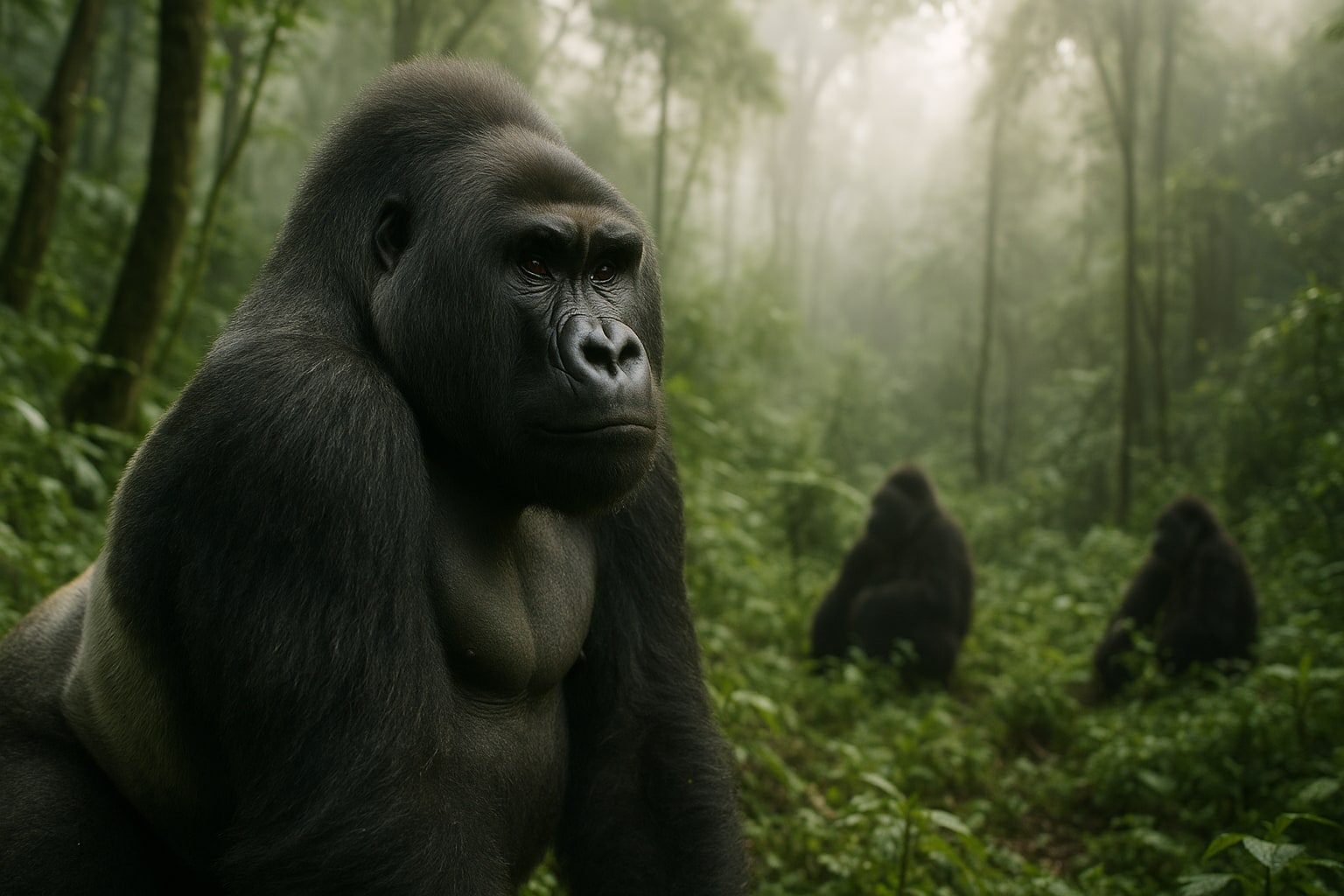
The mountain gorilla (Gorilla beringei beringei) is one of the most studied primates on the planet and also one of the few conservation stories with a reasonably hopeful ending. It lives in a handful of cloud forests in central Africa, between 2,200 and 4,300 metres above sea level, in a territory shared by three countries. Its population, although still small, has grown steadily over the last two decades.
We are talking about a subspecies of the eastern gorilla, not the western one usually seen in zoos. And it is of interest today for a specific reason: the censuses coordinated by the Greater Virunga Transboundary Collaboration confirmed in 2018 more than 1,000 living individuals, a milestone that led the IUCN to reclassify it from “Critically Endangered” to “Endangered”.
Classification and physical characteristics
The mountain gorilla belongs to the family Hominidae, the same as chimpanzees, orangutans and humans. Its full scientific name, Gorilla beringei beringei, distinguishes it from its closest relative, the Grauer’s gorilla (Gorilla beringei graueri), which inhabits the lowlands of the Congo.
Its physical traits are unmistakable:
- Weight: 140-220 kg for adult males; 70-100 kg for females.
- Standing height: 1.50-1.80 m.
- Coat: black, long and dense, adapted to the highland cold.
- Lifespan: 35-40 years in the wild; up to 50 in captivity.
Adult males develop a silver-grey coat on their back from around 12-13 years of age. Hence the term silverback (espalda plateada), which defines both the individual’s age and social role.
Mountain gorilla habitat
Only two isolated populations exist. The first lives in the Virunga massif, a volcanic chain shared by Rwanda, Uganda and the Democratic Republic of the Congo. The second is in Bwindi Impenetrable National Park, in Uganda.
The ecosystem is a humid montane forest with cool temperatures (7-20 °C) and abundant rainfall. The dense vegetation — bamboo, giant nettles, wild celery, thistles — is both pantry and shelter. In Virunga National Park, Africa’s oldest (1925), a significant fraction of the total population lives.
Political borders complicate conservation: a single group can cross from Rwanda to the DRC within hours.
Diet and social behavior
The mountain gorilla is a folivorous herbivore. An adult male consumes between 18 and 30 kg of vegetation per day: leaves, stems, bamboo shoots, flowers and occasionally ants or larvae. It does not drink water directly; it obtains it from succulent plants.
It lives in stable groups of 5 to 30 individuals led by a dominant silverback. This male decides feeding routes, mediates conflicts and defends the group. The typical structure includes several adult females, their offspring and some young males (blackbacks).
Social behavior is rich:
- Mutual grooming to strengthen bonds.
- Chest-beating as territorial display, not as an attack.
- Prolonged play in the young, even up to 6 years of age.
- New nests every night, built with branches and leaves.
Females reach sexual maturity around 8 years of age and have one offspring every 4 years on average. Gestation lasts about 8.5 months.
Conservation status
The IUCN classifies the mountain gorilla as Endangered (EN) since 2018, after years as “Critically Endangered”. The latest census (2018) estimated 1,063 individuals, split between Virunga (604) and Bwindi (459). It is the only great ape subspecies whose population is growing.
It is included in CITES Appendix I, which prohibits any international trade.
The active threats are concrete:
- Habitat loss due to agricultural expansion.
- Poaching, often as collateral damage (snares set for antelopes).
- Zoonotic diseases transmitted by humans (respiratory, Ebola).
- Armed conflict in eastern DRC, which directly affects Virunga.
Conservation programmes combine armed surveillance, field veterinary care (Gorilla Doctors), regulated high-cost tourism and work with local communities. The Dian Fossey Gorilla Fund, founded after the murder of the primatologist in 1985, has maintained daily monitoring of several groups in Rwanda for more than 50 years.
Verifiable curiosities
- They share about 98% of their DNA with us, according to genomic analyses published in Nature (Scally et al., 2012).
- Dian Fossey documented their behavior for 18 years at Karisoke; her work changed global perceptions of the species.
- Gorilla tourism generates key revenue: a permit in Rwanda costs USD 1,500 per person per hour of visit.
- Each gorilla has a unique pattern of nasal wrinkles, used by researchers to identify individuals.
Frequently asked questions
How many mountain gorillas are left in the world? Around 1,063 individuals according to the 2018 census coordinated by the Greater Virunga Transboundary Collaboration. It is the most recent official figure.
Where can mountain gorillas be seen? In three parks: Volcanoes (Rwanda), Bwindi and Mgahinga (Uganda) and Virunga (DRC). Always with an authorised guide and prior permit.
Are they aggressive towards humans? Not usually. Silverback displays are intimidating but rarely end in an attack if distances are respected (minimum 7 metres).
Can they be kept in captivity? There are no mountain gorillas in any zoo in the world. All historical attempts failed and it is now prohibited by CITES.
Why has its conservation status improved? Due to decades of continuous surveillance, field veterinary care, regulated tourism and the participation of local communities in the economic benefits.