Ficus benjamina: why it drops leaves and how to recover it
Discover the real causes behind your Ficus benjamina dropping leaves and learn, step by step, how to recover it with proper watering, light and care.
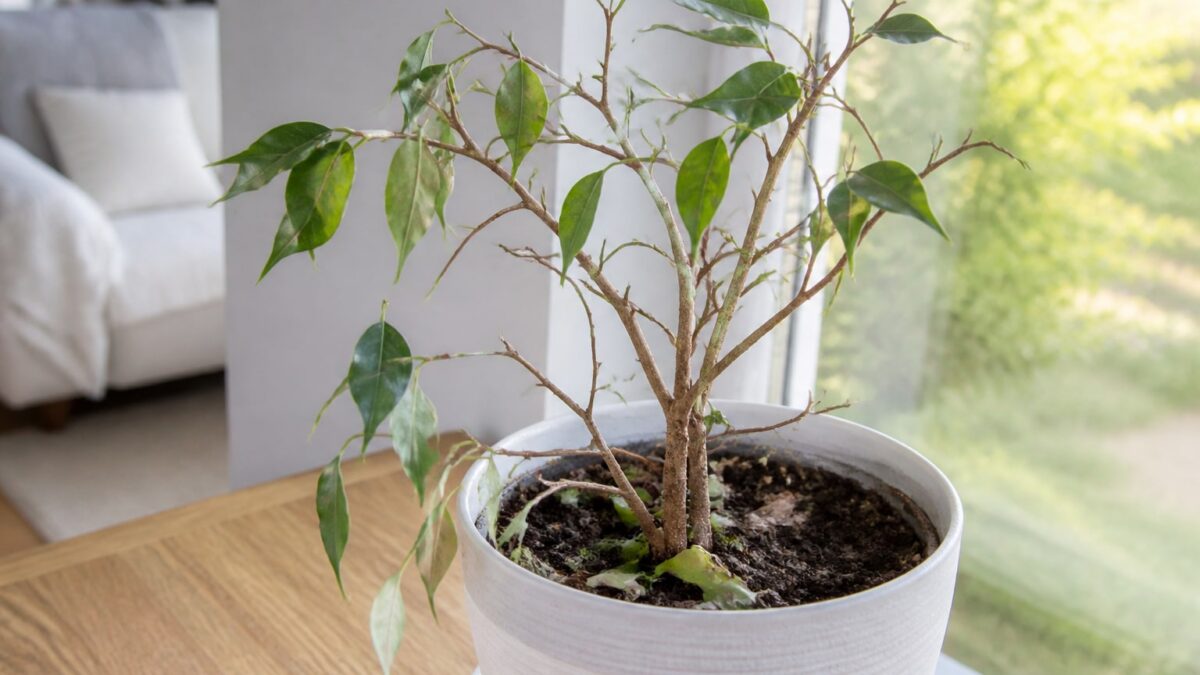
You have a Ficus benjamina (Ficus benjamina) at home and, suddenly, it starts shedding leaves as if it were perpetual autumn. It is the number one complaint from those who grow this plant: a seemingly healthy ficus that, within days, ends up with the floor covered in small green or yellow leaves. The good news is that there is almost always a solution.
This species, native to southern and southeastern Asia and northern Australia, is one of the most popular houseplants in the world. In its natural habitat it can exceed 20 metres; in a pot, it rarely goes beyond 2-3 metres. But it is also a plant extremely sensitive to changes, and that is the key to almost all of its problems.
Ficus benjamina quick facts
| Detail | Value |
|---|---|
| Scientific name | Ficus benjamina |
| Family | Moraceae |
| Origin | Southern and southeastern Asia, Australia |
| Light | Very abundant, indirect |
| Watering | Approx. once a week in summer; every 10-15 days in winter |
| Ideal temperature | 16-24 °C |
| Ambient humidity | 50-70 % |
| Toxicity | Irritating latex for pets and sensitive people |
Why the Ficus benjamina drops leaves: main causes
The ficus has a very marked defence strategy: faced with any stress, it sheds leaves. It is not dying, it is protesting. Identifying the cause is the first step.
Change of location or draughts
This is by far the most common reason. If you have just bought the plant, moved it to another room, or it is near a window you open daily in winter, the ficus will react by losing leaves within the following 7-15 days. Blasts of air from air conditioning or heating also affect it.
Incorrect watering (excess or deficit)
Overwatering is more dangerous than drought. If you notice yellow leaves that fall soft, waterlogged substrate and, sometimes, a sour smell from the soil, you are watering too much. Extreme drought, on the other hand, causes dry, crispy leaves that fall brown at the edges.
Lack of light
The Ficus benjamina needs plenty of indirect light. In a dark corner it survives for weeks, but eventually it yellows and defoliates from the inside outwards. A window facing east or south, with a sheer curtain, is the ideal setting.
Temperature and humidity
Below 13 °C it suffers. Cold draughts are lethal. Dry heating also strips leaves: the ideal ambient humidity is around 50-70 %, far from the 25-30 % typical of a heated living room.
Pests: scale insects, red spider mite and whitefly
Check the underside of the leaves. White cottony dots indicate scale insects; fine webs and tiny yellow dots, red spider mite; clouds of tiny flies when you move the plant, whitefly. All three cause leaf drop if untreated.
Recent repotting
If you changed its pot less than a month ago, leaf loss is almost certain. The ficus hates having its roots disturbed.
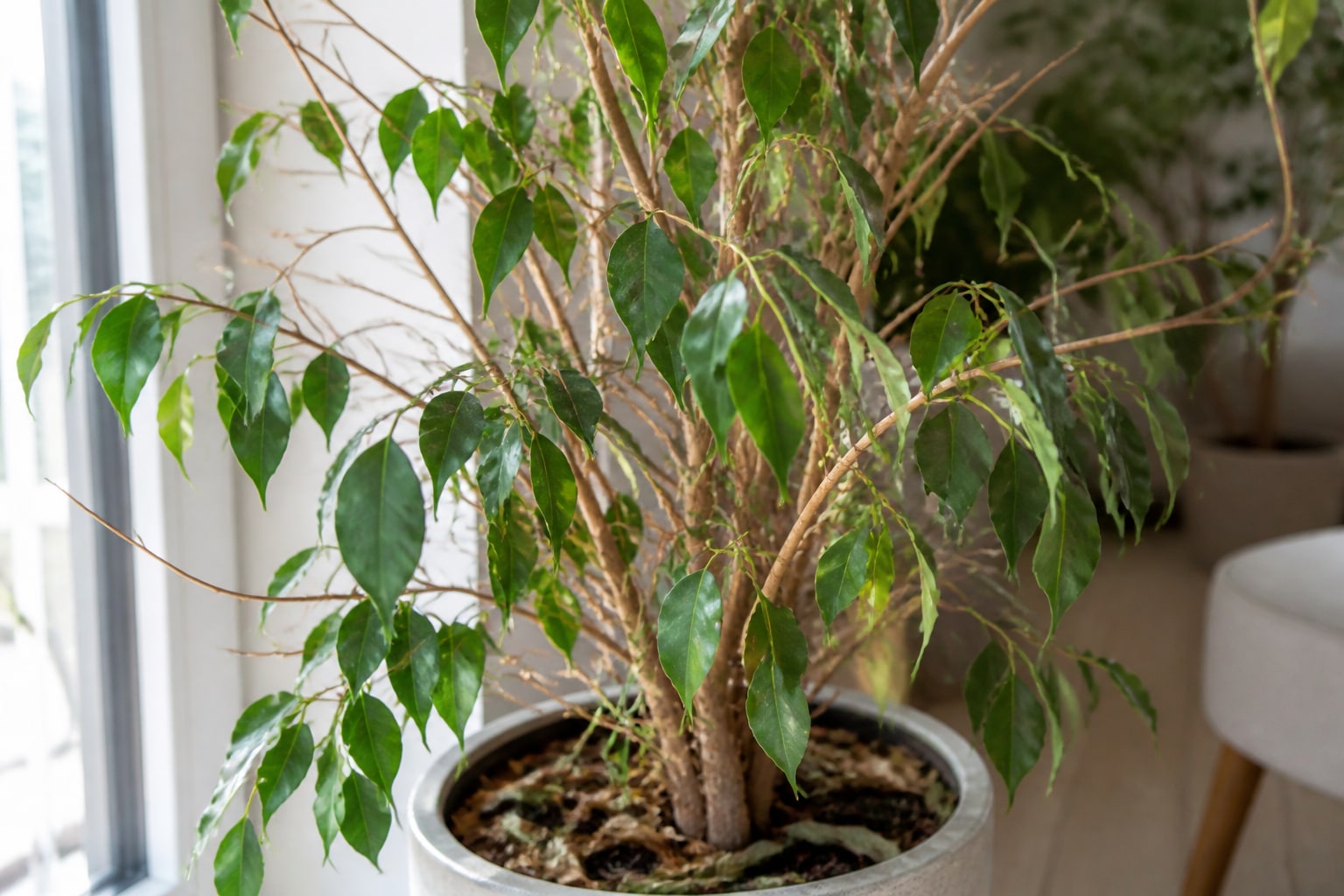
How to recover a Ficus benjamina step by step
- Diagnose before acting. Touch the substrate 3-4 cm deep. Look at the underside of the leaves. Check where it is located.
- Stabilise its location. Choose a spot with abundant indirect light, away from radiators and windows you open daily. And leave it there. Do not move it again.
- Adjust the watering. Let the top 2-3 cm of substrate dry out before watering again. In summer this is usually every 7 days; in winter, every 10-15.
- Improve humidity. Mist the leaves with limescale-free water 2-3 times a week, or place a tray with expanded clay and water under the pot (without the base touching the water).
- Treat pests if present. Potassium soap sprayed every 7 days for 3 weeks is usually enough for light infestations.
- Be patient. Regrowth can take 4-8 weeks. If the branches are still green inside when you gently scratch the bark, there is hope.
Yellow leaves: what is my ficus telling me?
| Symptom | Probable cause | Action |
|---|---|---|
| Yellow leaves that fall soft | Overwatering | Space out watering, check drainage |
| Yellow leaves with dry edges | Dry air or lack of water | Increase humidity, water |
| Yellow inner leaves | Low light | Move to a brighter area |
| Yellow dots and fine webbing | Red spider mite | Potassium soap, increase humidity |
| Massive drop without yellowing | Change of location or cold | Stabilise the spot, protect from draughts |
Common mistakes to avoid
- Watering with very cold or very hard water. Use room-temperature water, left to stand for 24 hours if it comes from the tap.
- Moving the plant constantly looking for “the perfect spot”. Choose one and stick with it.
- Fertilising a stressed ficus. Until it recovers, no fertiliser at all. Resume in spring, every 15 days, with a liquid fertiliser for green plants.
- Pruning during a leaf-drop episode. Wait for it to regrow and then tidy up.
- Forgetting that it is toxic. Its white sap (latex) irritates skin and mucous membranes; keep cats and dogs away from fallen leaves. If you have curious felines, you may be interested to know why cats chew houseplants and which ones to avoid.
Other resilient houseplants as an alternative
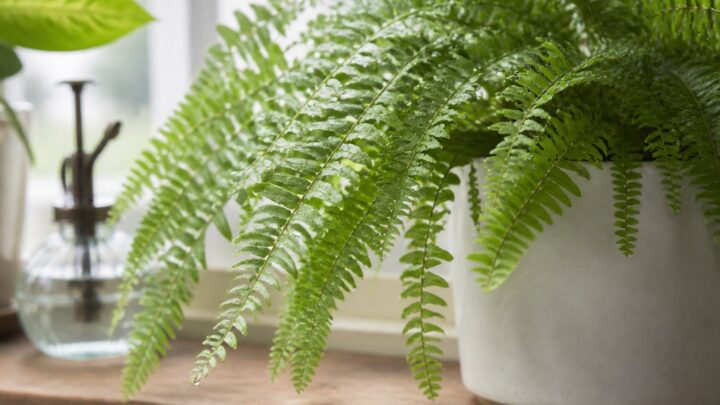
If your ficus simply won’t acclimatise despite everything, it is not your failure: there are more forgiving species. A Boston fern (Nephrolepis exaltata) also appreciates humidity and forgives location mistakes more readily.
Frequently asked questions
How long does a Ficus benjamina take to regain its leaves? Between 4 and 8 weeks if the cause has been corrected. New shoots appear first at the branch tips.
Should I prune the branches without leaves? Not straight away. Gently scratch the bark: if it is green underneath, the branch is still alive. Wait for spring regrowth before tidying up.
Can I save a ficus that has lost all its leaves? Yes, as long as the main branches and trunk retain green tissue inside. Reduce watering to a minimum, keep it in indirect light and be patient.
Why does it lose leaves in winter even if I don’t move it? It is almost always the combination of dry air from heating, less light and irregular temperature. Increase humidity and keep it away from radiators.
Is it normal for it to lose leaves when I bring it home newly bought? Completely. Moving from a greenhouse to a living room is a shock. Give it 2-3 weeks of stability before worrying.
As an Amazon Associate, I earn from qualifying purchases.

0 comments · Comment