Cat breeds that resemble leopards and panthers
Guide to domestic breeds with a wild look: from the Bengal, which recalls the leopard, to the Bombay with its panther-like coat. Origin, pattern, temperament and legality.
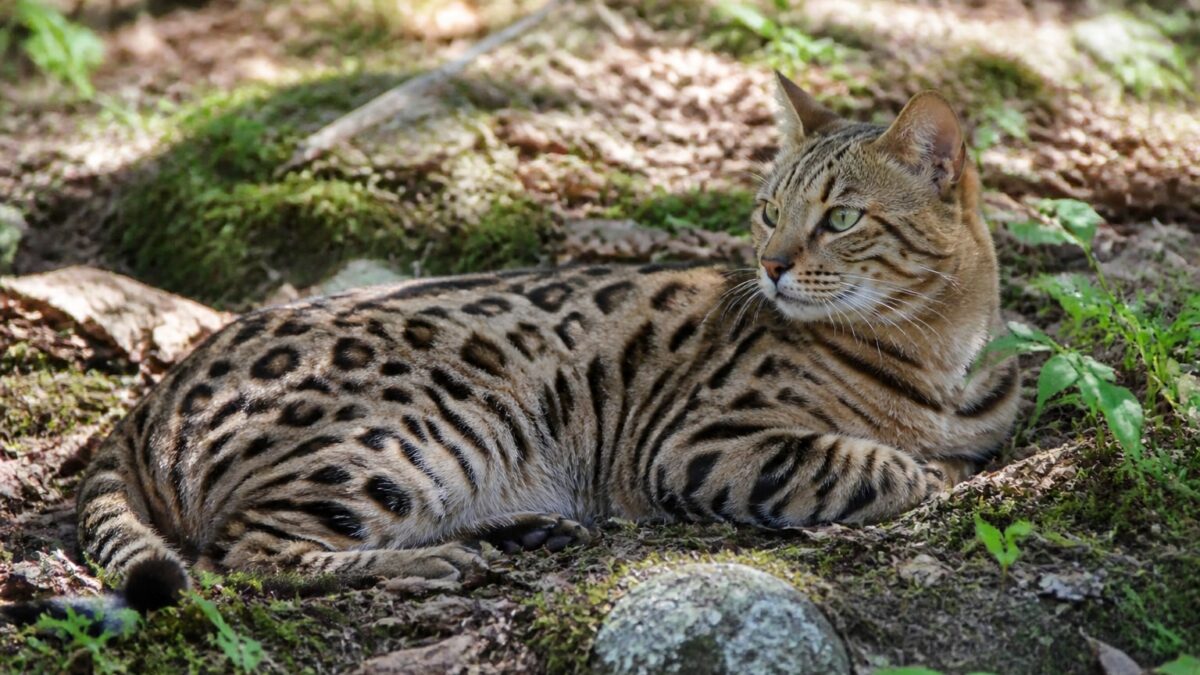
Some people look for the appearance of a wild feline in a domestic cat. A spotted coat, a long silhouette, that gaze that seems to come from the savannah. The good news is that there are breeds created, or selected, to resemble leopards, ocelots, servals or black panthers while still being a Felis catus. The less good news: not all of them are equally recommendable as companions, and some carry legal and welfare controversies worth knowing about.
This is a guide to help you if you are drawn to the wild look but want a cat that lives well in an apartment, gets along with the family and doesn’t get you into trouble with the law.
Quick reference: breeds with a wild look
| Breed | Wild feline it recalls | Coat pattern | Adult weight | Activity level |
|---|---|---|---|---|
| Bengal | Leopard (Panthera pardus) | Rosettes and spots | 4-7 kg | Very high |
| Savannah | Serval (Leptailurus serval) | Solid spots | 5-11 kg | Very high |
| Ocicat | Ocelot (Leopardus pardalis) | Bullseye spots | 3-6 kg | High |
| Bombay | Black panther | Uniform black | 3-5 kg | Medium |
| Egyptian Mau | Cheetah / leopard | Natural spots | 3-5 kg | High |
| Toyger | Tiger (Panthera tigris) | Tabby stripes | 3-7 kg | Medium-high |
Bengal: the cat that best imitates the leopard
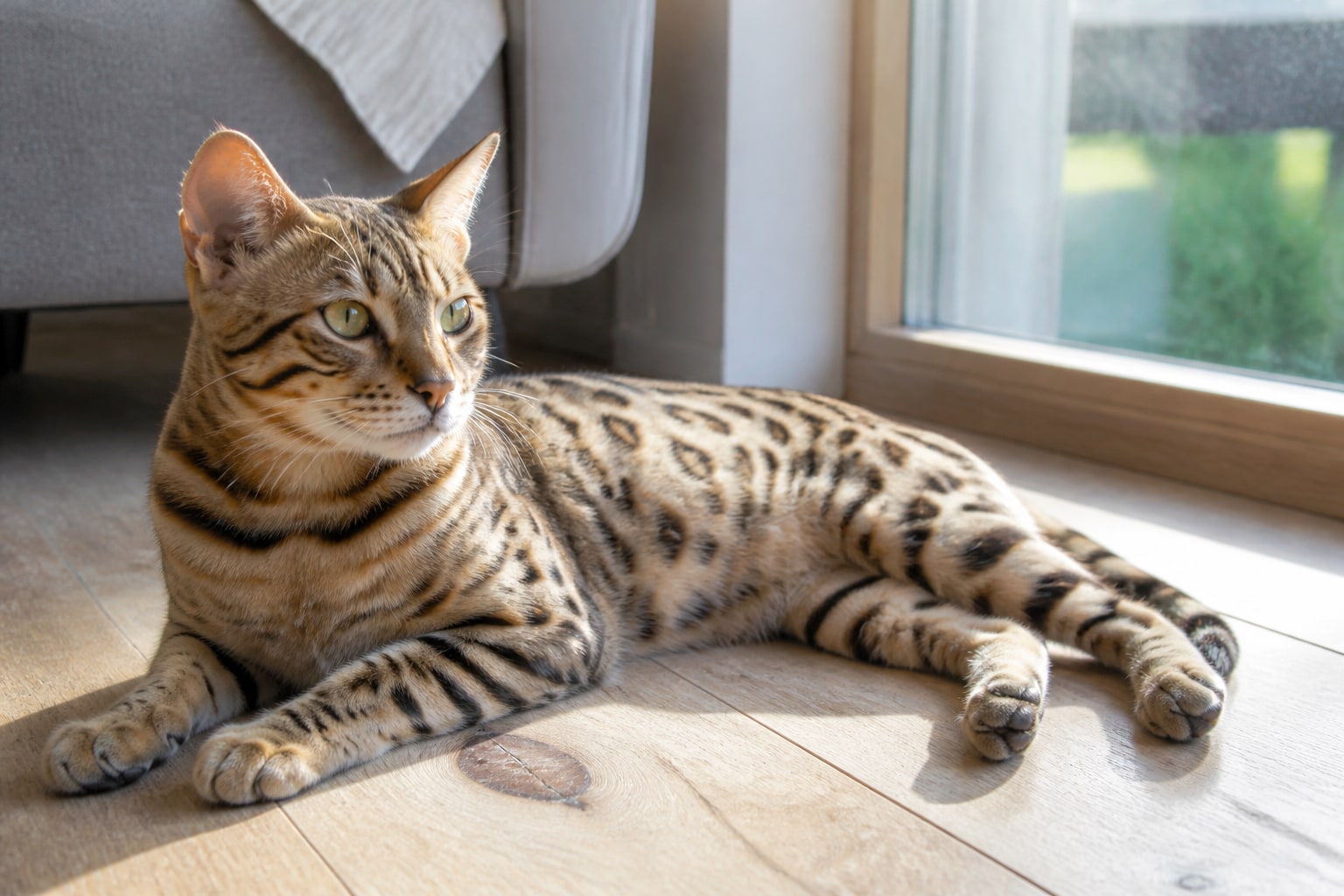
The Bengal (Prionailurus bengalensis × Felis catus in its origin) is the star breed when you want a cat that looks like a leopard. It was born in the 1960s in the United States from crossing the Asian leopard cat with domestic cats. Current generations (F5 onward) are fully domestic and legal in most European countries.
Its rosette and spot pattern on a gold, silver or snow background is the one that comes closest to the real leopard. It is muscular, athletic and weighs between 4 and 7 kg. It needs a lot of stimulation: tall scratching posts, hunting games, access to windows. A bored Bengal breaks things. If you work twelve hours away from home, it is not your cat.
Savannah: the elegance of the serval at home (with caveats)
The Savannah is a hybrid between the African serval and a domestic cat. It is the largest of the breeds with a wild look: an F1 male can exceed 10 kg and measure almost a metre including the tail. Very long legs, huge ears, solid spots.
Here comes the important warning. In Spain, keeping serval hybrids is restricted: the first generations (F1-F4) are considered wild animals and require permits equivalent to those for a non-domestic feline. Advanced generations (F5 and later) are usually admitted as pets, but it is advisable to check regional regulations before buying. In several EU countries the first generations are outright banned.
Ocicat: the look of an ocelot without a drop of wild blood
Curiously, the Ocicat has no recent wild ancestor. It was obtained by crossing Siamese, Abyssinian and American Shorthair. Its name comes from its resemblance to the ocelot (Leopardus pardalis), thanks to its rounded “bullseye” spots on a light background.
It weighs between 3 and 6 kg, is sociable, communicative and fairly tolerant of other animals. For someone who wants the spotted look without the intense character of the Bengal or the legal problems of the Savannah, it is a very reasonable option.
Bombay: the miniature black panther
If you are looking for a cat resembling a panther, the Bombay is the clear answer. Created in the 1950s in Kentucky by crossing a Burmese with a black American Shorthair, its coat is jet black, uniform and glossy, including the paw pads and nose. Copper or golden eyes.
There is no “panther” in nature as a species: what we call a black panther is a leopard or jaguar with melanism. The Bombay reproduces that look in a 3-5 kg, affectionate, calm cat strongly oriented toward people. A good choice for apartments.
Egyptian Mau and Toyger: natural spots and stripes
The Egyptian Mau is one of the few breeds with naturally occurring spots, without recent hybridisation. It is fast, reportedly reaching over 50 km/h in a sprint, and recalls a small cheetah. The Toyger, on the other hand, was selected from the 1980s onward to imitate a miniature tiger: tabby coat with well-defined vertical stripes.
Temperament: it is not all about looks
A cat with a wild look usually keeps active and demanding behaviour. Bengals and Savannahs need vertical space, 30-60 minutes of daily play and, if possible, the company of another cat that keeps up with them. If it is your first feline, an Ocicat, a Bombay or a Toyger will fit better.
Before bringing one home, it is also worth considering how it will get along with other animals. This guide on how to introduce a new cat into the home without conflict helps quite a lot when you already have another feline at home.
Legality and ethics: what you need to know
In the EU, wild feline hybrids are subject to CITES and national regulations. The F1-F4 Savannah requires specific permits in Spain. The F5+ Bengal is considered domestic and has no general restrictions. Buying a first-generation hybrid online is, besides legally risky, an animal welfare problem: these animals are not adapted to life in an apartment.
Before choosing a breed, check the regional regulations and prioritise registered breeders or, better yet, consult animal shelters: there are Bengals and Egyptian Maus looking for homes.
FAQ
Which domestic cat looks most like a leopard? The Bengal, for its rosette pattern and muscular build. The Ocicat is an alternative with no recent wild ancestors.
Is there a domestic cat that looks like a black panther? Yes, the Bombay. Uniform black coat, copper eyes and normal cat size (3-5 kg).
Is it legal to have a Savannah in Spain? It depends on the generation. F5 and later are usually admitted as pets; F1-F4 require wild animal permits and are restricted. Check with your autonomous community.
Are cats with a wild look aggressive? No more than other cats, but many (Bengal, Savannah) are very active and can show frustration if they do not receive enough stimulation. They are not breeds for inactive households.
Where to adopt or buy? Breed-specialised shelters, recognised feline associations (WCF, TICA, FIFe) and breeders with verifiable pedigree. Avoid sales on social networks without traceability.


0 comments · Comment