Bornean Orangutan: the critically endangered red great ape
Meet the Bornean orangutan (Pongo pygmaeus), the great arboreal ape fighting to survive in the forests of Asia. Verifiable data, threats, and conservation projects.
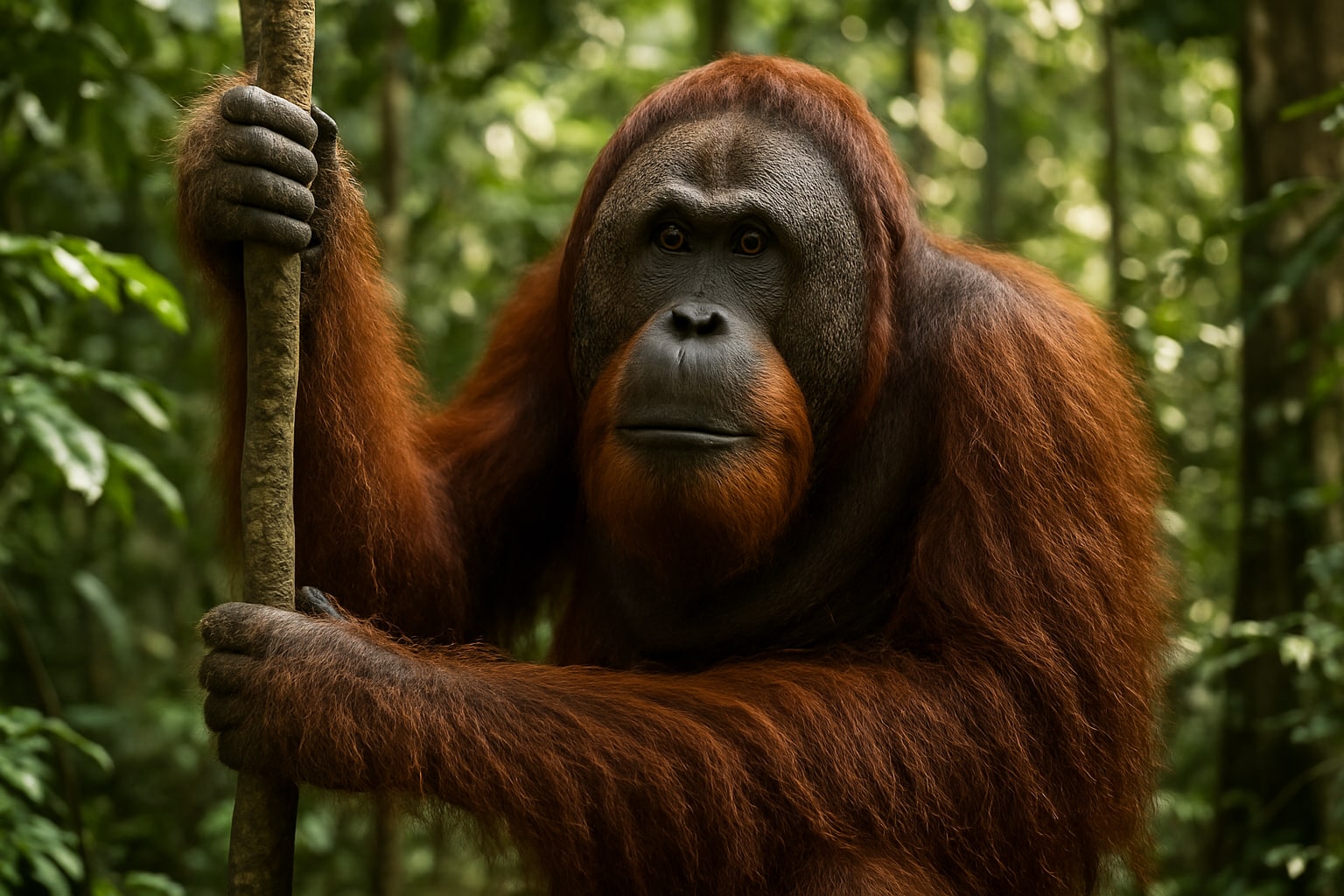
In the humid rainforests of Southeast Asia lives one of the closest relatives of human beings: the Bornean orangutan (Pongo pygmaeus). It shares about 97% of our DNA, spends nearly its entire life in the trees and, yet, is on the brink of extinction. The IUCN has listed it as Critically Endangered (CR) since 2016.
Its recent history is that of a red giant cornered by deforestation, fires, and illegal trade. Understanding it is the first step toward grasping what is at stake on the island of Borneo.
Who the Bornean orangutan is
The Bornean orangutan is one of the three great Asian apes, alongside the Sumatran orangutan (Pongo abelii) and the newly described Tapanuli orangutan (Pongo tapanuliensis), identified as a distinct species in 2017. Three subspecies of P. pygmaeus are recognized: P. p. pygmaeus, P. p. wurmbii and P. p. morio, distributed across different regions of the island.
The word “orangutan” comes from the Malay orang hutan, meaning “person of the forest”. It is no coincidence: it is the largest arboreal ape on the planet.
Identification: size, fur, and sexual dimorphism
Adult males weigh between 50 and 100 kg and reach 1.2–1.4 m in height when standing upright. Females are noticeably smaller, between 30 and 50 kg. A male’s arm span can exceed 2 meters, a perfect adaptation to life hanging from branches.
The fur is long, coarse, and of a distinctive reddish orange color. Dominant males develop prominent facial pads on either side of the face, called flanges, and a throat sac that amplifies their vocalizations, the famous long calls, audible from more than a kilometer away.
In the wild they live between 35 and 45 years; in captivity they can exceed 55.
Habitat and distribution in Borneo
It lives exclusively on the island of Borneo, shared among Indonesia (Kalimantan), Malaysia (Sabah and Sarawak), and Brunei. It prefers lowland tropical forests, peat swamp forests and, to a lesser extent, mountain areas below 1,500 meters.
It spends more than 90% of its time in the tree canopy. Every night it builds a new nest of branches and leaves between 12 and 18 meters above the ground. An orangutan may build up to 30,000 nests over its lifetime.
Diet and behavior
It is predominantly frugivorous: about 60% of its diet is fruit, with a preference for figs and durian. It rounds out its menu with young leaves, bark, flowers, insects and, occasionally, eggs or small vertebrates. It knows and remembers hundreds of plant species and their fruiting cycles.
Unlike chimpanzees or gorillas, it is a semi-solitary ape. Females live with their offspring, while males usually occupy large territories alone. The young depend on their mother for 7 to 8 years, the longest dependency period known in non-human mammals. This explains the interval between births: 6 to 8 years, one of the slowest in the animal kingdom.
Tool use and intelligence
The use of sticks to extract insects and seeds is documented, as well as large leaves used as umbrellas or gloves to handle thorny fruits. Research published in Science and Current Biology also describes local cultural traditions: socially transmitted behaviors that vary from one population to another.
Conservation status: how many are left?
The IUCN estimates the population of Pongo pygmaeus at around 104,700 individuals (2016 assessment), after a decline of more than 50% over the last six decades. Projections suggest it could fall to about 47,000 individuals by 2025 if the trend is not reversed.
The main threats are:
- Deforestation for palm oil plantations, rubber, and pulp and paper.
- Forest fires, especially in the peat swamp forests of Kalimantan.
- Poaching and capture of young for the illegal pet trade.
- Habitat fragmentation caused by roads and infrastructure.
The species is listed in CITES Appendix I, which prohibits its international trade.
Active conservation programs
Several organizations work on the ground:
- Borneo Orangutan Survival Foundation (BOSF), based in Indonesia, rescues, rehabilitates and reintroduces confiscated or orphaned individuals.
- WWF and Orangutan Foundation International (OFI) fund forest corridors and the protection of key areas.
- The Tanjung Puting National Park (Central Kalimantan) and the Gunung Palung National Park are priority refuges.
RSPO certification (sustainable palm oil) seeks to reduce pressure on forests, although with uneven results.
Verifiable curiosities
- It is the only great Asian ape that survives today; it once also inhabited southern China.
- Females can remember the location of fruit trees for years, according to studies from the Max Planck Institute for Evolutionary Anthropology.
- The males’ long calls serve both to attract females and to avoid encounters with other males.
- In 2018, a male named Rocky took part in an experiment at Durham University that demonstrated controlled vocal imitation ability.
Frequently asked questions
How many Bornean orangutans are left? According to the IUCN (2016), about 104,700 individuals. Recent estimates point to a continued decline due to habitat loss.
Can you keep an orangutan as a pet? No. It is listed in CITES Appendix I and owning one is illegal in virtually every country. Young sold on black markets almost always come from the killing of their mother.
How does it differ from the Sumatran orangutan? The Bornean one is somewhat sturdier, has darker fur and a more terrestrial behavior. The Sumatran one is slimmer and more social.
How can I help from Spain? By reducing consumption of products containing non-certified palm oil, financially supporting organizations such as BOSF or WWF, and avoiding tourism that involves direct contact with great apes.