Philodendron hederaceum: the heartleaf philodendron, ideal for beginners
Complete care guide for Philodendron hederaceum, the heartleaf philodendron: light, watering, substrate, propagation and toxicity explained with concrete data.
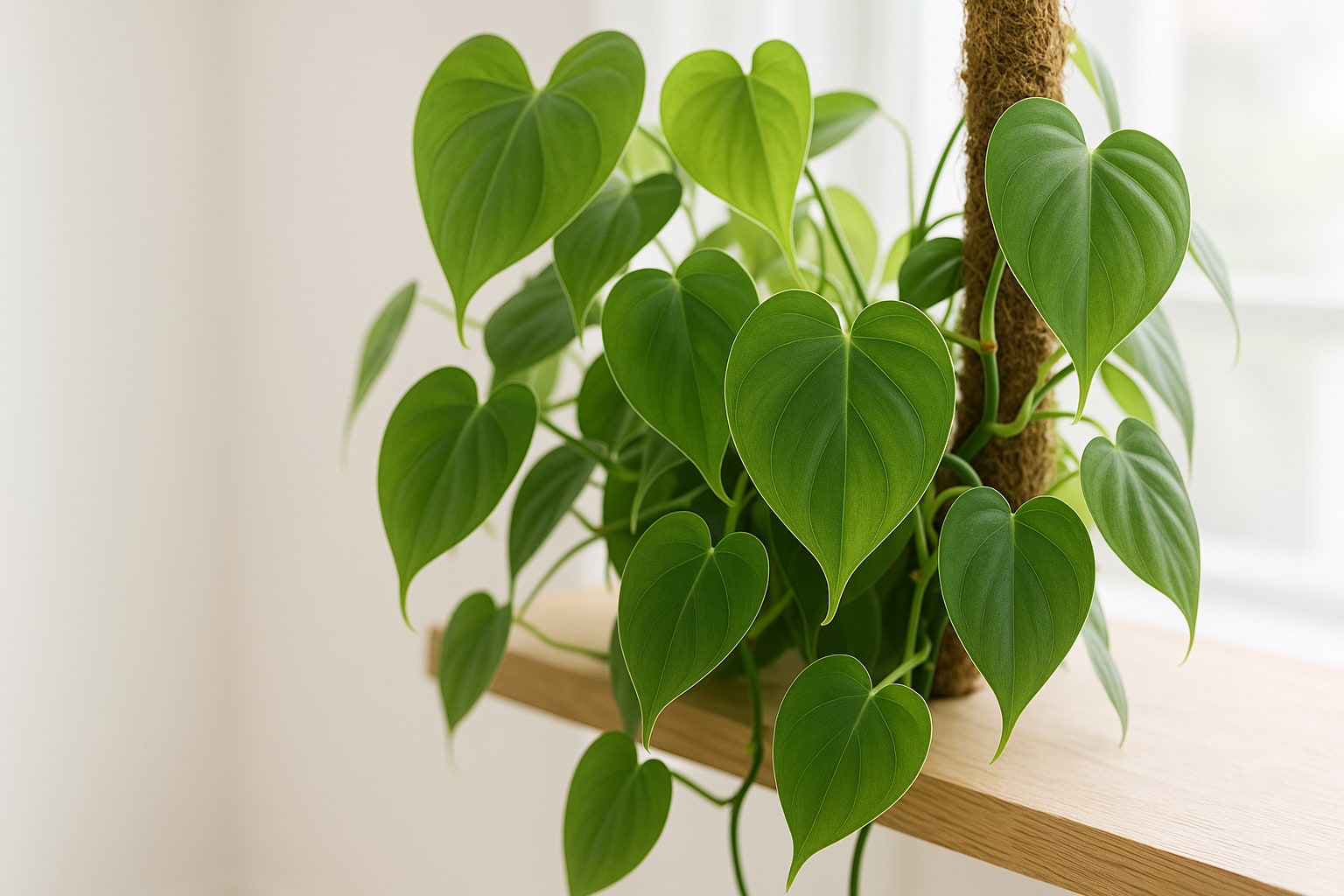
If you’re looking for a houseplant that forgives lapses in attention, grows quickly and looks good both trailing and climbing, the heartleaf philodendron (Philodendron hederaceum) is one of the best choices. It is still often called by its botanical synonym Philodendron scandens, and it is an aroid native to the rainforests of Central America and the Caribbean.
Its reputation among beginners is no coincidence: it tolerates medium light, signals when it’s thirsty and can be propagated in a glass of water. Let’s look at the details.
Quick profile of Philodendron hederaceum
| Data | Value |
|---|---|
| Scientific name | Philodendron hederaceum (syn. P. scandens) |
| Family | Araceae |
| Origin | Central America, Caribbean, northern South America |
| Light | Medium-high indirect |
| Watering | Every 7-10 days in summer; 10-15 in winter |
| Temperature | 18-27 °C |
| Toxicity | Yes, calcium oxalate crystals |
| Difficulty | Low |
Identification and varieties
It is an evergreen climber with heart-shaped leaves measuring 7 to 15 cm indoors (larger if climbing a moss pole). The stems are thin, flexible and produce aerial roots at every node, allowing them to cling to rough surfaces.
There are several popular cultivars that are cared for in the same way as the type species:
- 'Brasil': variegated leaves with a yellow central stripe.
- 'Micans': velvety leaves with bronze highlights.
- 'Lemon Lime': bright lime-green foliage.
Don’t confuse it with the pothos (Epipremnum aureum): philodendron leaves are thinner, more symmetrical and have a perfectly heart-shaped base.
Light: medium-high indirect
The heartleaf philodendron thrives in bright indirect light, roughly equivalent to standing 1-2 metres from an east- or south-facing window with a sheer curtain. It tolerates darker areas, but it will grow slowly and with long internodes (stems with widely spaced leaves).
Avoid direct midday sun: it will scorch the leaves within hours. If new shoots come out small and pale, move it to a brighter spot.
Watering: when the top 2-3 cm are dry
Water when the top 2-3 centimetres of substrate are dry to the touch. In a flat with normal central heating, this usually translates to:
- Spring-summer: every 7-10 days.
- Autumn-winter: every 10-15 days.
Use room-temperature water, preferably left to stand for 24 hours so the chlorine evaporates. Overwatering is the number one mistake with this plant: if the leaves yellow from the base and the stem softens, you are watering too much.
Substrate and pot
It needs an airy, well-draining substrate, with a slightly acidic pH (5.5-6.5). A mix that works well:
- 60% universal potting soil for indoor plants.
- 20% perlite.
- 20% fine pine bark or coconut fibre.
The pot must have drainage holes, without exception. Repot every 1-2 years, moving up just one pot size (2-3 cm more in diameter). If the pot is too big, it retains moisture and rots the roots.
Humidity and temperature
It adapts well to the ambient humidity of a home (40-50%), but appreciates more. Below 15 °C it stops growing, and below 10 °C it suffers damage. In summer, keep it away from direct draughts from air conditioning.
If the air is very dry (winter with heating on), group plants together or use a humidifier. Misting has a very short-lived effect and can encourage fungi if you wet the leaves at night.
Seasonal care
In spring and summer is when it truly grows: feed every 3-4 weeks with a balanced fertiliser (NPK 20-20-20) diluted to half the recommended dose. This is also the best time to repot and prune.
In autumn and winter, stop fertilising, space out waterings and keep it away from radiators. Don’t worry if it stops producing new leaves: this is normal.
Common problems
- Yellow leaves from the bottom: overwatering. Let it dry out and check the roots.
- Brown, dry tips: very dry air or water with a high chlorine content.
- Small leaves and long, bare stems: lack of light.
- Brown spots with a yellow halo: possible fungus from wet leaves.
- Pests: mealybugs and red spider mites. Clean with a cotton swab dipped in 70% alcohol or apply potassium soap.
If the problem persists, check the conditions before repotting. Another aroid that presents similar symptoms is the Zamioculcas zamiifolia, useful as a reference if you are setting up a low-maintenance corner.
Propagation: cuttings in water or soil
It is one of the most rewarding plants to propagate. Steps:
- Cut a stem 10-15 cm long just below a node (the small bump where the leaf and aerial roots emerge).
- Remove the lowest leaf.
- Place it in a glass of room-temperature water, with the node submerged.
- Change the water every 4-5 days.
- In 2-4 weeks, roots of 3-5 cm will appear. Transplant into substrate.
You can also insert the cutting directly into moist soil; rooting is slightly slower but avoids transplant stress.
Toxicity: watch out for pets and children
The Philodendron hederaceum contains calcium oxalate crystals (raphides) throughout the whole plant. If a dog, a cat or a child chews a leaf, it can cause mouth irritation, excessive salivation, swelling of the lips and tongue and, in rare cases, difficulty swallowing.
It is rarely fatal, but it is unpleasant. Keep it out of reach of curious pets or choose a non-toxic alternative such as the spider plant (Chlorophytum comosum). In case of ingestion, contact your veterinarian.
Frequently asked questions
Is Philodendron hederaceum the same as Philodendron scandens? Yes. P. scandens is an accepted older botanical synonym. Kew Gardens recognises P. hederaceum as the valid name.
How long does a heartleaf philodendron live? With basic care, easily 10-20 years indoors. It can be rejuvenated through cuttings, so the plant can be perpetuated indefinitely.
Can I keep it in the bathroom? Yes, as long as there is some natural light. It loves the high humidity of a bathroom.
Why isn’t my philodendron climbing? Without a support to grip (moss pole, string, rough wall), it tends to trail. Give it a moist moss pole and you’ll see it climb and produce larger leaves.
Does it need pruning? Only for aesthetics. Prune above a node in spring to encourage branching, and use the cuttings for propagation.