Iberian imperial eagle: the queen of the Peninsular skies
Everything about the Iberian imperial eagle (Aquila adalberti): identification, habitat, breeding, threats and the real conservation status on the Peninsula. Official data and verified figures.
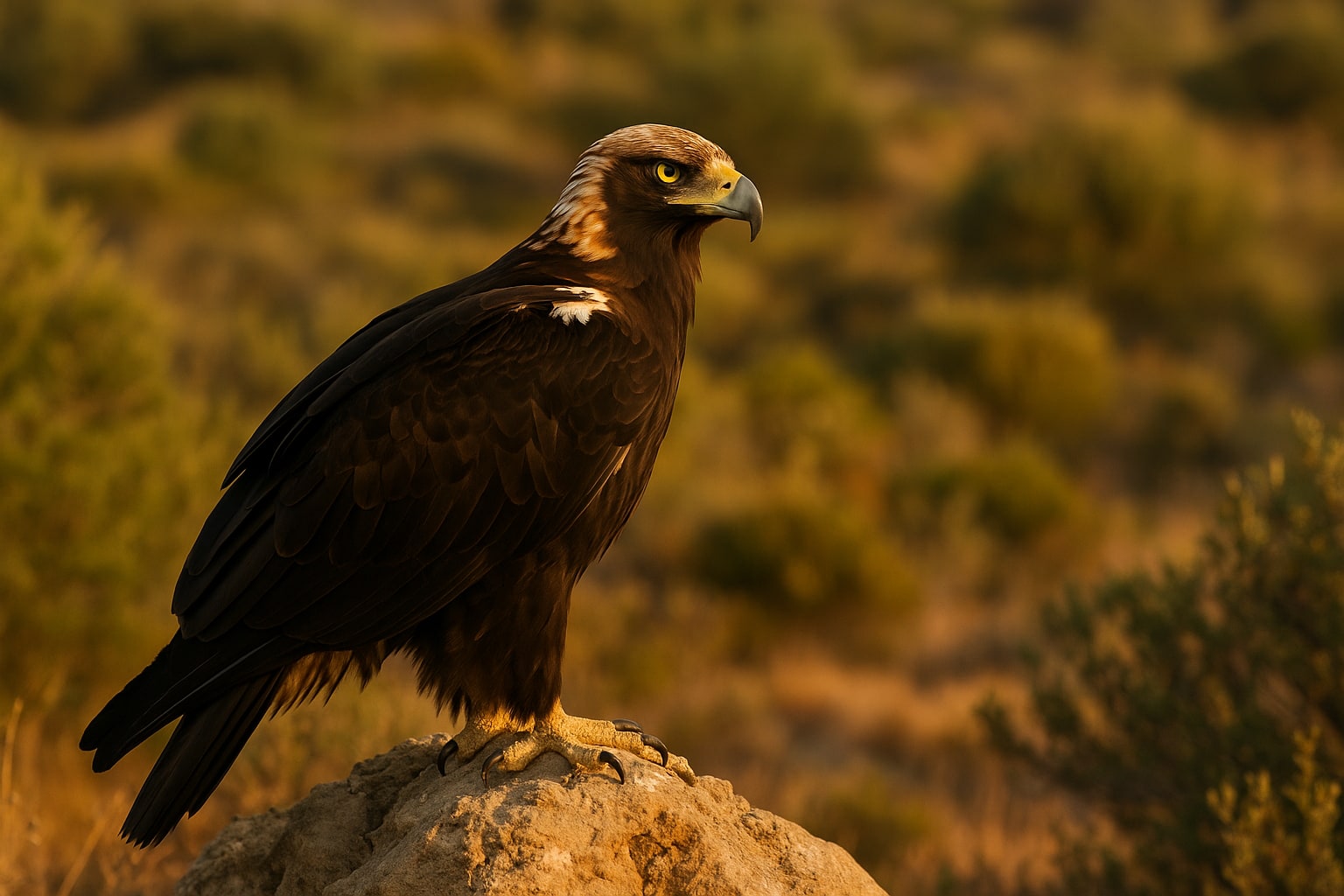
Few birds of prey are so closely tied to a single territory as the Iberian imperial eagle (Aquila adalberti). It doesn’t fly anywhere else in the world: it is endemic to the Iberian Peninsula and, for decades, it came close to disappearing. Today, after sustained conservation efforts, its story has become one of the few real success cases among Europe’s large threatened birds.
Its recovery is no accident. Behind it are regional recovery plans, the correction of power lines, management of wild rabbit populations and anti-poaching surveillance. Even so, it remains classified as Vulnerable (VU) by the IUCN, and its future depends on decisions made every year in the field.
A raptor that flies only in Iberia
The Iberian imperial eagle is a large bird of prey, with a wingspan of 1.80 to 2.20 metres and a weight of around 2.5-3.5 kg, with females slightly larger than males. In flight it is recognisable by its broad silhouette, relatively short tail and very prominent white shoulders in adults, a diagnostic feature compared with other Iberian eagles.
It lives on average 20-25 years in the wild, although it can exceed 30 in captivity. Adults have very dark brown plumage, almost black, with a golden nape and those characteristic white scapulars. Juveniles, on the other hand, are a uniform reddish brown during their first years.
Iberian imperial eagle vs eastern imperial eagle
Until the late 20th century it was considered a subspecies of the eastern imperial eagle (Aquila heliaca), which ranges from central Europe to Asia. Genetic and morphological analyses confirmed that they are two distinct species. The Iberian one is smaller, sedentary and has more sharply defined white shoulders; the eastern one is migratory and lacks that clean contrast.
Imperial eagle habitat: dehesas and Mediterranean scrubland
The imperial eagle’s habitat is closely linked to the mature Mediterranean forest: holm oak and cork oak dehesas, open pine forests and scrubland areas on lowland plains and sierras. It needs large, isolated trees for nesting, and open spaces where it can hunt.
It is distributed across the central and southwestern Peninsula: Castilla-La Mancha, Extremadura, Madrid, Castile and León, Andalusia and southern Portugal. In recent years it has recolonised areas of Aragon and is spreading northward, although at very low densities.
Diet: the importance of the rabbit
The wild rabbit (Oryctolagus cuniculus) is the foundation of its diet, to the point that the availability of this prey entirely determines the species’ breeding success. When rabbits become scarce due to diseases such as myxomatosis or rabbit haemorrhagic disease, pairs produce fewer chicks or fail to breed altogether.
It supplements its diet with:
- Partridges, wood pigeons and corvids.
- Reptiles such as the ocellated lizard.
- Medium-sized mammals: hares, fox cubs, squirrels.
- Occasional carrion, especially in winter.
Breeding of the Iberian imperial eagle
It forms stable pairs that occupy the same territory for years. Breeding begins in late winter: laying takes place between February and March, with 1-3 eggs incubated for about 43 days. The chicks remain in the nest for around 75-80 days and continue to depend on their parents for several weeks after their first flight.
The nest is a huge platform of branches built in the crown of large trees, usually holm oaks, cork oaks or pines. Each pair usually maintains several alternative nests within the same territory.
Conservation status: from 30 pairs to more than 800
In the 1960s and 70s, the critically endangered Iberian imperial eagle was a tangible reality: barely 30 pairs remained. Poisoning, electrocution on power lines and the decline of rabbits due to myxomatosis pushed it to the brink of collapse.
According to the latest census coordinated by MITECO and the autonomous communities, the population exceeds 800 breeding pairs in Spain (2022-2023 data), to which those in Portugal are added. The IUCN classifies it as Vulnerable (VU) and it is listed in Annex I of the European Birds Directive.
Main current threats
- Electrocution on power lines: it remains the leading cause of unnatural mortality.
- Illegal poisoning with baits aimed at other predators.
- Collisions with wind turbines in expansion areas.
- Rabbit shortage due to recurrent viral diseases.
- Loss of mature dehesas due to changes in land use.
Imperial eagle conservation: what is being done
The conservation of the imperial eagle is carried out through regional plans and LIFE projects co-financed by the EU. Key lines of work include correcting dangerous power pylons (mandatory under Royal Decree 1432/2008), boosting rabbit populations, anti-poisoning surveillance and GPS tracking of juvenile birds.
Organisations such as SEO/BirdLife, the CBD-Hábitat Foundation and GREFA work on the ground alongside administrations and owners of private estates, many of them privately owned dehesas where a large part of the population nests.
Verifiable facts
- It is the only endemic eagle of the Iberian Peninsula.
- Its reclassification as a separate species (A. adalberti) from A. heliaca was consolidated in the early 2000s.
- Juveniles can disperse hundreds of kilometres before settling a territory; individuals have been recorded in Morocco and southern France.
- Spain hosts more than 95% of the world population of the species.
Frequently asked questions
How many Iberian imperial eagles are left? More than 800 breeding pairs in Spain according to recent official censuses (MITECO), to which a small nucleus in Portugal is added. The trend has been positive since the 2000s.
Why is it called “imperial”? Because of its stature and its dark plumage with white shoulders, which recalled imperial iconography. The scientific name adalberti honours Prince Adalbert of Bavaria.
Is it the same as the golden eagle? No. The golden eagle (Aquila chrysaetos) is larger, has golden-brown plumage and occupies mountainous areas. The imperial eagle is exclusive to Iberia and prefers plains and dehesas.
Can it be seen in the wild? Yes, with patience and binoculars. Areas such as the Cabañeros National Park, Monfragüe or the La Janda region are good observation sites, always keeping a respectful distance during the breeding season.