How to Teach Your Dog Tricks with Positive Reinforcement
A practical guide to teaching your dog tricks with positive reinforcement: what it is, how to use the clicker, and the concrete steps to achieve it without stress or punishment.
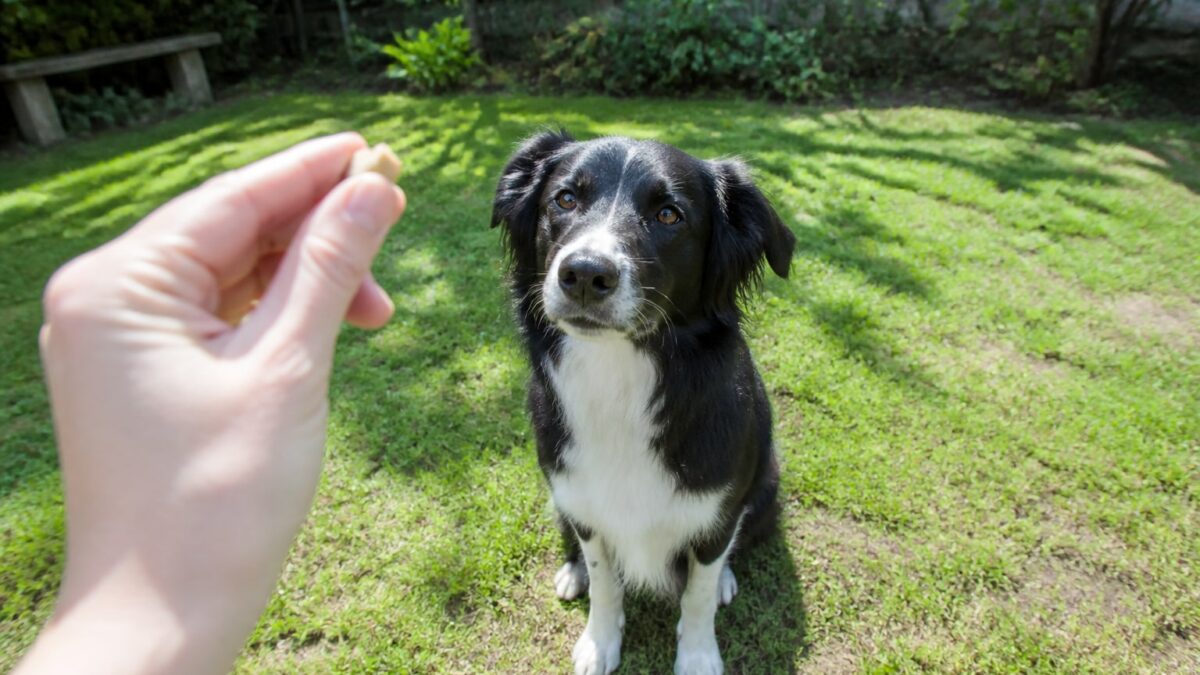
Teaching a dog tricks doesn’t depend on the animal’s temperament or its breed. It depends on the method. Positive reinforcement is today the home dog training technique most backed by ethologists and canine schools, because it builds learning without fear or pain. If you’re wondering how to teach your dog tricks step by step, here is the complete procedure, with timings, quantities, and mistakes to avoid from day one.
What is positive reinforcement
Positive reinforcement consists of adding something pleasant right after the dog does what you want, to increase the likelihood that it repeats that behavior. It isn’t about “rewarding just because”: the reward arrives at the exact moment the behavior occurs, never before.
This principle comes from the operant conditioning described by B. F. Skinner in the mid-20th century, and today it is the standard in positive dog training recommended by ethologist veterinarians. The difference from traditional methods is clear: there are no leash jerks or punishment collars, only well-administered pleasant consequences.
What is clicker training
Clicker training is a variant of positive reinforcement that uses a small mechanical device—the clicker—to mark the exact instant of the correct behavior. The sharp click sound is more precise than the human voice, because it always sounds the same and arrives without delay.
The basic process is simple:
- You click at the exact moment the dog performs the desired action.
- You deliver the reward within 1-2 seconds after the click.
- You repeat several times until the dog associates click with reward.
Once the dog understands that association, the click works as an instant “correct,” even at a distance or while moving.
What you need before starting
No sophisticated equipment is needed. This is enough:
- A clicker (optional but recommended) or a short word like “good!”.
- Training treats: small, soft, highly appetizing pieces (cooked chicken, low-salt cheese, chopped commercial treats).
- A quiet space, without noises or other pets around at first.
- Short sessions: between 5 and 10 minutes, two or three times a day.
The size of the reward matters: it should be small, roughly the size of a pea, so the dog eats it quickly and doesn’t lose concentration chewing.
How to teach your dog tricks step by step
For any trick to work, always follow this sequence:
- Choose a simple behavior (sit, give paw, lie down).
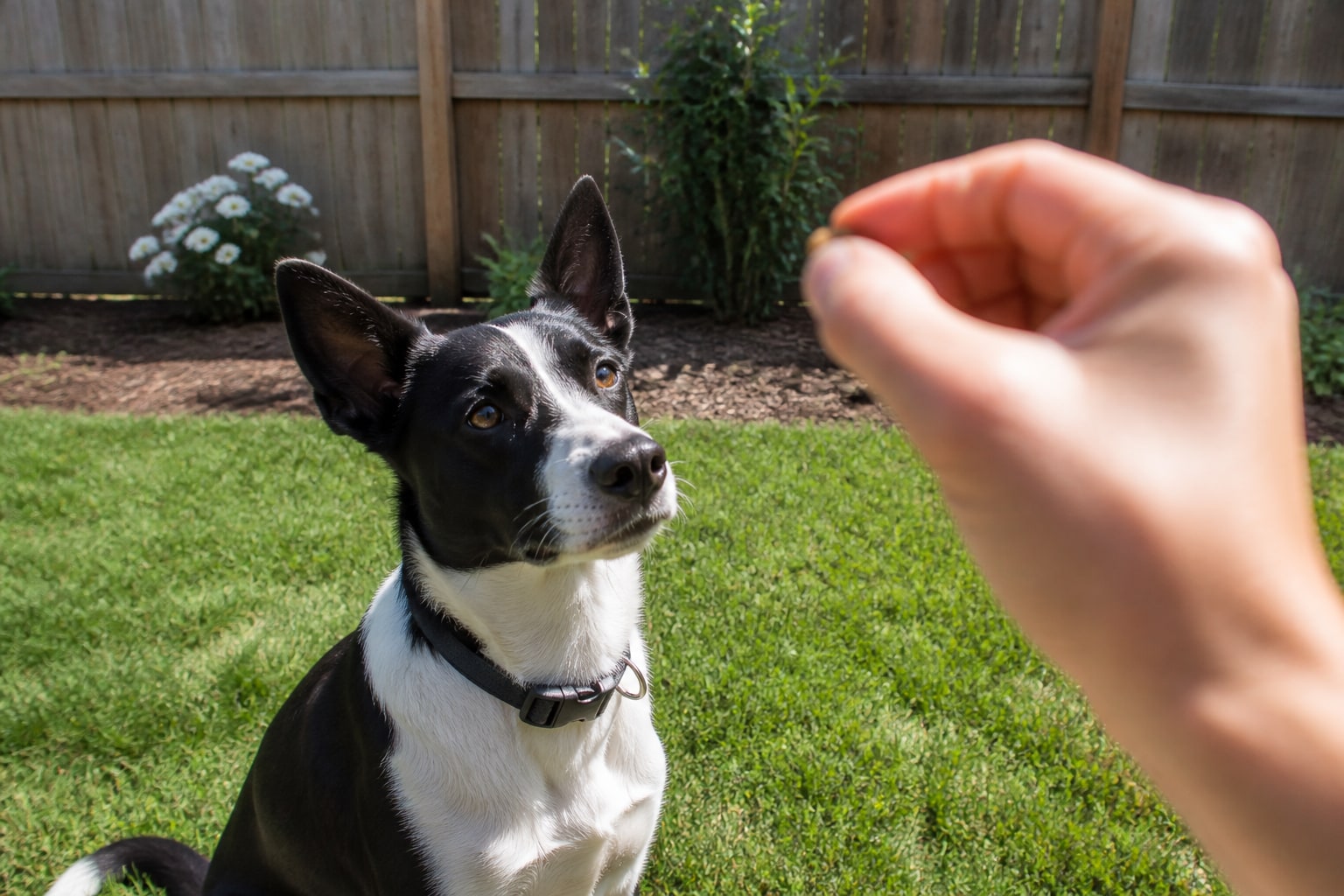
- Prompt the action with a gesture or by moving the treat near its nose (the “lure” or guiding technique).
- Mark the moment with the click or the keyword as soon as the dog performs the movement.
- Reward immediately, in less than 2 seconds.
- Repeat 8 to 10 times per session.
- Add the word for the trick (“sit”, “paw”) only when the dog already does it reliably, associating the verbal cue with the gesture.
- Gradually withdraw the physical treat, switching to intermittent reinforcement (rewarding only some of the time) once the trick is consolidated.
This order—action, mark, reward—is the foundation of any home dog training session, regardless of the trick you want to teach.
Basic tricks to start with
Some tricks are easier to start than others because they take advantage of the dog’s natural movements:
| Trick | Difficulty | Average learning time |
|---|---|---|
| Sit | Low | 2-4 sessions |
| Lie down | Low | 3-5 sessions |
| Give paw | Medium | 4-6 sessions |
| Stay | Medium | 1-2 weeks |
| Turn around | Medium-high | 1-2 weeks |
| Fetch an object | High | 3-4 weeks |
These times are approximate and vary according to the dog’s age, breed, and prior training experience.
Benefits of positive reinforcement in dogs
The benefits of positive reinforcement in dogs go beyond learning tricks. It strengthens the bond between the dog and the person training it, reduces stress associated with learning, and improves the animal’s ability to generalize commands in different contexts. It is also the recommended method for sensitive breeds or dogs with a history of anxiety, as often happens with the most affectionate dog breeds for families with children, where patience and consistency give better results than pressure.
Common mistakes when training with positive reinforcement
- Rewarding late: if more than 2-3 seconds pass, the dog doesn’t associate the reward with the correct action.
- Using unappealing treats that don’t motivate enough.
- Extending sessions beyond 10-15 minutes, which causes fatigue and loss of attention.
- Introducing the trick’s word before the behavior is consolidated.
- Training in environments with many distractions at the beginning of learning.
FAQ
How long does it take a dog to learn a basic trick? With short daily sessions, most dogs learn a simple trick like “sit” in 2 to 5 sessions. Complex tricks may require several weeks of constant practice.
Is the clicker essential? No. You can use a short word as a marker as long as you say it with the same tone and at the same instant. The clicker simply offers more precision because it is a constant sound.
Which treats work best? Soft, small, and strongly flavored foods usually work better than dry or large rewards, because they are eaten quickly and don’t interrupt the session.
Can positive reinforcement correct unwanted behaviors? Yes, though indirectly: the correct alternative behavior is rewarded instead of punishing the unwanted one. For persistent behavior problems, it is advisable to consult a canine educator or a veterinarian specialized in ethology.
At what age can you start training a puppy? From 8 weeks you can begin very basic exercises and short sessions, always adapted to its attention span, which at that age is very limited.
As an Amazon Associate, I earn from qualifying purchases.




0 comments · Comment