Ficus elastica: care for the rubber plant and how to make its leaves shine
Practical guide to caring for your Ficus elastica: light, watering, substrate and homemade tricks so that the leaves of your rubber plant look shiny and healthy all year round.
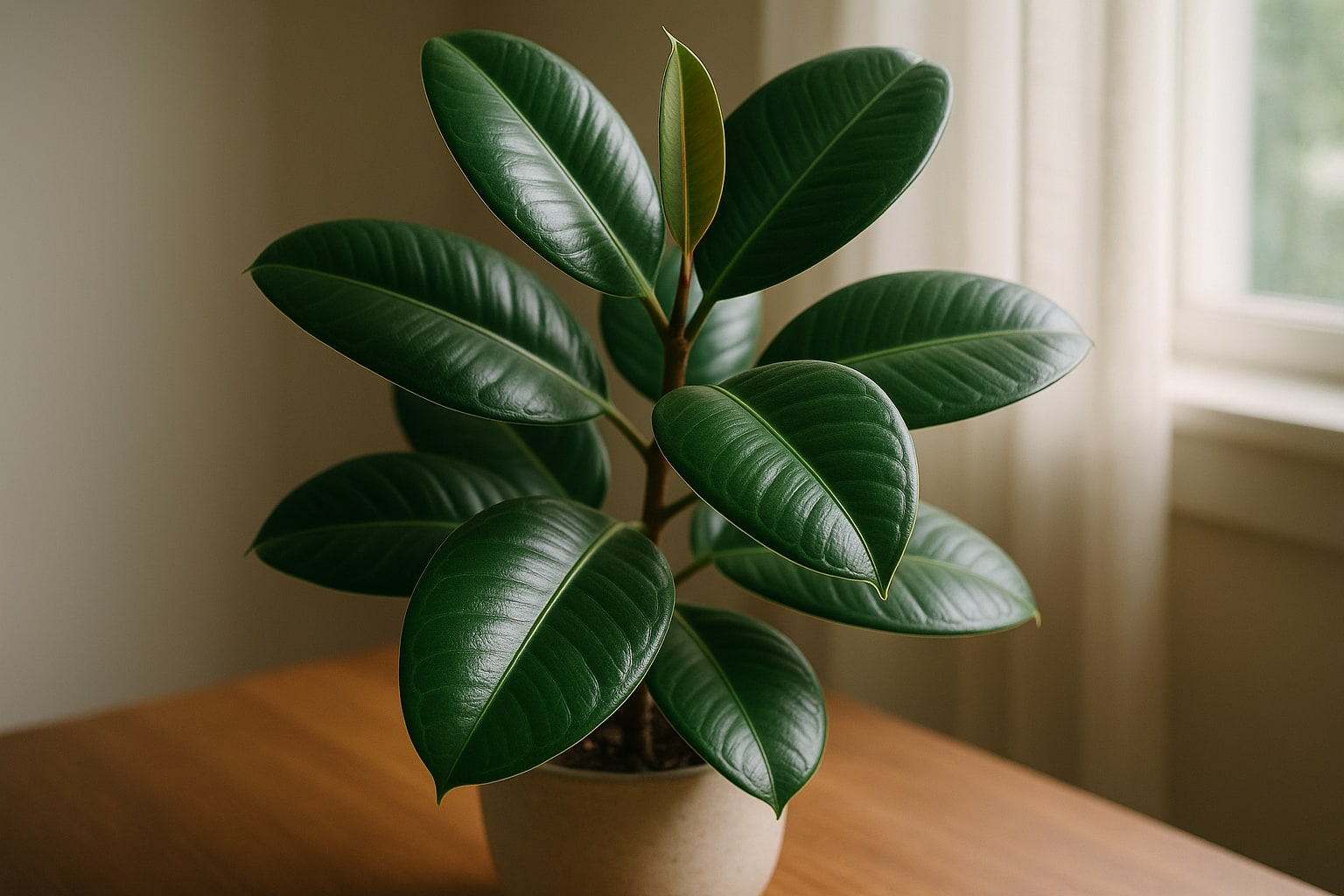
The rubber plant (Ficus elastica) is one of the most rewarding houseplants you can have at home. Its large, oval, deep green leaves—sometimes almost black or streaked with cream—have a sculptural presence that fills a room without demanding much in return.
Native to northeastern India, Nepal, Bhutan and Southeast Asia, in its natural habitat it can exceed 30 metres in height. In a pot it stays much more compact, but it keeps its character: vigorous growth, leathery leaves and a very distinctive milky sap.
A quick look at the Ficus elastica
It belongs to the Moraceae family, the same as the common fig. It is an evergreen tropical tree, with white latex in its stems and leaves, and a great ability to adapt to indoor life as long as you respect three things: light, moderate watering and temperature stability.
In nurseries you will find several varieties. The most common is ‘Robusta’, with very large green leaves. You will also see ‘Tineke’ and ‘Ruby’ (variegated in cream or pink) and ‘Burgundy’ or ‘Abidjan’, which are almost black.
Light: where to place it
It likes bright, indirect light. Near a window facing east, or a metre away from a south-facing window with a sheer curtain, is its ideal spot.
- Prolonged direct sun: burns the leaves, especially in the variegated varieties.
- Low light: it survives, but loses colour, stretches its internodes and stops producing new leaves.
- Variegated (‘Tineke’, ‘Ruby’): they need more light than the green ones to maintain their streaking.
A tip: if your hand does not cast a defined shadow at the height of the plant, there is too little light for it.
Watering the Ficus elastica
This is where most games are decided. Watering the rubber plant should be moderate and spaced out.
- Spring-summer: water when the first 2-3 cm of substrate are dry. This is usually every 7-10 days.
- Autumn-winter: space it out to every 15-20 days, depending on the heating.
- Amount: soak until water runs out of the drainage holes and empty the saucer after 10 minutes.
- Water: preferably at room temperature and, if possible, left standing for 24 hours so the chlorine can dissipate.
The classic sign of overwatering is yellow leaves falling from the bottom upwards. Underwatering shows as wilted leaves that regain their firmness after watering.
Substrate and repotting
It needs a loose, aerated substrate with good drainage. A mix that works very well is:
- 60% quality universal potting mix
- 20% perlite or coarse sand
- 20% coconut fibre or fine pine bark
The ideal pH is between 6.0 and 6.5. Repot every 2-3 years, in spring, into a pot only 2-3 cm wider. A pot that is too large retains moisture and rots the roots.
Temperature and humidity
It is comfortable between 18 and 27 °C. Below 12 °C it starts to suffer; cold draughts and sudden changes make it drop leaves.
The ideal ambient humidity is around 50-60%. In homes with dry central heating, a humidifier or misting the leaves once or twice a week with limescale-free water helps a lot.
How to make ficus leaves shine (without damaging them)
The leaves of the rubber plant collect dust easily, and this reduces photosynthesis. Polishing ficus leaves is not just cosmetic: keeping them clean improves their health.
Homemade methods that work:
- Damp cloth with lukewarm water: the basic and the best option. Support the leaf from underneath with one hand and gently wipe the upper surface with the cloth.
- Water with a few drops of lager beer (not dark beer): cleans and gives a discreet, natural shine. Apply with cotton wool and then wipe with a dry cloth.
- Milk diluted 50% with water: a nursery trick, gives a soft shine with no residue if applied in small amounts.
- Half a banana peel on the upper surface: leaves them gleaming thanks to the natural oils.
What NOT to use:
- Cooking oil, mayonnaise or petroleum jelly: they clog the stomata and suffocate the leaf.
- Commercial shine products with silicones: they give instant shine but build up residue and, over time, damage the tissue.
- Glass cleaners or alcohol-based products.
If you are interested in the same approach for other large-leaved plants, this guide to the Zamioculcas zamiifolia will be useful, as it shares many of the same care needs.
Pruning and sap
You can prune in spring to control height or encourage branching. Cut just above a node with clean scissors. White latex will come out: it is irritating to skin and mucous membranes, and toxic to dogs and cats if they chew it. Wear gloves and clean the cut with a damp cloth.
Pests of the Ficus elastica
The most common ones:
- Mealybugs: white cottony spots on the underside of the leaves and in the leaf axils. Remove with a cotton swab and 70% alcohol.
- Red spider mites: dry environments, fine webs and speckled leaves. Increase humidity and spray with water.
- Brown scale: brown shields attached to the midrib. Remove by hand and treat with potassium soap.
Check the underside of the leaves once a month. That is where almost everything begins.
Common mistakes when caring for an indoor ficus
- Watering on a fixed schedule without checking the soil.
- Moving it around constantly: it hates changes.
- A giant pot “so it grows more”. It appreciates a small one.
- Polishing it with oil. We insist: don’t.
- Ignoring cold draughts near windows in winter.
FAQ
How long does a Ficus elastica live indoors? With basic care it can exceed 15-20 years without problems, and there are centenarian specimens indoors with periodic repotting.
Is it toxic to dogs and cats? Yes. Its latex causes digestive and skin irritation. Keep it out of reach of pets and consult a vet if it has been ingested.
Why does it suddenly drop its leaves? It is almost always a sudden change: of location, temperature or watering. Return it to its previous conditions and wait 3-4 weeks.
Is the care for the ‘Robusta’ ficus different? The ficus robusta is the most common variety and also the most tolerant. Same care, somewhat less demanding about light than the variegated ones.
Can I propagate it? Yes, by 15 cm apical cutting in spring, with rooting hormone and moist substrate. Also by air layering, which is more reliable on large specimens.